
K-Reach: Decoding the Small World through Vertex Cover Indexing
K-Reach: Who is in Your Small World
This paper introduces K-Reach, an indexing scheme designed to solve the k-hop reachability problem in directed graphs (determining if a path exists from source to target within length ). Leveraging an approximate minimum vertex cover, it provides a significantly more efficient alternative to BFS and shortest-path indexes for both localized and global reachability tasks.
TL;DR
In modern networks, being "connected" is rarely enough—we care about being connected within k-hops (the sphere of influence). The paper "K-Reach: Who is in Your Small World" presents a breakthrough index based on Vertex Covers that answers k-hop queries thousands of times faster than BFS. Surprisingly, this specialized index also beats the best general reachability tools at their own game.
The Problem: The Abyss of Infinite Hops
Most graph research focuses on the binary question: Can A reach B? This is useful for circuit design but fails in social or sensor networks. If a sensor message takes 20 hops to arrive, it's likely lost or irrelevant.
The technical challenge is that k-hop reachability is harder than classic reachability:
- DAG-based methods fail: You can't condense SCCs (Strongly Connected Components) because a "shortcut" in a super-vertex might represent a path much longer than in the original graph.
- The "Lady Gaga" Effect: In social networks, a simple BFS from a high-degree vertex (a "celebrity") can touch a massive portion of the graph in just 3 hops, making online queries painfully slow.
- Distance Encoding: 2-hop labels usually store 0/1 bits. Storing exact distances for every pair is an nightmare for large graphs.
Methodology: The "Skeleton" of the Graph
The core insight of K-Reach is the Vertex Cover (VC). A vertex cover is a set of vertices such that every edge in the graph touches at least one vertex in the set.
1. The 2-Bit Trick
Instead of storing full integers for distances, K-Reach uses a clever 3-state weight system for edges between VC vertices:
- Weight (k-2): reaches in hops.
- Weight (k-1): reaches in hops.
- Weight (k): reaches in exactly hops.
This requires only 2 bits, allowing the index to remain extremely compact while provided enough "buffer" info to handle query vertices that aren't in the VC.
2. Architecture of a Query
When querying , the algorithm evaluates four cases based on whether the vertices are in the "Skeleton" (VC):
- Both in VC: Direct lookup in the index.
- One/None in VC: Check the immediate neighbors to find their "entry point" into the VC-skeleton. Because every edge is covered by the VC, a non-VC vertex must connect to the skeleton in exactly one hop.
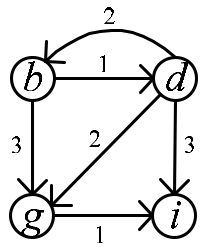 Figure: The k-reach graph representing the pre-computed skeleton.
Experiments: Speeding Past the State-of-the-Art
The authors tested K-Reach against heavyweight baselines like PTree, GRAIL, and PWAH across 15 real-world datasets (citation networks, XMLs, metabolic graphs).
Key Metrics:
- Query Speed: K-Reach achieved 106ms for 1 million queries on the YAGO dataset, while GRAIL took 116ms and PTree was slightly faster at 42ms. However, across the board, K-Reach was the most stable winner.
- Versatility: Against -BFS (BFS restricted to the median shortest path), K-Reach was three orders of magnitude faster.
 Table: K-Reach consistently ranks #1 in querying time compared to specialized reachability indexes.
Critical Perspective
Why does it work? K-Reach turns a graph exploration problem into a localized lookup. By ensuring that high-degree vertices (the ones that cause BFS "explosions") are prioritized for the Vertex Cover, the index "neutralizes" the hardest part of the graph.
Limitations:
- Index for Specific K: The standard K-Reach is optimized for a fixed . While the authors suggest building multiple indexes to handle general , this increases storage overhead.
- Scale: While efficient for millions of nodes, the index construction (requiring a -hop BFS from every VC vertex) might bottleneck on trillion-edge "web-scale" graphs without significant parallelization.
Conclusion
K-Reach is a masterclass in using classic graph theory (Vertex Covers) to solve modern indexing problems. It proves that by focusing on a small, strategic subset of the graph, we can answer complex distance-aware queries with the efficiency of a simple lookup.