
K-Source: Optimizing the Cost-Efficiency Trade-off in Mobile Data Offloading
K-Source: Multiple source selection for traffic offloading in mobile social networks
This paper introduces K-Source, a multiple source selection framework designed to optimize mobile traffic offloading in Mobile Social Networks (MSNs). By selecting an optimal subset of initial source nodes to receive data via cellular links and propagate it through cost-free peer-to-peer (D2D/Bluetooth) links, the method achieves superior efficiency in data dissemination.
TL;DR
With mobile data traffic exploding, cellular networks are under immense pressure. K-Source addresses this by intelligently selecting a handful of "initial sources" to download data via cellular links and then spread it for free via local peer-to-peer (D2D) connections. The core innovation lies in its ability to not only find who the best sources are but also how many sources are needed to balance speed against cost.
Background & Motivation
The proliferation of smartphones has turned Mobile Social Networks (MSNs) into data-hungry hubs. Cellular offloading—using Wi-Fi or opportunistic D2D communications—is the primary remedy. However, most research treats "diffusion time" as the only metric.
The authors argue that this is unrealistic. In a real-world deployment, every node that downloads data directly from a base station incurs a cost (). If you select too many sources, your costs skyrocket; if you select too few, the data spreads too slowly. Furthermore, community-based detection algorithms often fail in fluid, unstructured environments.
Methodology: The Core of K-Source
The researchers approach the problem as a Utility Optimization Problem.
1. Dual-Scenario Diffusion Estimation
Unlike previous models that treat all contacts equally, K-Source differentiates between:
- Dense Networks: Where frequent contacts lead to wireless collisions. Probability is calculated as the inverse of the sum of contact frequencies to account for interference.
- Sparse Networks: Where mobility is high and contacts are rare. Probability is directly proportional to contact frequency.
2. Heuristic Clustering (The K-Means Analogy)
To solve the NP-hard selection problem, the authors adapt a K-means strategy:
- Assignment: Nodes are assigned to the "nearest" source based on the shortest estimated diffusion path.
- Update: Within each cluster, a new source is selected that minimizes the maximum diffusion time to any node in that specific cluster.
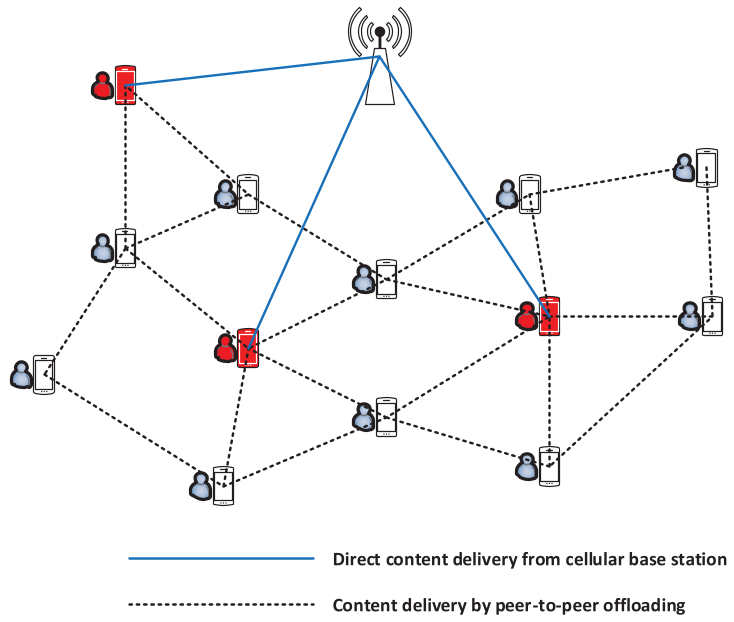 Fig 1: The hybrid cellular and MSN architecture where local P2P links complement the base station.
Experiments and Results
The authors tested the algorithm using both a synthetic Random Geometric Graph (RGG) for dense environments and the INFOCOM06 trace for sparse, real-world human mobility.
Key Findings:
- Efficiency: K-Source consistently outperformed random selection by over 10% in terms of diffusion speed.
- The Optimal K: The cost function curve (see Fig 4) successfully illustrates a "U-shape." As the number of sources () increases, the diffusion time drops, but the cellular cost rises. The K-Source algorithm pinpoints the trough of this curve.
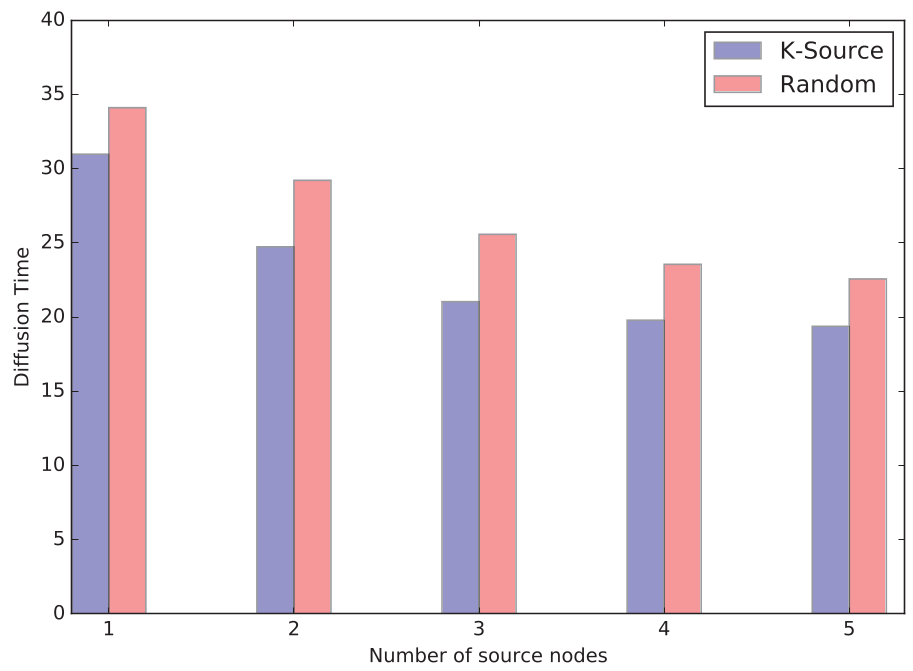 Fig 2: Comparison of K-Source vs. Random Selection in a dense network scenario.
Critical Analysis & Conclusion
While K-Source provides a robust framework for static or semi-static networks, its dependence on knowing contact frequencies beforehand might be a limitation in highly dynamic, unpredictable environments. However, its low computational complexity makes it highly suitable for real-time mobile applications compared to heavy community-detection methods.
Takeaway: The future of 5G/6G offloading isn't just about faster links, but about "Incentive-Aware" and "Cost-Aware" social distribution. K-Source provides the mathematical proof that finding the "turning point" in source numbers is just as important as finding the most influential users.