
K12-KGraph: Teaching LLMs the Missing Logic of Education
K12-KGraph: A Curriculum-Aligned Knowledge Graph for Benchmarking and Training Educational LLMs
The paper introduces K12-KGraph, a comprehensive, curriculum-aligned knowledge graph for Chinese K-12 education (Math, Physics, Chemistry, Biology) extracted from official textbooks. Leveraging this graph, the authors developed K12-Bench, a 23,640-question multi-select benchmark for "curriculum cognition," and K12-Train, an exceptionally sample-efficient SFT corpus that allows models to outperform much larger datasets in educational tasks.
TL;DR
Answering a test question is easy; understanding why that question is being asked is hard. Current LLMs excel at the former but fail at curriculum cognition—the structural understanding of how knowledge is organized. This paper introduces K12-KGraph, a massive knowledge graph derived from official Chinese textbooks, a new benchmark (K12-Bench) that exposes the failures of current SOTA models, and a training set (K12-Train) that proves structural data is 10x more efficient than raw volume for educational alignment.
The Problem: Knowledge Without Structure
Current benchmarks like GaokaoBench evaluate "Factual Recall." If you ask an LLM to solve a linear equation, it might succeed. But if you ask:
- "What are the direct prerequisites for understanding this concept?"
- "In which chapter does this experiment first appear?"
- "Which visual element in this diagram proves the law of conservation of mass?"
Most models—even frontiers like GPT-4o—struggle. They possess the what but lack the how and where of the curriculum. This "Curriculum Cognition" is the backbone of real human tutoring but is entirely missing from standard instruction-tuning datasets like OpenHermes or UltraChat.
Methodology: The Anatomy of K12-KGraph
The researchers built a heterogeneous property graph with a focus on two dimensions:
- Textual Curriculum Structure: Mapping nodes like Concept, Skill, Experiment, and Exercise via edges like
prerequisites_for,verifies, andappears_in. - Multimodal Grounding: Linking VisualElements in textbook figures directly to concepts.
The Construction Pipeline
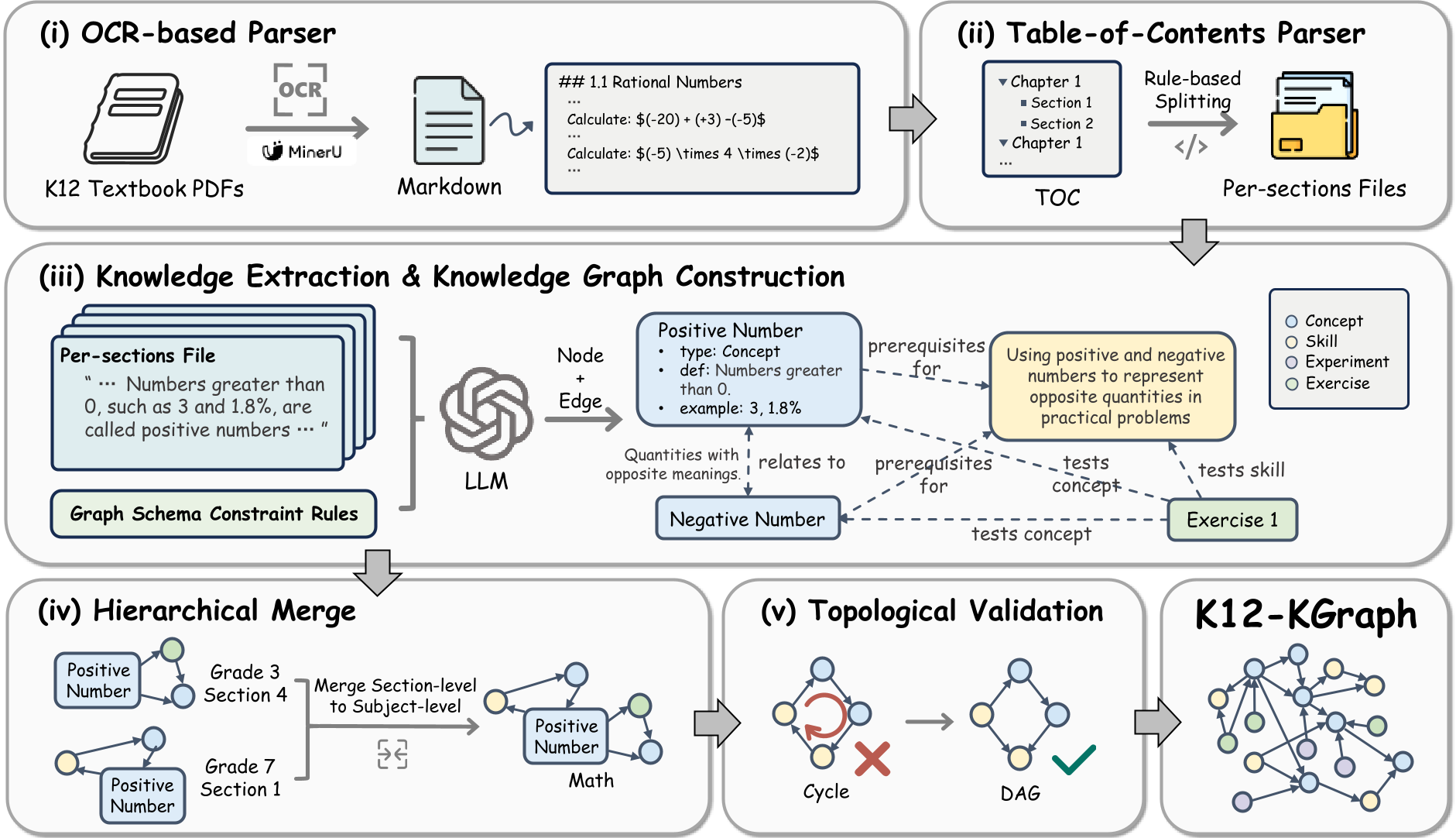 Figure 1: The 5-stage pipeline: OCR -> Segmentation -> LLM Extraction -> Hierarchical Merge -> Human-in-the-loop Validation.
By using a DAG (Directed Acyclic Graph) validation, the team ensured that the prerequisite chains were logically sound, preventing the "circular logic" often found in raw LLM outputs.
K12-Bench: A Reality Check for LLMs
The authors transformed the graph into a multi-select benchmark (23,640 items) targeting five task families: Ground, Prereq, Neighbor, Evidence, and Locate.
The results were humbling.
- Open-Source Gap: Llama-3-8B-Instruct scored near the Random Baseline (7.2% EM).
- Proprietary Ceiling: Gemini-3-Flash, the top performer, reached only 57.1%.
- The Hardest Tasks:
Prereq(Prerequisite Reasoning) andNeighbor(Related Concepts) proved to be the most difficult, showing that models don't truly understand the "topology" of knowledge.
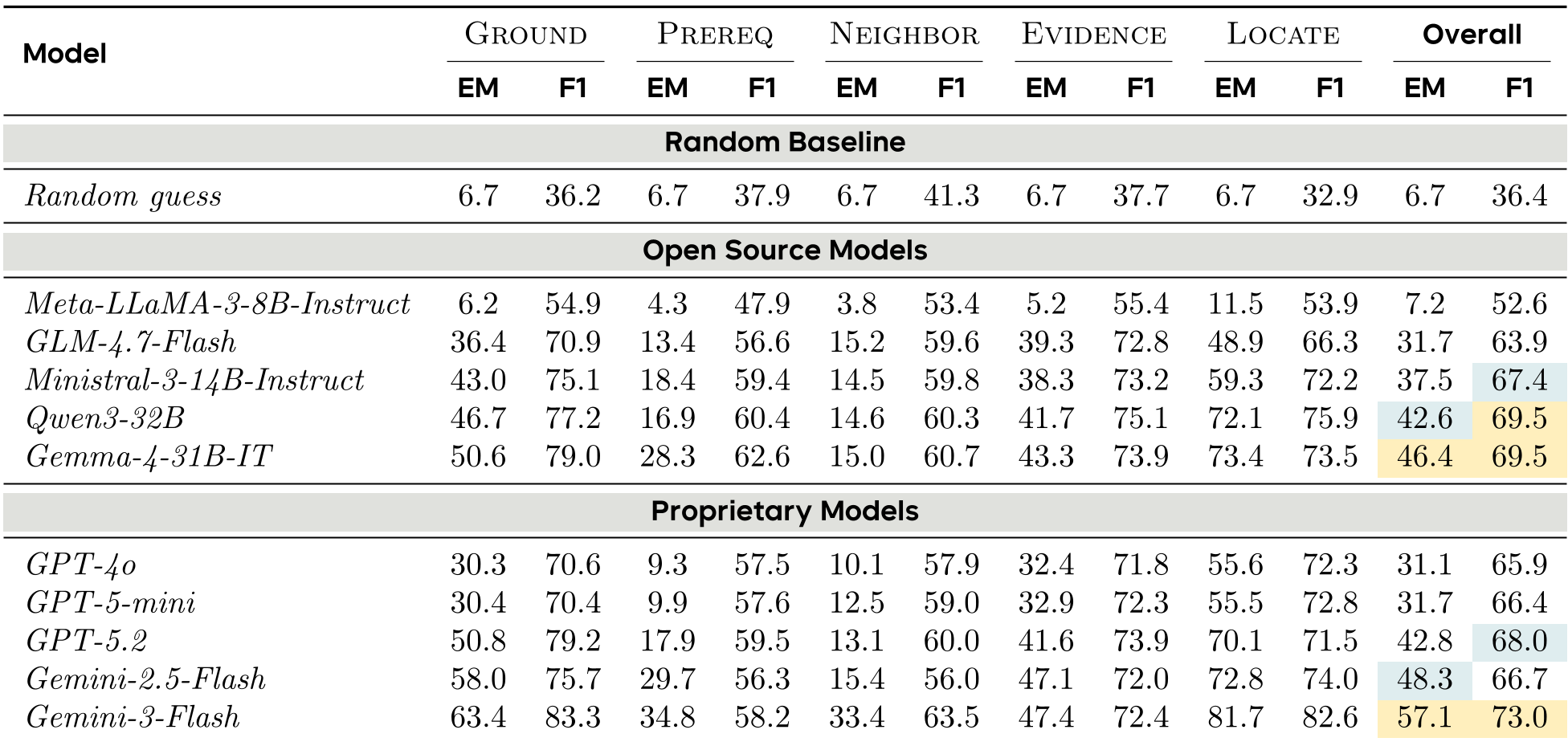 Table: K12-Bench results showing that even powerful models fail to reach 60% accuracy in structural reasoning.
K12-Train: Quality Over Quantity
The most striking discovery of this paper is the sample efficiency of KG-guided data. The researchers synthesized ~7,300 samples (K12-Train).
When compared against massive datasets like WizardLM (140k+ samples) or DataFlow, the tiny K12-Train consistently won. Specifically:
- In NLP: Under a controlled 2,300-sample budget, K12-Train-Text outperformed 8 mainstream corpora on GaokaoBench.
- In Vision (VLMs): K12-Train-Full (combining text and multimodal data) surpassed the base Qwen3.5-2B model and all other SFT baselines on multimodal tasks like K12Vista.
Why does it work?
The authors hypothesize two reasons:
- Structural Grounding: Each QA pair teaches a relationship, not just a fact.
- Pedagogical Transfer: Training on the structure of Science (Math/Physics) actually improved scores in Humanities (History/Geography), suggesting the model learned a "structurally-grounded answer style" that is universal.
Critical Analysis & Conclusion
Takeaway
K12-KGraph shifts the focus from "scaling laws" (more data) to "structural laws" (better organization). It proves that a model's educational utility isn't just about how much it knows, but how well it understands the connective tissue of that knowledge.
Limitations
While the graph is robust for Chinese curricula (PEP textbooks), its direct applicability to other international curricula (like IB or AP) remains to be tested. Furthermore, while it improves MCQ performance, its impact on long-form tutoring dialogue is still an open question.
Future Outlook
This work paves the way for "Pedagogical Alignment"—a new stage of post-training where models aren't just aligned to follow instructions, but to follow the logical progression of human learning.