
Kalema: Gamifying Arabic Digitization to Bridge the Accessibility Gap
Kalema: Digitizing Arabic Content for Accessibility Purposes Using Crowdsourcing
Kalema is a Gamified Crowdsourcing (GWAP) system designed to digitize scanned Arabic documents for the visually impaired. By transforming the "tedious" task of text transcription into a competitive "falling word" game, it achieves high-accuracy Arabic digitization where traditional OCR systems fail.
TL;DR
For the millions of visually impaired Arabic speakers, digital content is a scarce resource. Kalema is an innovative platform that bypasses the high error rates of standard Arabic OCR by turning document transcription into a "Game With A Purpose" (GWAP). By engaging the crowd in a fun, social-competitive game, it achieves over 90% accuracy in digitizing complex Arabic texts that machines simply cannot read reliably.
Background & Positioning
In the landscape of document processing, Arabic remains one of the "hard" languages. Unlike English, Arabic is inherently cursive (connected) and uses dots and diacritics that change word meanings entirely. While Tesseract and ABBYY are industry standards for OCR, their performance on diacritized Arabic is often incomprehensible. Kalema positions itself as a Human Computation solution, leveraging the superior pattern recognition of native speakers to solve what remains a computational bottleneck.
The Core Challenge: Why Arabic OCR Fails
The authors identify two primary failures in existing systems:
- Script Complexity: The connected nature of Arabic calligraphy makes character segmentation extremely difficult.
- Visual Noise: Aging documents and the presence of diacritics (small signs above/below letters) confuse traditional geometric OCR algorithms.
Current manual volunteer efforts are slow and "boring." Kalema's insight is to replace the chore of "transcription" with the thrill of "gaming."
Methodology: Gaming the System
The Kalema architecture is divided into three distinct modules:
1. Segmentation via Tesseract
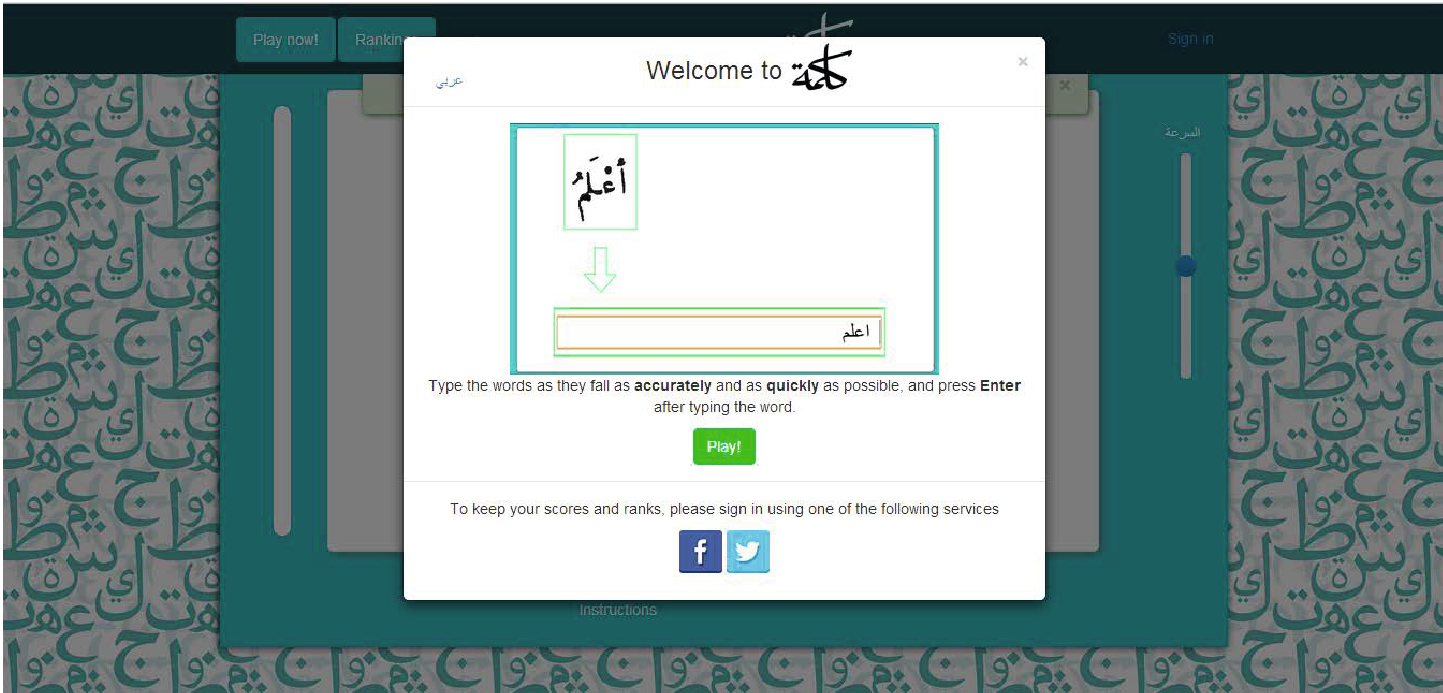
Ironically, the system uses Tesseract not for recognition, but for segmentation. The admin uploads a page, and Tesseract identifies the coordinates of individual words, cropping them into discrete images.

2. The GWAP Mechanic
The game features falling word images. Players must type the word before it hits the bottom. To ensure engagement:
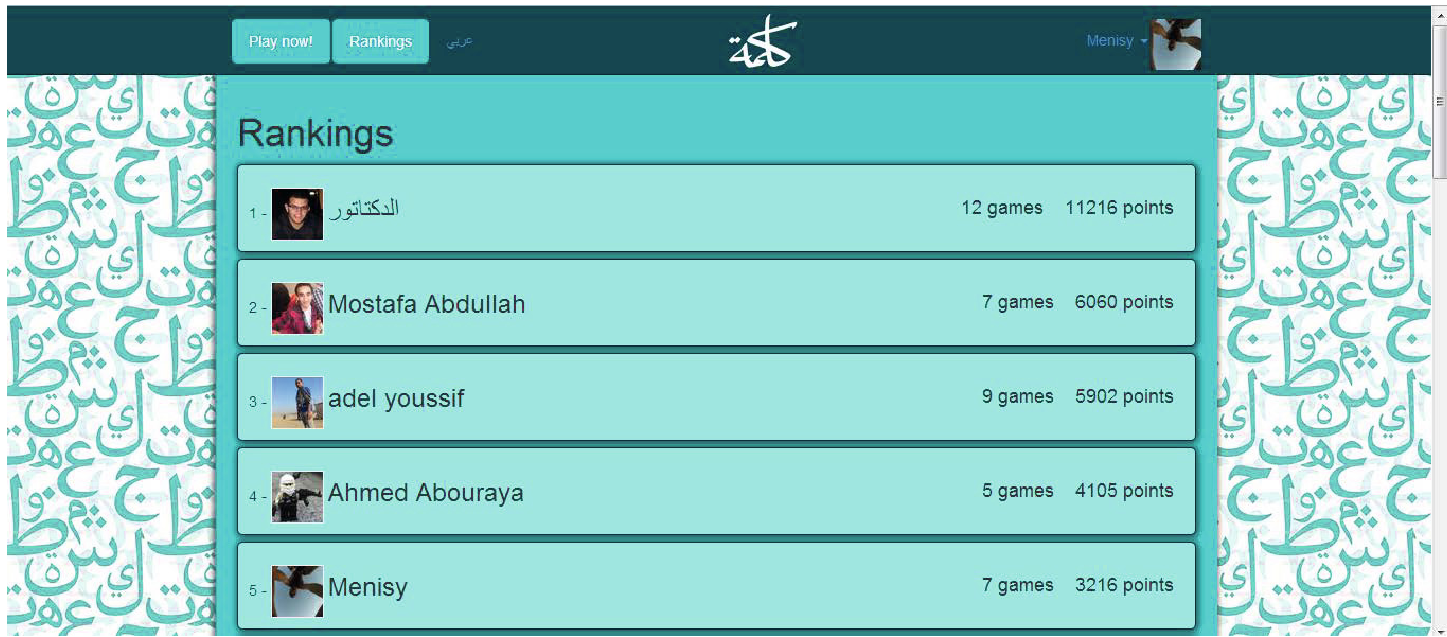
- Social Integration: Facebook and Twitter logins allow for leaderboards and "challenging" friends.
- Dynamic Difficulty: A slider allows users to control the speed of falling words.
3. Smart Validation Algorithm
To prevent spam or low-quality input, Kalema uses a two-tier validation approach:
- Gold Standard Testing: Randomly inserting pre-validated words. If a user fails to type these accurately (60% threshold), their entire session's data is discarded.
- Consensus through Levenshtein Distance: The system calculates the edit distance between different users' inputs for the same word. Scores increase when users agree. Eventually, a "consensus" string emerges as the ground truth.
Performance Benchmarks
Despite a brief 4-day testing window, the results were statistically significant:
- Volume: 448 games played, resulting in nearly 11,000 word guesses.
- Efficiency: An average of 2.32 guesses was sufficient to verify a word.
- Accuracy: Reached up to 90% for digitized content.
Critical Insight & Future Outlook
The success of Kalema highlights an important trend in AI: Human-in-the-loop (HITL). When the cost of machine error is high (as it is for Braille or audio conversion for the blind), crowdsourcing provides a necessary safety net.
Limitations: The current iteration relies on modern scans. Dealing with ancient manuscripts or complex artistic calligraphy would likely require more specialized game modes.
Future Work: The authors propose a "Validation Game"—a simpler binary choice (Does this text match the image?)—which would be even faster for users and could serve as a secondary verification layer. Kalema proves that with the right incentive structure, the "tedious" work of digitizing history can become a community-driven achievement.