
Karamad: Bridging the Digital Divide via Voice-Based Crowdsourcing
Karamad: A Voice-based Crowdsourcing Platform for Underserved Populations
Karamad is a voice-based crowdsourcing platform designed for underserved populations (low-literate, visually impaired, and under-connected) who lack internet or smartphone access. Using an Interactive Voice Response (IVR) system on feature phones, it enables tasks like surveys and speech corpus collection, achieving organic growth to 725 workers who completed over 3,900 tasks during a 6-month deployment in Pakistan.
TL;DR
While the global gig economy booms, billions are left behind due to the "digital barrier"—a lack of smartphones, internet, and literacy. Karamad is a groundbreaking IVR (Interactive Voice Response) platform that turns basic feature phones into income-generating tools. By allowing users to complete surveys and record speech data via a simple phone call, Karamad successfully engaged hundreds of visually impaired and unemployed workers in Pakistan, proving that the "unconnected" can be a high-quality, reliable workforce.
Contextualizing the Problem: The Great Exclusion
Mainstream platforms like Amazon Mechanical Turk are built on a "privilege stack": you need a PC, high-speed internet, and academic-level English. This leaves out nearly 46.4% of the world's population. Previous research in "HCI for Development" (HCI4D) tried to bridge this gap, but often relied on expensive airtime subsidies or complex smartphone apps.
The authors of Karamad identified a unique insight: Underserved populations—specifically the blind and the low-literate—already form dense offline social networks. If a platform can provide a trustworthy way to earn income without requiring high-tech hardware, these networks will drive organic growth.
Methodology: High-Tech Backend for Low-Tech Frontend
Karamad’s architecture is a masterclass in inclusive design. It balances technical constraints with user-centric safeguards:
- Zero-Cost Eligibility Screening: Using Early Media, Karamad informs users if tasks are available before the call is officially "answered." This prevents the tragedy of a poor worker spending their last airtime credits only to find no work available.
- Interaction Modality: Avoiding complex multi-digit inputs, Karamad uses binary (Yes/No) and Multiple Choice Questions (MCQ) segmented into ranges.
- The Payment Gateway: Since PayPal or Stripe don't work for this demographic, the team automated airtime top-ups (mobile credit) as a liquid form of currency.
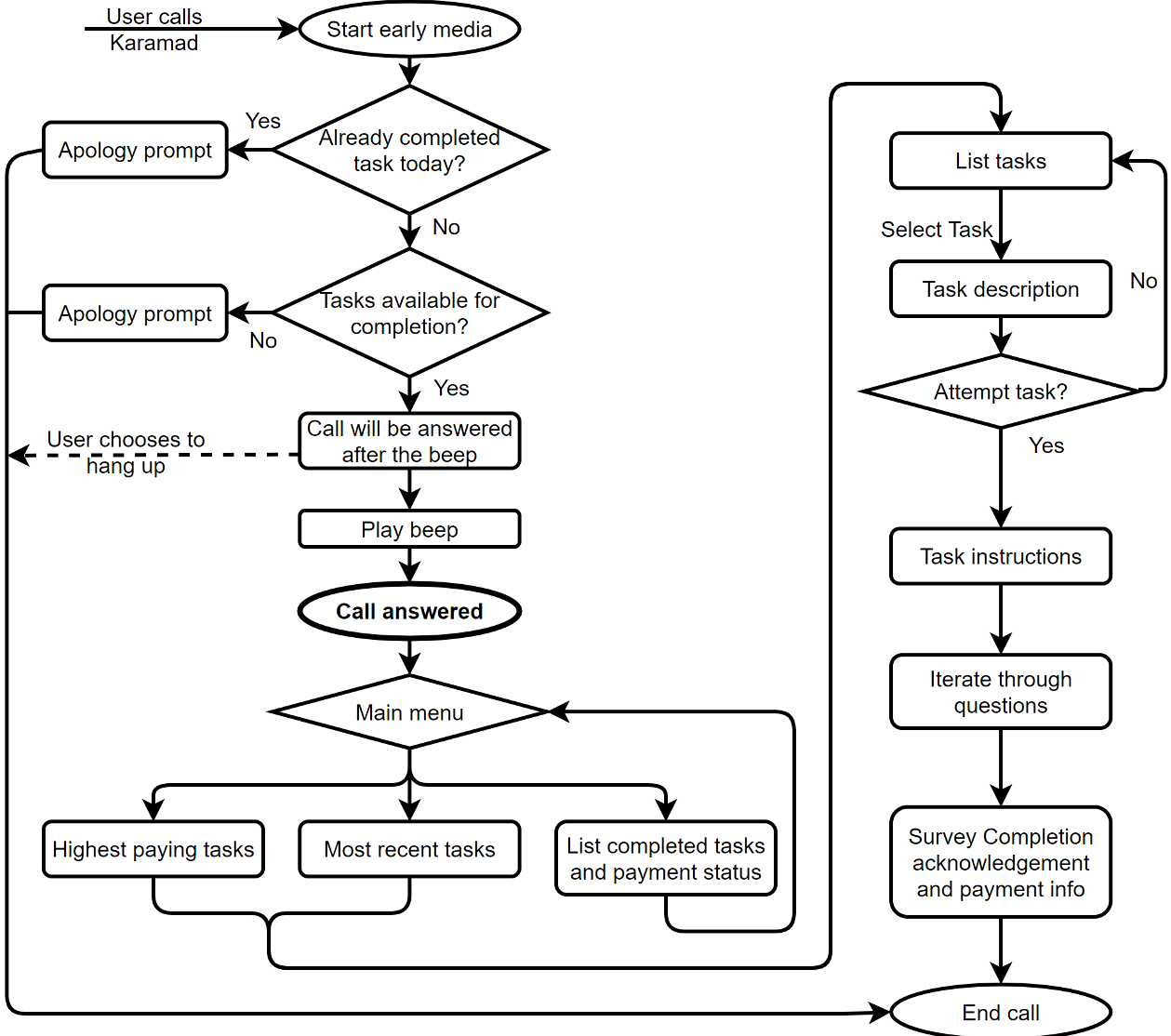 The worker-facing IVR flow highlights the critical use of early media to protect worker finances.
Experimental Results: Sustained, Organic Success
The 6-month deployment in Pakistan revealed several profound insights:
- The Power of Word-of-Mouth: Without a single dollar spent on advertising, the service reached nearly 1,000 users. The blind community, in particular, acted as "nodes" of information, spreading the service across provinces.
- Financial Viability: Users spent roughly $0.68 of their own airtime to earn significantly larger rewards. The average net income per worker was PKR 490—a meaningful supplement for those with zero previous income.
- Data Reliability: Despite concerns about low-resource workers' "unreliability," Karamad found a 91.9% consistency rate in open-ended audio location questions and high reliability in binary tasks.
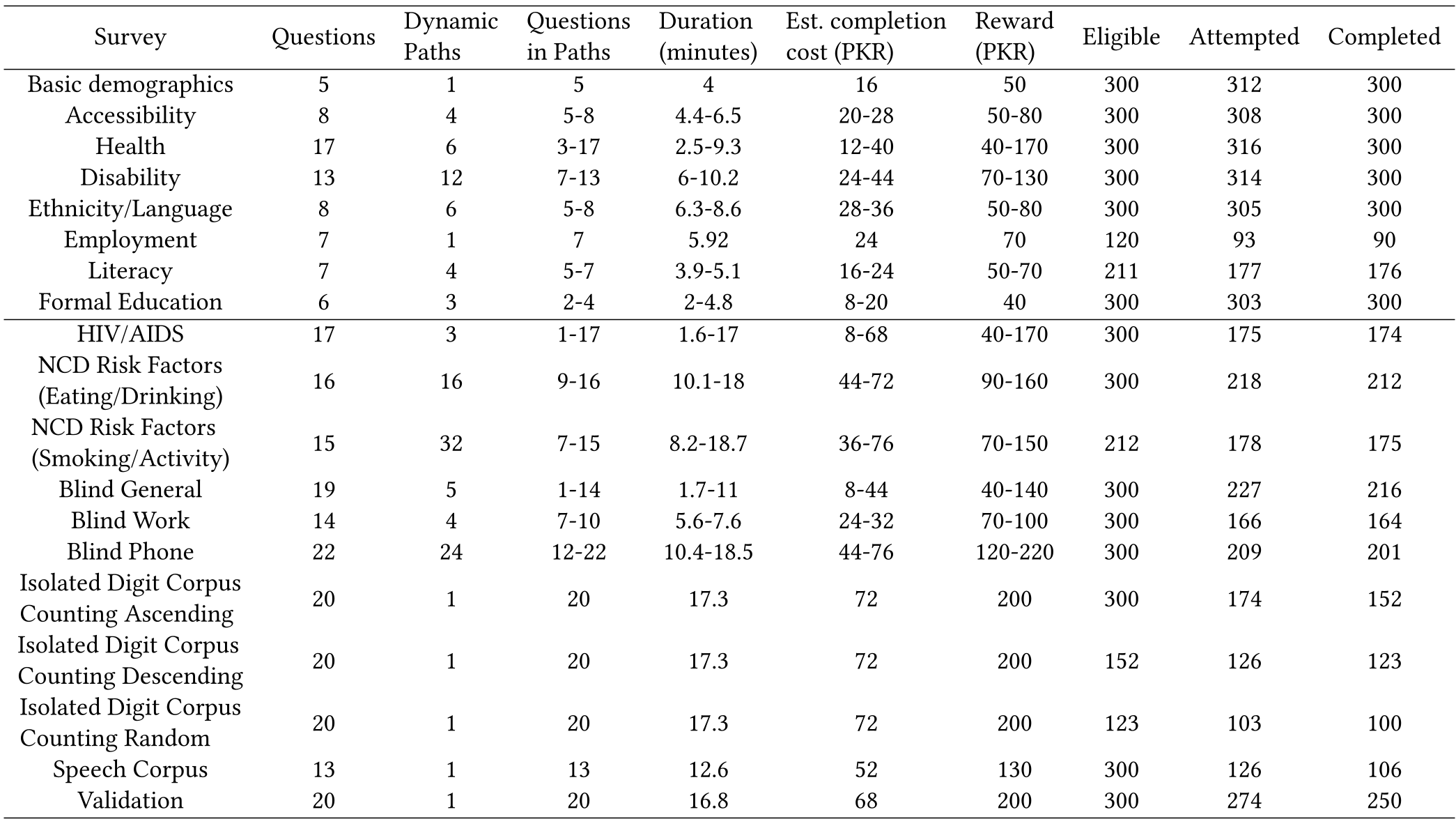 A breakdown of the 19 tasks deployed, ranging from health surveys to isolated digit corpus collection.
Critical Insight: Beyond the Money
The most moving finding of the paper is qualitative. For many respondents—especially women and the visually impaired—Karamad wasn't just about the money; it was about independence. One female worker noted that the top-ups meant she no longer had to ask her brothers for mobile credit.
The platform also highlighted a "Privacy Paradox." Users were more willing to discuss sensitive health topics (HIV, non-communicable diseases) with the machine-driven Karamad IVR than with a human interviewer, due to perceived anonymity.
Limitations and Future Outlook
While successful, Karamad faces "Sybil Attack" risks—users calling from multiple SIM cards to bypass limits. Future iterations suggest using National ID numbers for registration. Additionally, the move from airtime top-ups to mobile wallets (like Easypaisa) is the logical next step for true financial inclusion.
Conclusion: Karamad proves that voice is not just a secondary interface; for billions, it is the only interface. By designing for the most constrained users, we can build platforms that are more robust, ethical, and truly global.