
KEA System: Bridging Mathematical NLP and Social Intelligence
Knowledge Base Concepts in the KEA System Combined with Social Networking Techniques
The paper introduces the KEA system, a semi-automated knowledge management framework for mathematical and natural scientific texts. It combines Natural Language Processing (NLP) to extract semantic triples (RDF/OWL) with Social Networking techniques (tagging and profiling) to manage information flood and refine database structures.
TL;DR
The KEA system is a hybrid knowledge management framework designed to tackle the unique challenges of mathematical texts. It utilizes deep Natural Language Processing (NLP) to extract semantic relationships and employs Social Networking techniques (tagging, user tracking, and FOAF profiles) to filter, rank, and personalize the resulting "information flood."
The Problem: The Mathematical Information Flood
Mathematical language is uniquely dense. Unlike general prose, it is characterized by:
- Axiomatic Complexity: Every sentence carries significant logical weight.
- Low Redundancy: Traditional keyword-based retrieval fails to capture the subtle dependencies between definitions, theorems, and proofs.
- Integration Challenges: Merging knowledge bases from different authors often leads to semantic contradictions that automated systems cannot resolve without human intuition.
Methodology: A Multi-Layered Semantic Architecture
The KEA system addresses these challenges through a specialized pipeline that separates explicit data extraction from human-driven refinement.
1. The NLP Subsystem (mArachna)
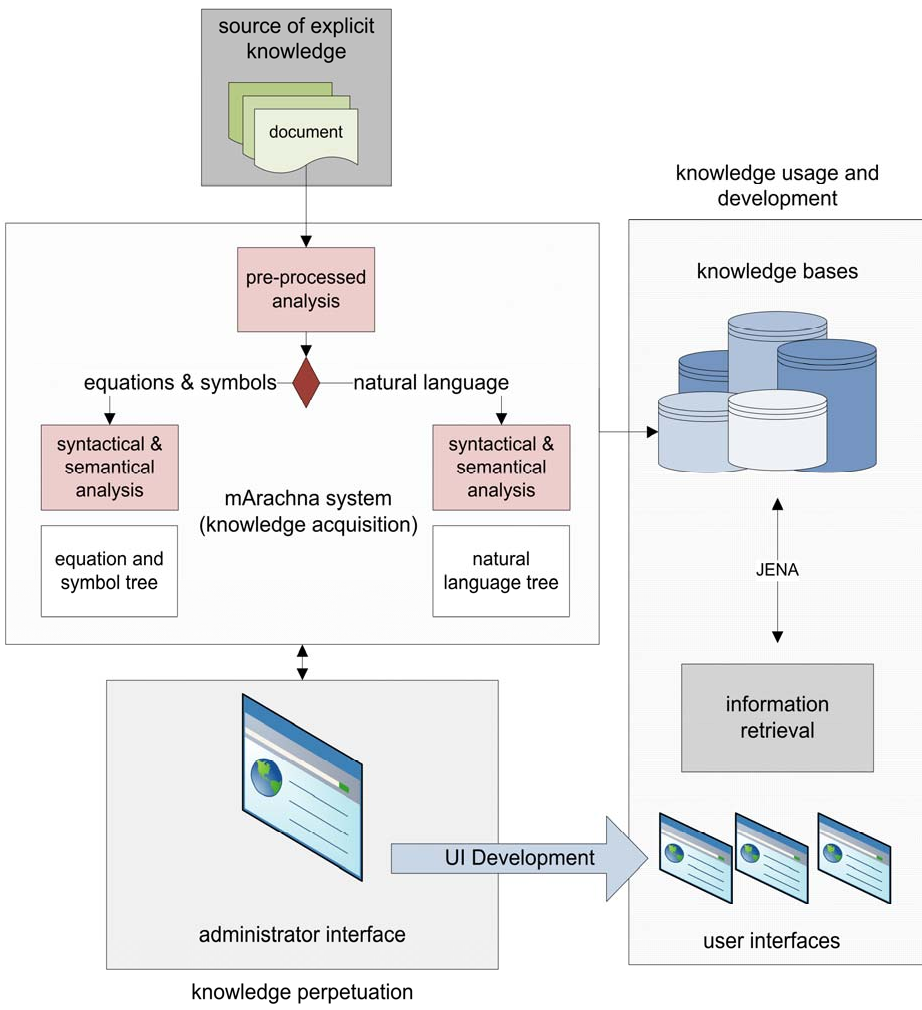
CEA uses the mArachna system to perform syntactic and semantic analysis of scientific texts.
- It treats mathematical symbols and equations as distinct entities.
- It generates OWL (Web Ontology Language) triples, creating a complex semantic network of nodes (terms/phrases) and associations.
2. Multi-Level Knowledge Bases
The knowledge is organized into a hierarchy to facilitate easier merging and retrieval:
- Level 1 (Fine-grained): Words and symbols.
- Level 2 (Collocations): Correlative fragments within sentences.
- Level 3 (Entities): Definitions, theorems, and propositions.
- Level 4 (Axiomatic Structure): The logical map of the entire text.
The "Social" Fix: Human Behavior as a Ranking Signal
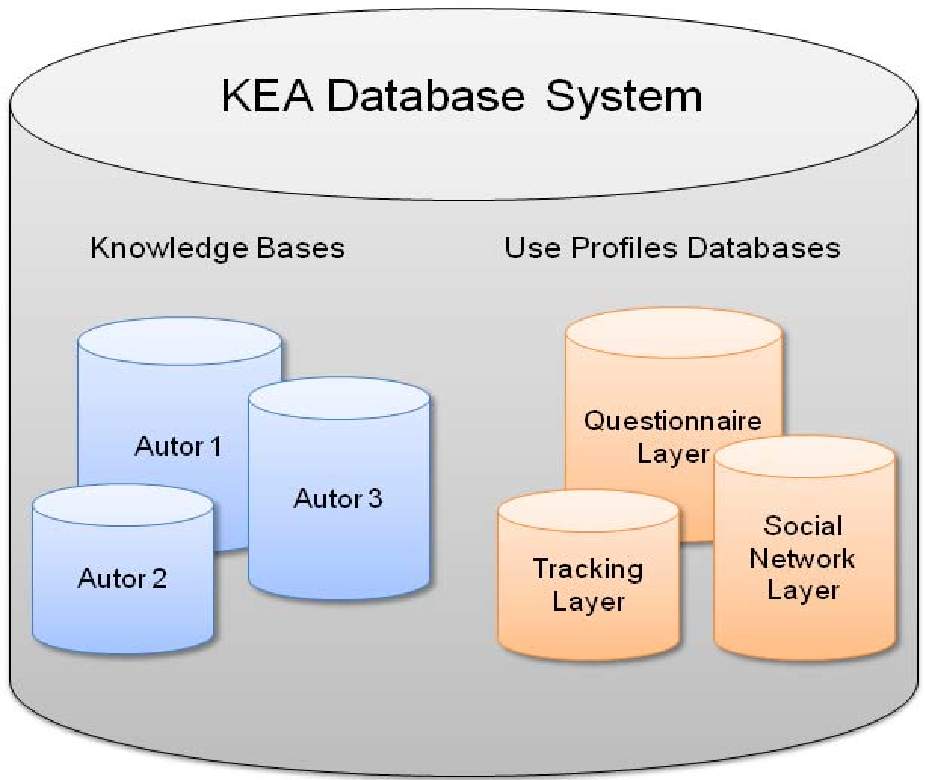
Perhaps the most innovative aspect of KEA is the use of Social Networking layers to solve the "merging problem." Instead of relying solely on algorithms to resolve inconsistencies, KEA tracks:
- The Tracking Layer: High-use fragments get higher "page rankings."
- Social Bookmarking: Users tag equations or text fragments, providing an intuitive importance score that automation misses.
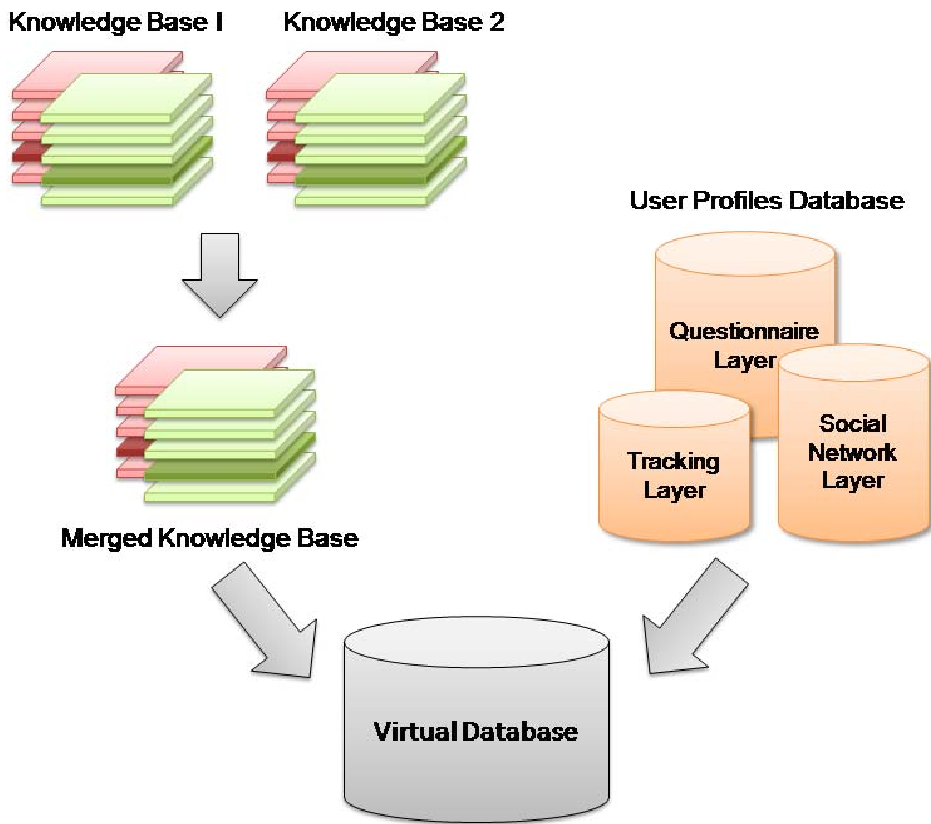
- User Profiles (FOAF): By building profiles based on user expertise and interests, the system "virtualizes" the database—showing only the relevant context for a specific user (e.g., an engineer vs. a math PhD).
Experiments and Results: Virtual Databases
By dissolving linguistic layers during the merging process and applying user-driven rankings, KEA creates Virtual Databases. These are essentially customized views of the massive global knowledge base.
- Standardization: Uses RDF/OWL and FOAF to ensure interoperability.
- Dynamic Adaptation: The length of stay and frequency of visits on specific information fragments determine their visibility in future queries.
Critical Insight & Conclusion
The authors acknowledge a fundamental truth in AI: while computers are excellent at managing Explicit Knowledge (storing triples), they cannot yet impart Implicit Knowledge (the ability to draw new logical conclusions from math).
Key Takeaways:
- Human-in-the-Loop: Social tagging isn't just for social media; it’s a vital metadata tool for scientific accuracy.
- Personalization is Key: "One size fits all" knowledge bases fail in mathematics; specialized roles require specialized views.
Future Outlook: The KEA system serves as a bridge for the "Semantic Web." Looking forward, integrating these structured ontologies with modern generative AI could potentially bridge the gap between explicit text retrieval and implicit logical reasoning.