
Keep Your Friends Close: Why Social Trust is the Missing Link in Sybil Defenses
Keep your friends close: Incorporating trust into social network-based Sybil defenses
The paper introduces trust-aware random walk models—including lazy, originator-biased, and interaction-based walks—to enhance social network-based Sybil defenses like SybilLimit. It demonstrates that integrating differential trust significantly impacts graph mixing times, providing a more realistic evaluation of security in diverse social structures.
TL;DR
Social network-based Sybil defenses traditionally treat every "friendship" edge as equal. This paper argues that this is a dangerous oversimplification. By introducing Trust-Biased Random Walks, the authors show that "meaningful" social networks (like academic collaborations) actually mix much slower than superficial ones (like Facebook), demanding a complete rethink of how we configure Sybil-resistant systems.
Background Positioning: The Algorithmic vs. Sociological Gap
In the decentralized world, a Sybil attack—where one attacker creates thousands of fake identities—is a structural nightmare. SOTA defenses like SybilLimit and SybilGuard rely on two pillars:
- The Algorithmic Assumption: There is a "sparse cut" between honest and Sybil nodes.
- The Sociological Assumption: Social edges represent real-world trust.
While researchers have obsessed over the math of the sparse cut, they ignored the variability of the trust itself. This paper fills that gap, positioning itself as a bridge between graph theory and social reality.
The Core Problem: Not All Edges Are Created Equal
Why do uniform random walks fail? Previous works assumed that social graphs are "fast mixing." However, the authors observed an inverse relationship: The higher the trust in a graph, the slower it mixes.
- In Facebook: You might add a stranger; the graph is dense and "expands" quickly.
- In Co-authorship: You only link with people you know; the graph is clumpy and has tight communities.
Using traditional uniform walks on high-trust graphs leads to underestimating the required walk length (), causing honest nodes to be rejected because the walk hasn't "spread" far enough to satisfy the verification criteria.
Methodology: Engineering Trust into the Walk
The authors propose four primary designs to "bias" the walk, forcing the mathematics to respect social boundaries.
1. Lazy Random Walks
Nodes have a probability of staying put. This models "self-trust"—the idea that you are the most reliable person in your network.
P' = αI + (1 - α)P
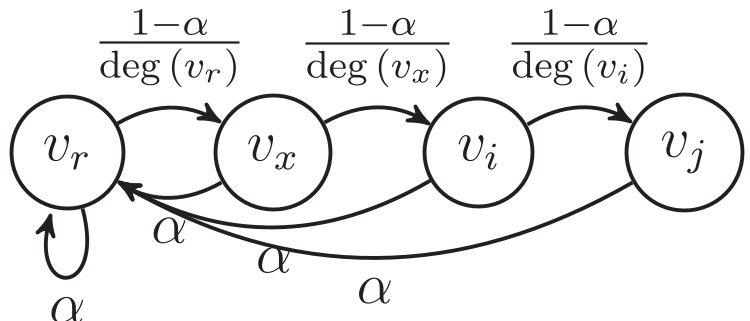
2. Originator-Biased Walks
The walk has a tendency to "gravitate" back to the starting node. This is a powerful way to keep the walk within the initiator's trusted "social neighborhood."
3. Interaction & Similarity Biasing
Instead of 0/1 edges, edges are weighted by:
- Interaction: Frequency of communication.
- Similarity: The Cosine similarity of neighbor sets (Jaccard-like metrics).
Experiments: The Cost of Trust
The authors tested these models across 13 real-world datasets, ranging from DBLP to YouTube.
Key Insight: The Mixing Time Paradox
In Figure 3 of the paper, we see that to reach a total variation distance of (required for 99% admission in SybilLimit), uniform walks need significantly more steps than previously thought.
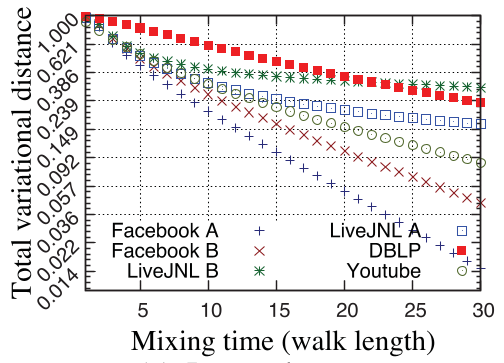
Key Takeaways from the Data:
- Facebook/Wiki-vote: Extremely fast mixing. Very easy for Sybils to infiltrate if trust isn't modeled.
- Physics/DBLP: Slow mixing. These require or more to be effective, contradicting the often cited in early Sybil defense papers.
SybilLimit Performance
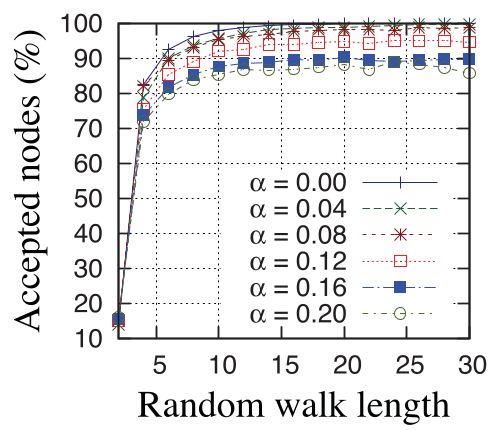
When the authors applied their Originator-biased walks to SybilLimit, they found that even a small bias () drastically impacts the "Admission Rate." This proves that defenders can use these parameters as a "knob" to tune security: higher means tighter security but requires longer walks for honest users.
Conclusion and Outlook
This paper is a sobering reminder that topological properties are not a substitute for human context.
Takeaways:
- If you are building a Sybil defense for a high-interaction platform (like a DAO), Interaction-biased walks are your best friend.
- The "ideal" walk length is not a constant; it is a function of the network's social density.
- Limitation: The current model uses a global . Future work should look at node-specific trust, where your most "loyal" friends have higher weights than casual acquaintances.
By "keeping your friends close" through biased math, we can finally build decentralized systems that are as resilient as our real-world social circles.