
Kernel Methods Meet the Exponential Family: A Unified Theory for Machine Learning
Kernel methods and the exponential family
This paper establishes a unified theoretical framework linking kernel-based learning (e.g., SVM, Kernel Logistic Regression) with the statistical exponential family. By embedding exponential families into Reproducing Kernel Hilbert Spaces (RKHS), the authors derive classical and novel algorithms, notably providing a statistical optimality proof for one-class SVM novelty detection.
TL;DR
This seminal paper bridges the gap between the functional elegance of Kernel Methods (like SVM) and the statistical rigor of Exponential Families. By treating the kernel map as a sufficient statistic in a nonparametric density model, the authors provide a probabilistic foundation for popular algorithms and derive new, convex formulations for heteroscedastic regression and novelty detection.
Background: Two Worlds Collide
For years, Support Vector Machines (SVMs) were the darlings of machine learning due to their "Maximum Margin" intuition and the "Kernel Trick." However, purist statisticians often viewed them as black-box functional estimators. Conversely, the Exponential Family (including Gaussian, Poisson, and Binomial distributions) provided the backbone of classical statistics but was often limited by rigid parametric assumptions.
The authors ask: What if the natural parameters of an exponential family lived in a Reproducing Kernel Hilbert Space (RKHS)?
The Motivation: Why Unify?
Prior to this work:
- SVMs lacked a natural way to output probabilities.
- Kernel Logistic Regression felt like a disparate "probabilistic version" of SVM.
- Novelty Detection (One-class SVM) was largely seen as a geometric heuristic rather than a formal statistical test.
The unifying insight is that by defining the probability density as: ...virtually all kernel algorithms emerge as special cases of Maximum A Posteriori (MAP) estimation.
Methodology: Kernelizing the Exponential Family
1. From Parametric to Nonparametric
In classical stats, we map data to a finite vector of statistics . Here, the authors map to a function in an infinite-dimensional RKHS. This allows the model to approximate any distribution, effectively creating a "Universal Approximator" for probability densities.
2. Standardizing the Zoo
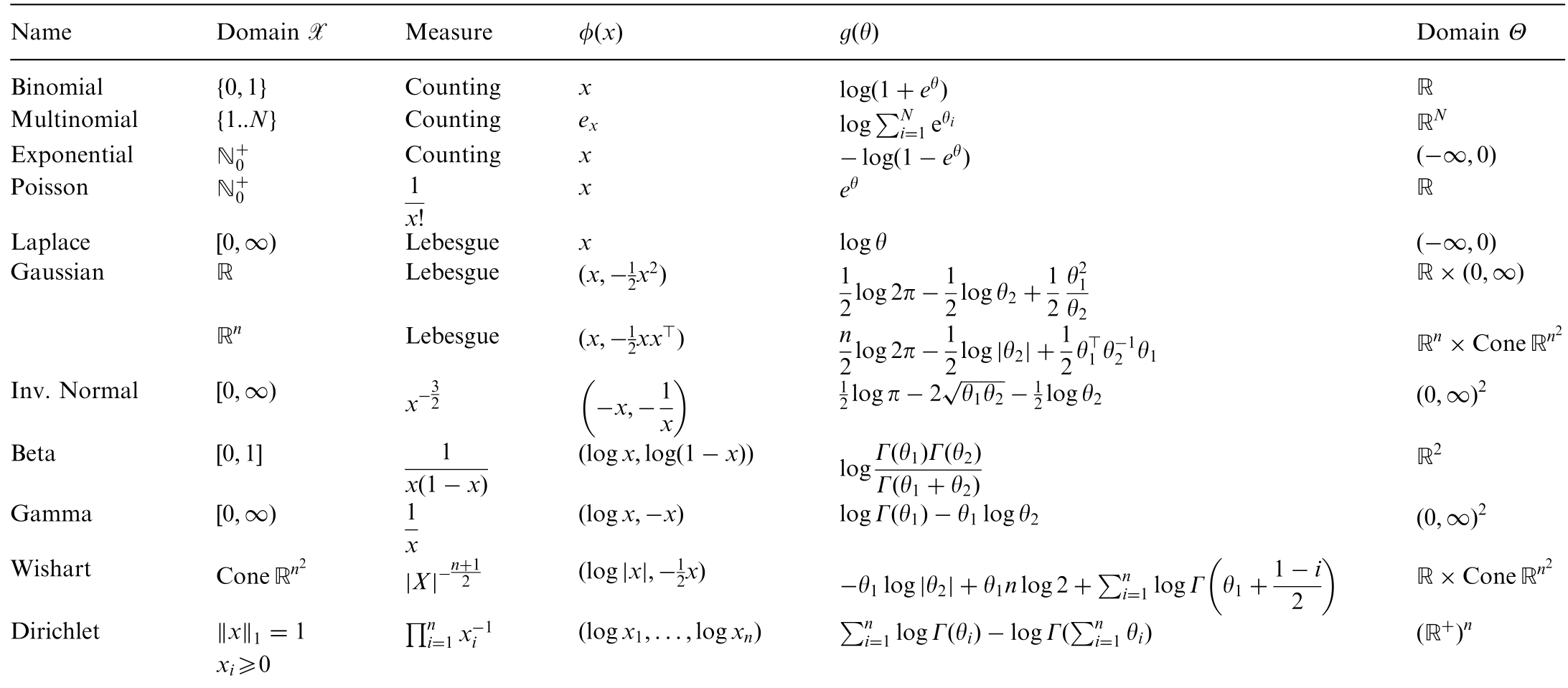
The paper provides a remarkable table (see below) showing how diverse distributions fit this mold. By changing the kernel and the carrier measure, we move from Binomial to Dirichlet or Gaussian.
3. Resolving Concavity in Regression
One of the technical triumphs highlighted is in heteroscedastic regression (where variance changes with input). Previous models for varying variance usually resulted in non-convex optimization. By using natural parameters () of the exponential family, the authors transform the problem back into a convex optimization, ensuring global convergence.
Experiments & Theoretical Results: Novelty Detection
The paper's most impactful application is in Novelty Detection. The authors prove that the standard "One-Class SVM" algorithm is actually a robust approximation of the Generalized Likelihood Ratio (GLR) test.
The Statistical Test
When we want to know if a distribution has changed (change-point detection), we compare the likelihood under the null hypothesis () vs. the alternative ().
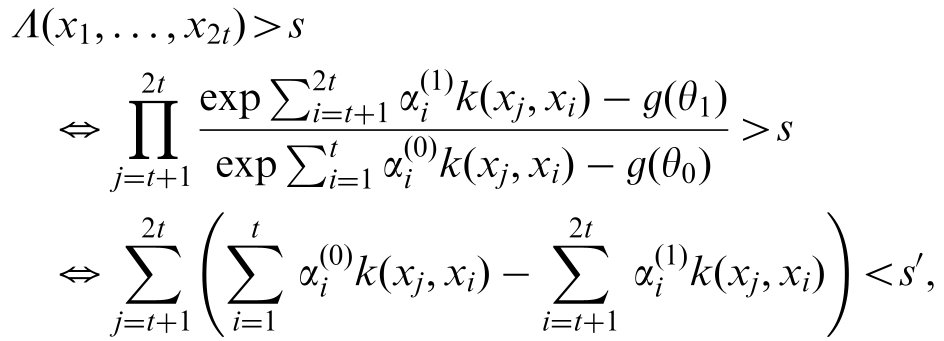
The result Equation (17) demonstrates that the heuristic of checking if the sum of kernel values falls below a threshold is not just a "trick"—it is an optimal test in the Neyman-Pearson framework under specific conditions.
Critical Analysis & Conclusion
The Takeaway
The "Kernel-Exponential" link isn't just a mathematical curiosity. It tells us that:
- Regularization in kernel methods is equivalent to a prior on the parameters of a distribution.
- The Representer Theorem ensures that even in infinite-dimensional spaces, our optimal solution always depends only on the training data points.
Limitations & Future Work
While theoretically beautiful, calculating the log-partition function (the normalization constant) remains the "Achilles' heel" for complex kernels, as it requires integrating over the entire domain . The authors suggest robust approximations (like the one-class SVM) to sidestep this, but for true density estimation, computational challenges remain.
This paper remains a cornerstone for anyone looking to understand the probabilistic roots of kernel methods and serves as a blueprint for "kernelizing" classical statistical tools.