
KNPH: Bridging Social Graph Topology and Digital Fingerprinting for Massive-Scale Forensics
Kernelized Neighborhood Preserving Hashing for Social-Network-Oriented Digital Fingerprints
This paper introduces Kernelized Neighborhood Preserving Hashing (KNPH) to create two-tier digital fingerprints for large-scale social networks. By combining community relationship codes with user identification codes, the system achieves state-of-the-art efficiency in collusion tracing while preserving social graph structures.
Executive Summary
TL;DR: This paper presents a novel digital fingerprinting framework specifically engineered for social networks. By introducing Kernelized Neighborhood Preserving Hashing (KNPH), the authors generate a two-tier fingerprint that encodes a user's position within their social community. This approach not only enhances resistance against collusion attacks but also leverages binary hashing to transform the traditionally slow "traitor tracing" process into a high-speed database retrieval task.
Positioning: This work moves beyond traditional "coded" vs. "non-coded" fingerprints by incorporating Manifold Learning into the security domain, setting a new benchmark for social-network-oriented content protection.
Problem & Motivation: The Social Collusion Threat
In modern Social Network Services (SNS), collusion is the primary threat to copyright protection. Existing methods like Boneh-Shaw or ACC codes treat users as independent entities. However, in reality, users are more likely to collude with those in their immediate community.
The technical challenges are two-fold:
- Structure Ignorance: Current fingerprints don't reflect that User A and User B are friends, losing valuable prior knowledge for detection.
- The Scalability Wall: Tracing a leak among billions of users using a correlation detector (Linear Scan) is mathematically robust but computationally impossible for real-time applications.
Methodology: The Two-Tier SNF Architecture
The authors solve this by proposing a Two-Tier Social Network Fingerprint (SNF):
- Tier 1: Community Relationship Code: A binary segment generated via KNPH that ensures users in the same community have high Hamming similarity.
- Tier 2: User Identification Code: A unique ECC-based code (like RS codes) to distinguish individuals within those communities.
The Engine: KNPH (Kernelized Neighborhood Preserving Hashing)
The methodology relies on an elegant fusion of three concepts:
- NMF (Non-negative Matrix Factorization): Learns parts-based representations of users.
- LLE (Locally Linear Embedding): Ensures that if users are neighbors in the social graph, their fingerprints remain neighbors in the latent space.
- Kernel Trick: Allows the system to work directly with the Adjacency Matrix of a social network, even when explicit user feature vectors (metadata) are unavailable.
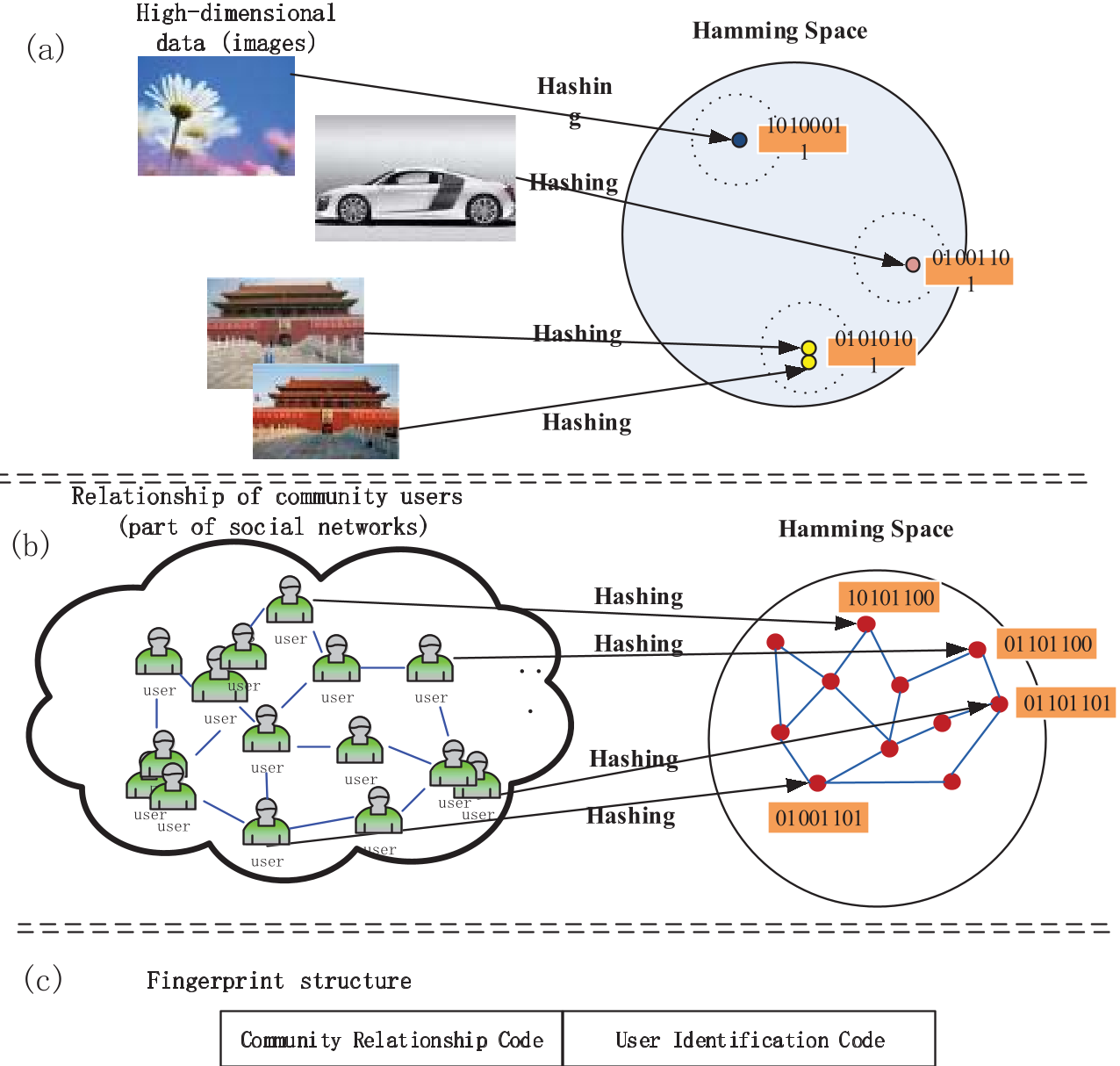 Figure 1: The two-tier fingerprint structure and its mapping from the social graph to the Hamming space.
Experiments & Results
The framework was stress-tested on real-world datasets from SNAP (Facebook, Twitter, Google+).
1. Neighborhood Preservation
The KNPH method demonstrated superior accuracy in keeping community members "close" in fingerprint space compared to Spectral Hashing (SpH) and Self-Taught Hashing (STH), especially as the user count scaled into the hundreds of thousands.
2. Detection Efficiency
By treating the community code as a key in a Hash Table and Inverted Index, the authors bypassed linear scanning. Instead of comparing a suspicious file against every user, the system only checks the most probable "neighborhoods."
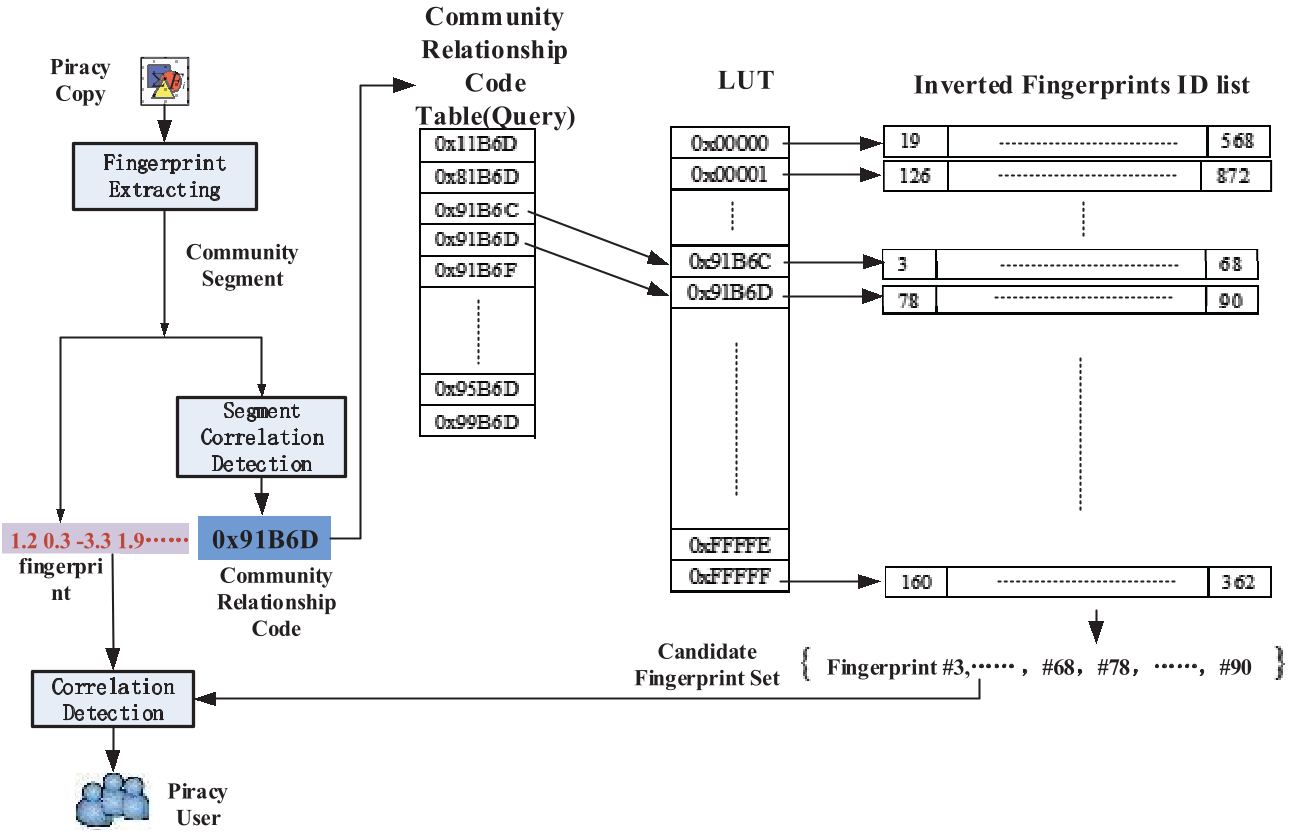 Figure 2: The Accelerated Tracing Process using Hash Tables.
Key Performance Gain: In testing across 100,000 users, the proposed detector reduced time costs by several orders of magnitude, making it feasible to trace culprits in sub-second intervals.
3. Anti-Collusion Robustness
The system showed a high Probability of Detection () against common attacks like Average, MinMax, and Interleaving attacks, outperforming the existing GRACE baseline in most "Catch All" and "Catch One" scenarios.
Critical Analysis & Conclusion
Takeaway
The genius of this work lies in treating digital fingerprinting as a similarity search problem. By forcing the fingerprint to respect the underlying social manifold, the authors turn the "scale" of social networks from a weakness into a structural strength for indexing.
Limitations
- Dynamic Updating: While the authors mention out-of-sample extensions, a total social graph restructuring might require retraining the dictionary .
- Storage: Realizing lookup for 64-bit keys requires substantial memory or sophisticated sparse-table implementations.
Future Outlook
This approach paves the way for "context-aware" security. Future iterations might incorporate GNNs (Graph Neural Networks) to further refine how community relationships are distilled into binary codes, potentially offering even higher resistance to cross-community collusion.