
Key Allocation: Building the Blueprint for Private Social Networks
Key allocation schemes for private social networks
The paper introduces a novel asynchronous key management scheme for private social networks. It enables distance-based access control (e.g., "friends of friends") without relying on a trusted third party, allowing users to share content securely even when offline.
TL;DR
In a world where social media giants act as all-seeing "trusted third parties," this paper proposes a way to take back control. It introduces a decentralized, asynchronous key management system that allows you to share content based on social distance—like "friends of friends"—without the server ever seeing your data or your private friendship graph.
The Trust Paradox in Social Media
Current platforms like Facebook or LinkedIn face a fundamental privacy flaw: the server knows everything. Even if they offer "privacy settings," those settings are enforced by the server itself. If the server is compromised or malicious, your "private" data is exposed.
Previous research tried to solve this with peer-to-peer protocols, but they required users to be online at the same time to "hand over" keys (Synchronous systems). This paper breaks that limitation, offering an Asynchronous solution where content stays encrypted and accessible regardless of who is online.
Methodology: The Access Graph Logic
The core innovation lies in transforming a social network (who knows whom) into a cryptographic Access Graph.
1. From Hops to Keys
For every user Alice, the system creates multiple "content vertices" corresponding to different depths (Friend, Friend-of-Friend, etc.). If Bob is a friend of Alice, he receives a secret that allows him to derive Alice's "Depth 1" key. Because of the mathematical structure (using PRFs and CCA-secure encryption), he can then use that to potentially reach "Depth 2" if Alice has permitted it.
2. Decentralized Construction
Unlike a central authority issuing keys, users in this scheme generate their own "subgraphs."
- User Setup: You create your own master key and a set of keys for different trust levels.
- Offering an Edge: When you "friend" someone, you send them a specific tag/key pair.
- Accepting an Edge: The recipient attaches your subgraph to theirs in the public (but encrypted) registry.
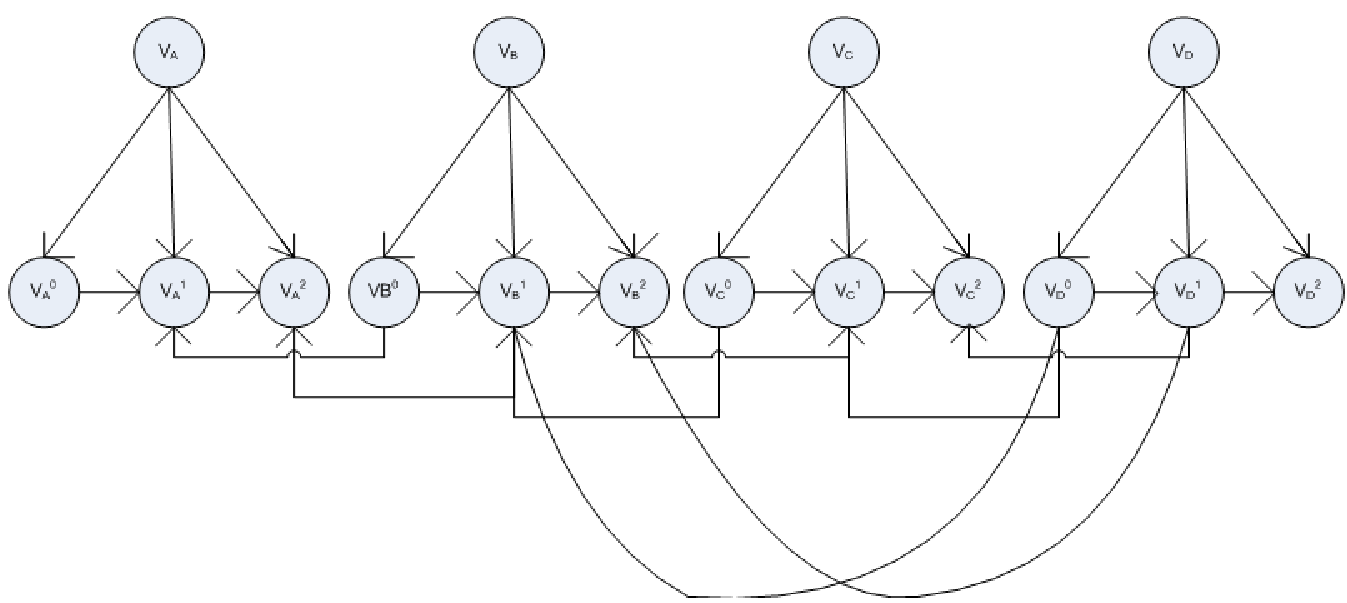 Figure overhead: The mapping of social relationships into a hierarchical key derivation path.
Handling Complexity: Relationships and Strengths
The authors don't just stop at "friendship." They extend the model to handle:
- Relationship Types: Distinguishing between "Family" and "Work" through different branches in the key tree.
- Relationship Strengths: Using a multiplicative trust model (e.g., if A trusts B at 0.8 and B trusts C at 0.5, then A trusts C at 0.4). This is mapped to the key hierarchy so that lower trust levels simply cannot derive higher-level keys.
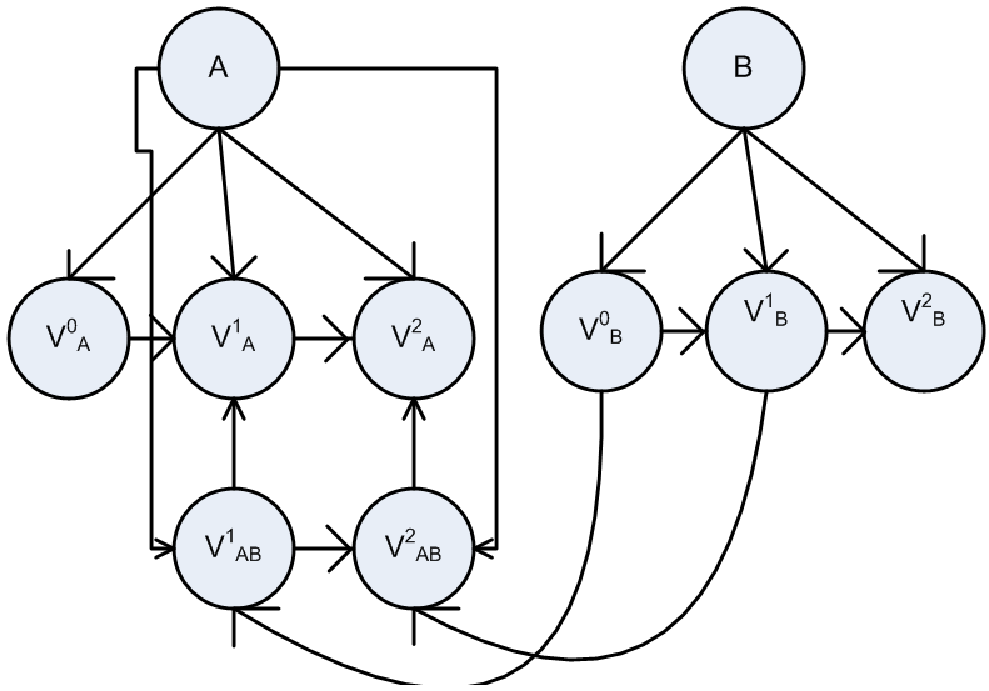 Figure: How different relationship types (Friend vs. Family) create parallel access paths.
Experimental Insight
The paper proves that the security holds under the Key Indistinguishability standard. Effectively, for anyone outside the allowed "hop distance," the encryption key is mathematically indistinguishable from random noise.
The performance remains practical:
- Storage: Proportional to the number of users and edges.
- Speed: Deriving a key only takes a few cryptographic operations per hop (O(d)).
Critical Analysis & Conclusion
This paper is a seminal "strawman" for private social networking. It brilliantly applies hierarchical key management—usually reserved for corporate structures (RBAC)—to the fluid, organic structure of social graphs.
Limitations:
- Scalability: In its purest form, users may need to download a large portion of the public graph metadata to find their derivation path.
- Key Leakage: If a "friend" turns rogue and manually shares a key, the system cannot prevent it (this is an inherent "human factor" problem in all DRM-style systems).
Future Outlook: As Web3 and decentralized identity (DID) continue to grow, the logic of asynchronous key management presented here becomes a vital building block for creating truly private, censorship-resistant digital communities.