
Beyond Digitization: Deciphering the Blueprint for ERMS Adoption in Higher Education
The Key Factors in Adopting an Electronic Records Management System (ERMS) in the Educational Sector: A UTAUT-Based Framework
2019-01-01
Summary
Problem
Method
Results
Takeaways
Abstract
The paper develops a multi-dimensional framework to identify key factors influencing the adoption of Electronic Records Management Systems (ERMS) in Higher Professional Education (HPE) institutions. Using a hybrid model combining the Unified Theory of Acceptance and Use of Technology (UTAUT) and the Technology-Organization-Environment (TOE) framework, it establishes that individual, technological, and environmental factors significantly correlate with ERMS adoption and subsequent organizational performance improvements.
## Executive Summary
**TL;DR**: This study presents a robust, statistically validated framework for adopting Electronic Records Management Systems (ERMS) within the Higher Professional Education (HPE) sector. By merging the **UTAUT** and **TOE** models, the research identifies that while infrastructure is key, the "Environment" (laws and policies) acts as a critical catalyst for institutional change.
In the landscape of information management, this work serves as a **foundational bridge**, shifting the focus from healthcare-centric systems to the unique, high-volume environment of academic record-keeping in developing economies.
## The Motivation: Why Education is Lagging
In an era of exponential data growth, Higher Professional Education institutions are often the last mile for digital transformation. The research identifies a persistent gap: while developed nations have mandated digital recording, many institutions in the developing world struggle with a "records management myopia."
The authors argue that the failure to adopt ERMS isn't just a lack of funding; it's a **multi-dimensional failure of alignment**. Current systems often lack:
- **Legal Admissibility**: Digital records are often unrecognizable in court due to outdated laws.
- **Individual Readiness**: Staff often feel frustrated or lack the technical self-efficacy required for transition.
- **System Adaptability**: Software is frequently too rigid to handle the specific needs of Outcome-Based Education (OBE).
## Methodology: The UTAUT-TOE Hybrid
The researchers didn't just look at whether people *liked* the tech. They analyzed the interaction between the individual, the machine, and the surrounding ecosystem.
### The Proposed Framework
The model breaks down adoption into three strategic pillars:
1. **Individual Factors**: Moving past simple "Attitude" to measure "Self-efficacy" and specific "Knowledge/Skills."
2. **Technological Factors**: Focusing on "ICT Infrastructure" and system "Adaptability."
3. **Environmental Factors**: Investigating the impact of "Laws and Legislation" and "Competitive Pressure."
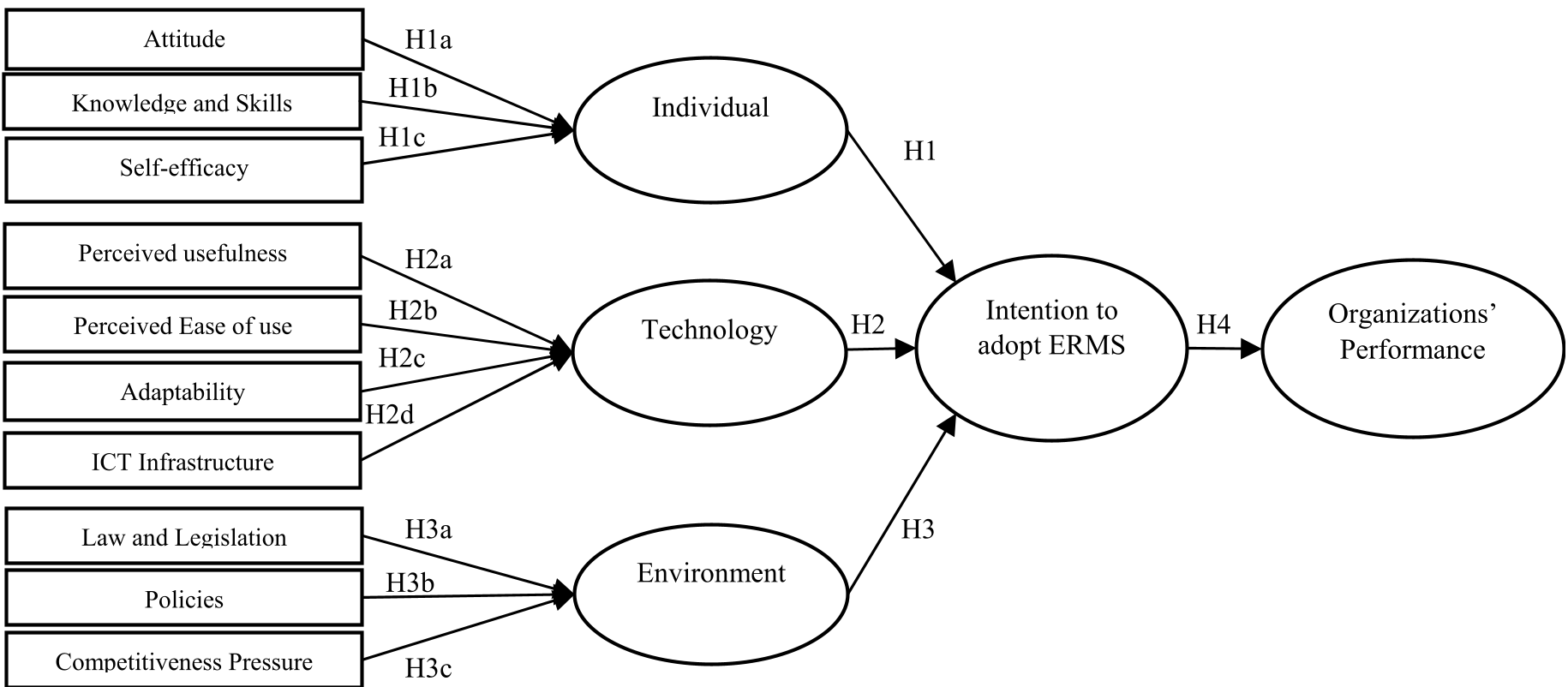
*Figure: The integrated UTAUT-TOE model used to assess ERMS adoption intention.*
## Experimental Insights: What Drives Adoption?
By analyzing 364 valid responses using **Structural Equation Modeling (SEM)**, the study yielded several striking insights:
* **The Power of Infrastructure**: ICT Infrastructure (β=0.964) remains the strongest individual predictor. Without the hardware and connectivity, no amount of policy can drive adoption.
* **Environment is Non-Negotiable**: Environmental factors showed a high path coefficient (β=0.629). In countries like Yemen, the lack of legal protection (Laws and Legislation) is a massive deterrent to digitizing sensitive student data.
* **The Performance Payoff**: The study proved that ERMS isn't just a storage tool—it has a direct effect on **Organization's Performance** (β=0.806), improving reporting quality and decision-making speed.
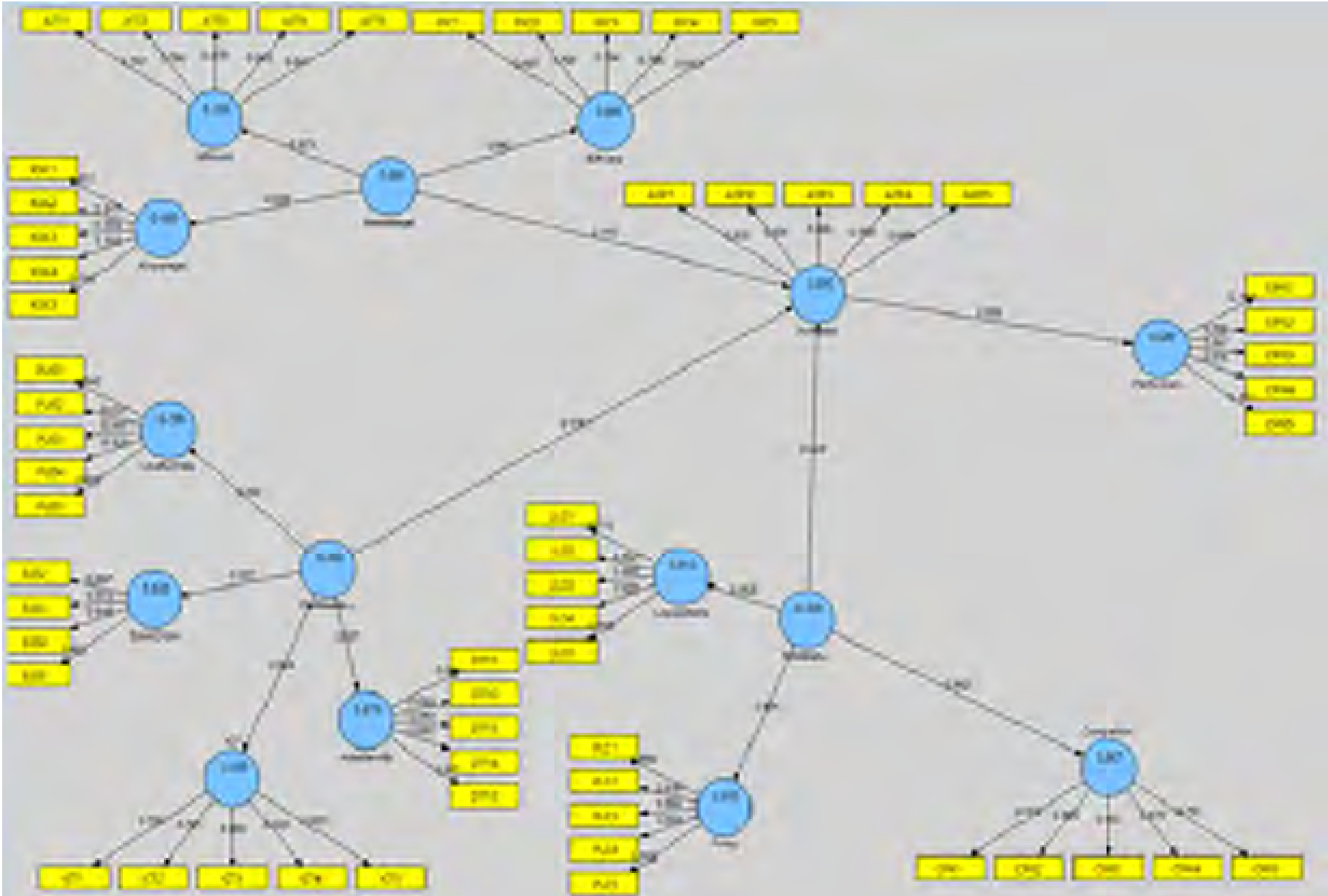
*Figure: SEM results illustrating the strength of relationships between factors and adoption intention.*
## Critical Analysis & Conclusion
### The "Policy First" Revelation
The most profound takeaway is the importance of **Policies (β=0.954)** and **Laws (β=0.955)**. Technology adoption fails not when the software is poor, but when the institution fails to provide a "safety net" of legal rules and implementable procedures.
### Limitations and Future Outlook
While the study is highly internal-consistent (Cronbach’s α > 0.88 for most constructs), it focuses heavily on a single case study (Yemen). Future research should explore:
- **Vendor Influence**: How the market availability of ERMS tools affects adaptability.
- **Long-term Sustainability**: Moving beyond "intention" to measure "actual usage" over a 5-year period.
Ultimately, this paper serves as a roadmap for HPE executives. It proves that to transform a university, you must digitize the records, but to digitize the records, you must first transform the policy.
---
*Reference: Mukred, M. et al. (2019). The Key Factors in Adopting an Electronic Records Management System (ERMS) in the Educational Sector: A UTAUT-Based Framework. IEEE Access.*