
Securing the Social Graph: Key Management in Decentralized OSNs
Key management in distributed online social networks
This paper investigates key management strategies for Decentralized Online Social Networks (DOSNs), specifically focusing on the Safebook architecture. It explores various cryptographic methods to ensure data confidentiality and fine-grained access control in the absence of a central authority, identifying Gentry-Waters Broadcast Encryption (BE) as the most efficient solution for large-scale distributed environments.
TL;DR
In a world where we move away from centralized giants like Facebook toward Decentralized Online Social Networks (DOSNs), how do we keep our "private" posts actually private? Without a central server to check permissions, encryption becomes the only firewall. This paper evaluates several cryptographic contenders and finds that Broadcast Encryption (BE) is the gold standard for balancing security, storage, and the reality of users being frequently offline.
Background: The Wild West of P2P Socializing
Decentralized networks like Safebook treat every user as a peer. Your profile might be mirrored across your friends' computers to ensure it's always reachable. However, this creates a massive security hole: if your friends (or their compromised devices) host your data, they can read everything unless it's encrypted.
The challenge isn't just encrypting the data; it's Key Management. How do you share a secret key with 50 specific friends without creating a storage nightmare or requiring everyone to be online at the same time?
The Contenders: How to Build a Digital Deadbolt
1. Simple Shared Keys
The most intuitive method. You pick a key, encrypt your "Phone Number" attribute with it, and then share that key with selected friends.
- The Catch: You either bloat your own profile by storing thousands of encrypted keys (Profile-side) or force your friends to store a key for every single attribute you share (Client-side). This doesn't scale.
2. One-way Function Tree (OFT)
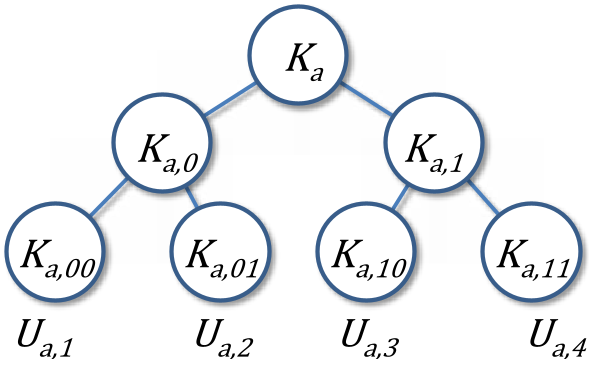
A smarter approach using a binary tree where the "root" is the final encryption key.
- Mechanism: Users are leaves. By knowing their own secret and some intermediate "node" keys, they can calculate the root.
- The Catch: Every time a friend is added or removed, the tree must be updated. In a P2P world where people are often offline, sending these update messages is like trying to synchronize a massive game of "telephone" with people who aren't picking up.
3. Gentry-Waters Broadcast Encryption (The Winner)
This is the "specialist" approach. It allows a sender to broadcast a message to a specific subset of users using a single header.
- The Insight: It uses Bilinear Pairings, a sophisticated mathematical tool that allows authorized users to derive the key using their own unique secret and a public "header" found in the profile.
- Why it wins: It requires zero interaction. If you add a friend, you just update the header in your profile. No messages need to be sent.
Performance Showdown: The Numbers
The authors didn't just guess; they modeled the storage and computational costs.
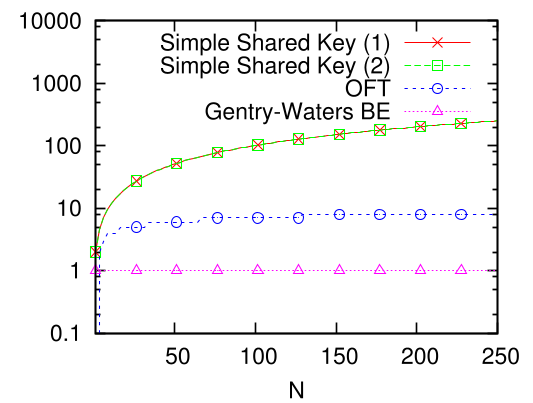
As shown in the evaluation (Figure c), the Storage at the users (Su) for OFT and Simple Shared Keys grows linearly or logarithmically. However, for the Broadcast Encryption (BE) approach, the client-side storage is effectively zero. The user only needs their own private identity key, regardless of how many attributes their friends are sharing.
Furthermore, the Messaging (Mr/Ma) requirement for BE is non-existent. In a network where mobile phones may lose connection or go into sleep mode, "zero-message" key updates are the difference between a functional app and a broken one.
Critical Insight: Why Does This Matter?
The real takeaway here is the Inductive Bias of decentralized systems. We often assume that what works for "Group Chat" (like Signal's tree-based keys) works for "Social Media." This paper proves otherwise.
Because social media is Asynchronous (you post now, I read in three hours), the key management must also be asynchronous. Tree-based methods (OFT/LKH) are too "chatty." Broadcast Encryption fits the "Bulletin Board" nature of social networks perfectly because it shifts the burden from the network (messages) to the individual's computation (bilinear pairings).
Conclusion & Future Outlook
While Gentry-Waters BE is the clear winner for storage and bandwidth, it relies on more complex math (Pairing-based cryptography). As mobile hardware continues to include dedicated cryptographic accelerators, the "computational cost" of this method will become negligible, making it the bedrock for future privacy-first, decentralized social platforms.
Next Steps: Researchers should look into Attribute-Based Encryption (ABE), which could allow users to share data based on "Roles" (e.g., "All my colleagues") rather than just specific "Lists of IDs," further simplifying the user experience.