
KeyGraph for Social Networks: Bridging Communities in Mobile Context Sharing
KeyGraph-Based Social Network Generation for Mobile Context Sharing
The paper introduces a KeyGraph-based social network generation method for context sharing in mobile environments. By leveraging Bluetooth co-occurrence data and Bayesian Networks, it automatically identifies "home" communities and "key people" who bridge different social groups to manage privacy-aware information sharing.
TL;DR
Determining who to share your personal data with is a persistent challenge in mobile computing. This paper proposes a system that uses Bluetooth co-occurrence and the KeyGraph algorithm to automatically build social maps. It identifies your "inner circle" (home community) and "bridge contacts" (key people), allowing the system to intelligently share behavior data widely while keeping sensitive location data private within your primary group.
The "Home Community" Fallacy
Most context-sharing applications assume a binary world: you are either in a group or you are not. However, human social structures are far more fluid. A student might belong to a "Lab Group" but also have ties to a "Study Group" through a mutual friend.
Current SOTA methods often fail because:
- Isolation: They ignore inter-community links, leading to rigid sharing policies.
- Lack of Physicality: Metadata like SMS logs don't guarantee that two people are actually together.
- Privacy Rigidity: There is no distinction between sharing a "Behavior" (e.g., studying) vs. a specific "Location" (GPS coordinates).
Methodology: From Keywords to Key People
The core innovation lies in repurposing the KeyGraph algorithm, traditionally used for document indexing, to map social proximity.
1. Context Inference via Bayesian Networks
Before sharing, the system must know what the user is doing. Using GPS and Accelerometer data, a Bayesian Network (BN) infers high-level activities.
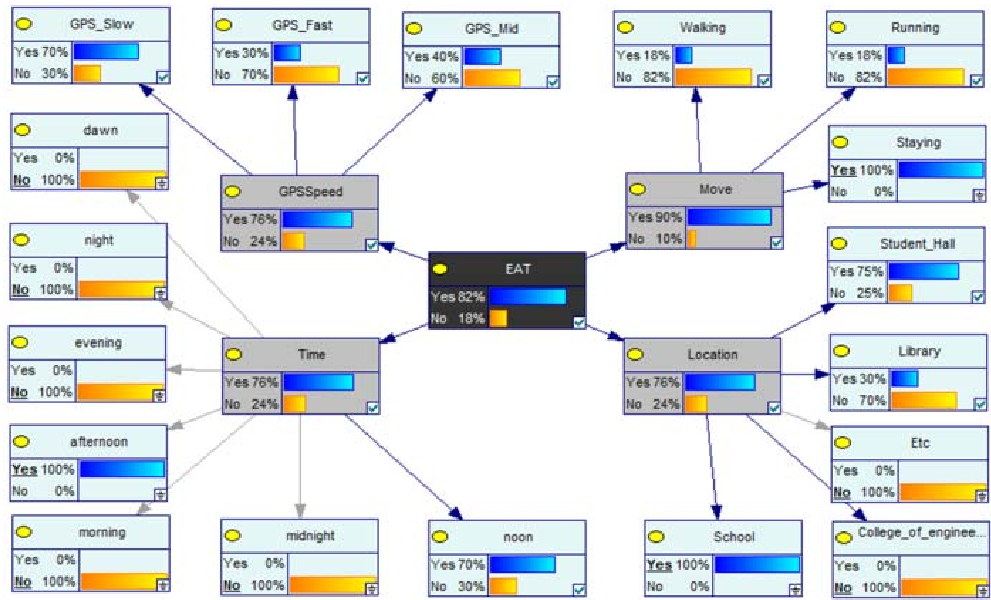 Figure 2: A Bayesian network designed to infer the 'eat' activity by processing time, speed, and transportation mode.
2. Social Mapping with KeyGraph
KeyGraph operates in two distinct phases:
- Phase 1: Foundation Building: Bluetooth logs detect who spent time near whom. High association strengths create "foundations" or home communities.
- Phase 2: Extracting Key People: The algorithm identifies "Key People" who appear in the neighborhood of multiple clusters but aren't necessarily the most "frequent" contacts. These are the bridges.
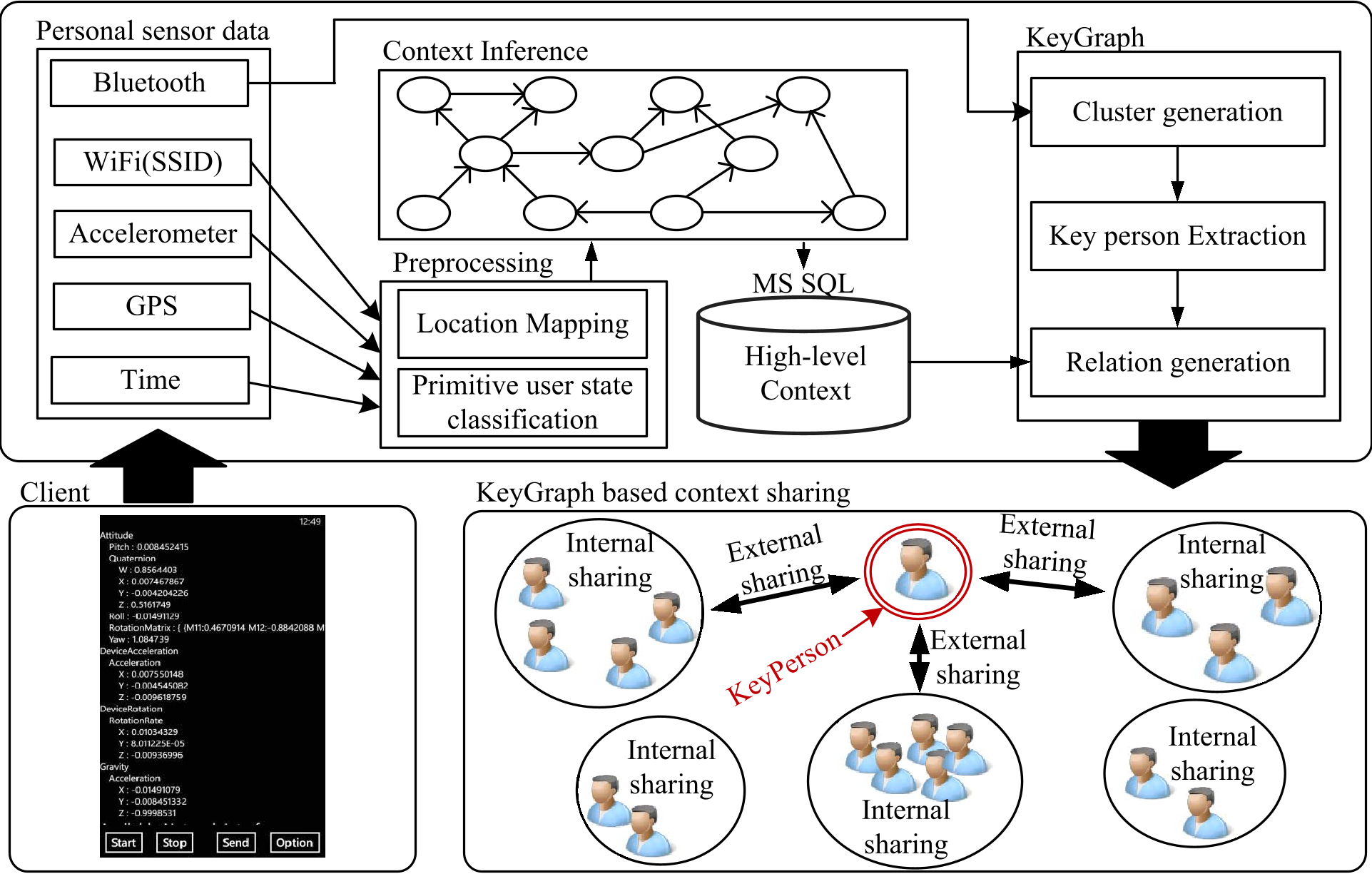 Figure 1: The Server-Client architecture facilitating data collection, BN inference, and KeyGraph processing.
Selective Sharing Strategy
The authors suggest a tiered privacy model based on the KeyGraph topology:
- Internal (Home) Group: Receives both Location and Behavior contexts.
- External (Linked) Group: Receives only Behavior contexts.
This ensures that while a colleague might see you are "Busy/Working," they don't necessarily see your exact GPS coordinates unless they belong to your core social foundation.
Experimental Validation
The system was tested using Nokia Lumia 900 devices and a centralized server. The KeyGraph algorithm successfully mapped 11 subjects into their respective working groups and identified the participants who served as links between disparate groups.
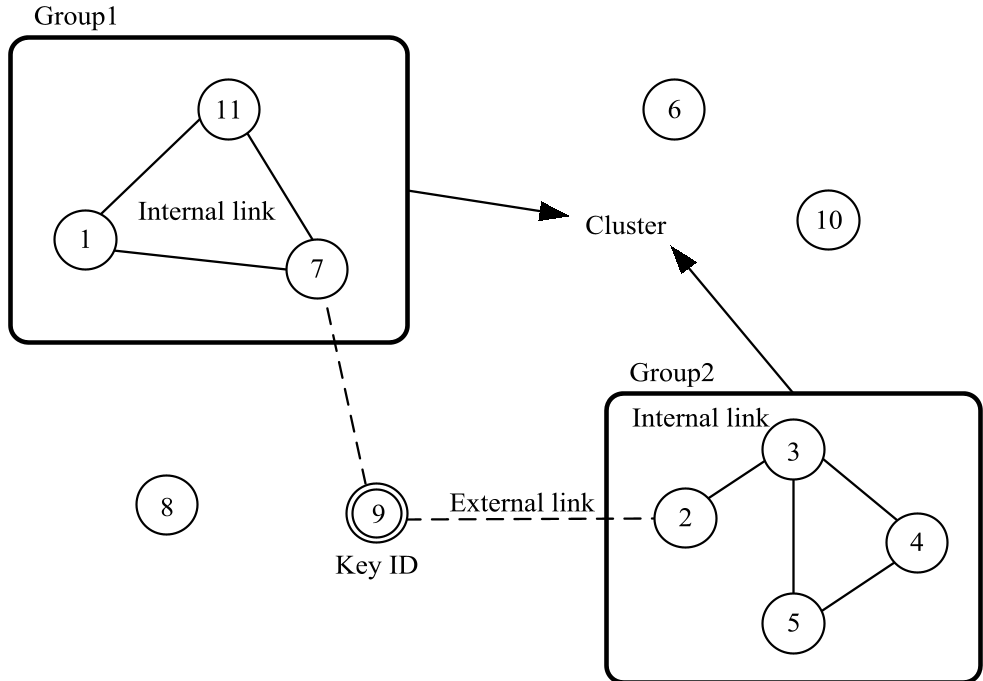 Figure 6: The resulting KeyGraph showing the nodes (users) and the clusters/foundations formed by physical proximity.
Critical Insight & Conclusion
By treating social interactions like a "document" where users are "terms," the authors provide a mathematical framework for Chance Discovery in social networks. The use of Bluetooth provides a much-needed layer of physical ground truth that digital-only logs lack.
Limitations: The study's small sample size (11 students) and reliance on high-energy sensors (GPS/Bluetooth) raise questions about battery scalability. However, as an proof-of-concept for automated privacy management, it offers a compelling path forward: systems that understand the topology of our social lives can make better decisions about our privacy than we can manually.