
Deciphering the Digital Rhythm: How Keystroke Dynamics Reveal Our Emotions
Does Keystroke Dynamics tell us about Emotions? A Systematic Literature Review and Dataset Construction
This paper presents a Systematic Literature Review (SLR) on emotion recognition via keystroke dynamics and introduces EmoSurv, a novel web-based data collection framework. The study synthesizes a decade of research, highlighting that machine learning models (e.g., SVM, KNN) can achieve up to 91% accuracy in detecting emotional states through typing rhythms.
TL;DR
Can the way you type reveal how you feel? This paper systematically reviews a decade of research into Keystroke Dynamics (KD) for emotion recognition, finding accuracy rates as high as 91%. The authors address the industry's biggest bottleneck—data scarcity—by launching EmoSurv, a web-based platform designed to build a large-scale, open dataset for the research community.
Background Positioning
In the spectrum of Affective Computing, we usually look to "heavy" sensors: webcams for facial expressions or wearables for heart rate. This work positions keystroke dynamics as a "transparent biometric"—a software-only solution that requires no extra hardware, leveraging the subtle muscle fluctuations in our fingers that occur when our emotional state shifts.
Identification of the "Data Desert"
The authors identify a critical gap: while the theory that "emotions alter physical rhythm" is well-supported by neurology, the practical application is hindered by:
- Intrusiveness of Prior Tech: Systems requiring shaving for electrodes or constant camera monitoring are privacy-invasive and expensive.
- Dataset Scarcity: Most existing studies use fewer than 30 participants, making the results statistically "noisy."
- Instability: Typing patterns change depending on the software or hardware used, yet few datasets account for these variables.
Methodology: The Anatomy of a Keystroke
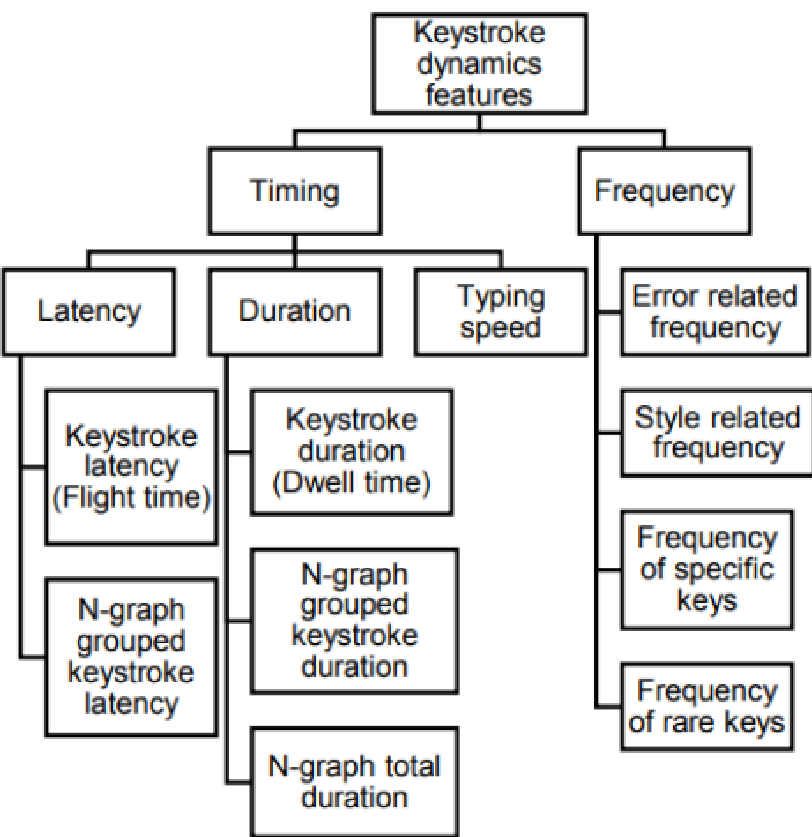
The heart of the research lies in transforming raw keypresses into emotional features. The timing between events is measured at a millisecond level:
- Dwell Time (Duration): The interval between pressing and releasing a key.
- Flight Time (Latency): The transition time between two keys (digraphs) or three keys (trigraphs).
- Frequency Features: How often do you hit 'Backspace' or 'Delete'? High error rates often correlate with stress or high arousal.
The EmoSurv Proposal
To solve the data problem, the authors built EmoSurv. Unlike previous desktop-locked experiments, this is a web-based portal. Participants are "emotionally primed" via specific video clips (e.g., clips designed to elicit joy or sadness) and then asked to type both fixed and free-form text.

Experimental Insights & SOTA Comparison
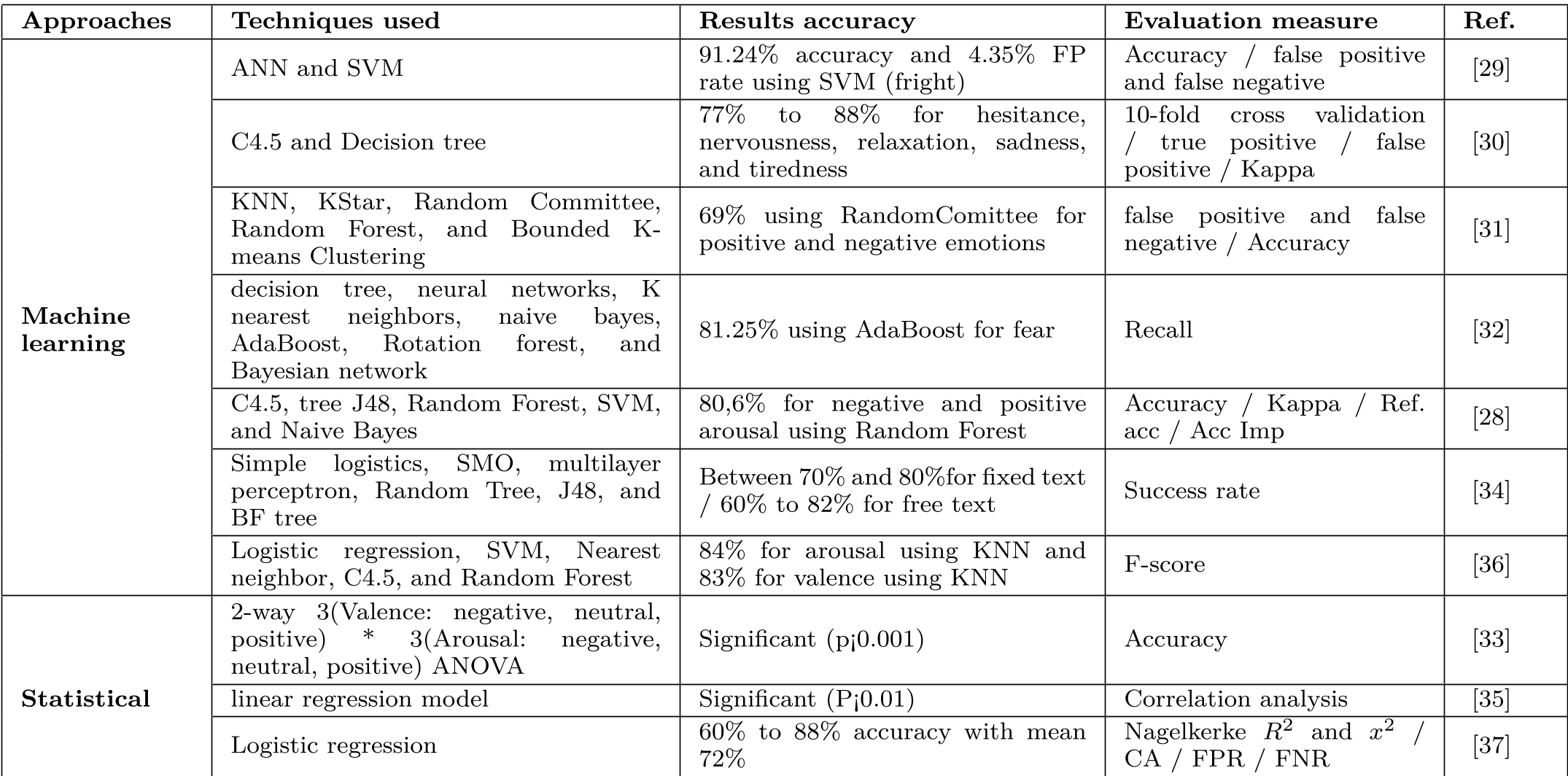
The SLR component of the paper highlights a clear shift from simple statistical models to Machine Learning. Specifically:
- SVM (Support Vector Machines) achieved the highest specific accuracy (91.24%) for identifying "fright."
- KNN (K-Nearest Neighbors) proved highly effective for the Arousal-Valence model, reaching 83-84% accuracy.
- The "Fixed vs. Free" Debate: Fixed text (typing a specific sentence) generally yields higher accuracy than free text (journaling), likely due to the reduction in linguistic noise.
Critical Analysis & Future Outlook
While the accuracy numbers are promising, the authors are refreshingly objective about the limitations.
The Complexity of Interaction: Typing is not just influenced by emotion—it’s influenced by age, gender, exhaustion, and even the "mushiness" of a keyboard. Most prior work ignores these confounding variables.
Future Outlook: The next frontier isn't just "detecting" the emotion, but applying it. Imagine a world where a learning platform detects a student's "frustration" through their typing rhythm and automatically offers a hint, or a remote-work tool that suggests a break when it senses "high-stress" typing patterns.
Conclusion
This paper serves as both a map of the past decade and a blueprint for the next. By moving data collection to the web via EmoSurv, the authors are democratizing keystroke dynamics research, moving it out of the lab and into the real world.