
Cracking the Code of Social Snippets: Effective Keyword Extraction for Micro-Content
Keyword extraction for social snippets
The paper introduces a machine learning-based framework for keyword extraction from "social snippets" (short, informal user-generated content like Facebook status updates). By leveraging a Gradient Boosting Machine (GBM) and a curated set of linguistic and statistical features, the authors achieve a superior balance of precision and recall compared to traditional TF-IDF and industry baselines like Yahoo! and KEA.
TL;DR
In the era of social media, "snippets"—short status updates like those on Facebook and Twitter—represent a goldmine for ad targeting and user intent. However, their brevity and informal nature break traditional NLP models. This paper proposes a supervised learning approach using Gradient Boosting Machines (GBM) and a refined feature set to extract meaningful keywords where traditional TF-IDF fails.
The "Short and Noisy" Challenge
Most keyword extraction algorithms were built for the "Web 1.0" era: long-form articles where frequency-based metrics like TF-IDF reign supreme. Social snippets introduce two primary hurdles:
- Statistical Sparsity: With an average of only 21 words per snippet, Term Frequency (TF) is almost always 1. You cannot rely on a word appearing multiple times to signal its importance.
- Informality: Social text is noisy, often lacking proper grammar, and a significant portion (~25%) of snippets contain no meaningful keywords at all.
The authors' insight is that when frequency fails, we must rely on linguistic structure (POS tags) and dataset-wide popularity (DF) to pick up the slack.
Methodology: Beyond Simple Heuristics
The authors treat extraction as a binary classification problem: Is this candidate unigram/bigram a keyword?
The Feature Engine
- TF-IDF & DF: While TF is weak, the Inverse Document Frequency (IDF) and Document Frequency (DF) still help identify "hot" or "trendy" topics across the platform.
- Linguistic (lin): A key observation that nouns are much more likely to be keywords.
- Relative Position (pos): Where the word appears in the short snippet matters.
- Threshold Selection (top-p%): Instead of forcing the model to pick keywords, the authors use a percentile-based threshold. This allows the model to return zero keywords for "garbage" posts, significantly boosting overall precision.
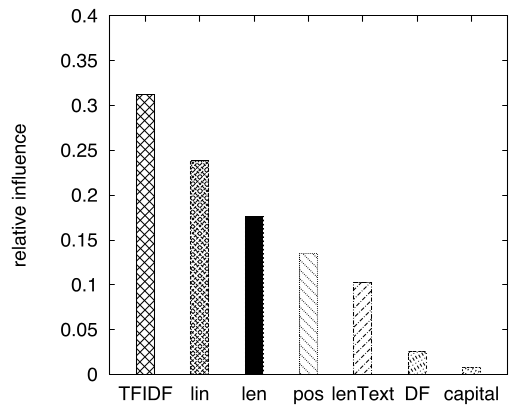 Figure 1: The relative influence of each feature in the GBM model shows that while TF-IDF is useful, linguistic and length features are essential contributors.
Experiments & Results
The study compared multiple models, including Support Vector Machines (SVM), Decision Trees (DT), and Logistic Regression (LR).
GBM Wins the Day
The Gradient Boosting Machine (GBM) emerged as the clear winner. Unlike linear models (SVM/LR), GBM can capture complex non-linear interactions between features like "Capitalization" and "POS Tag."
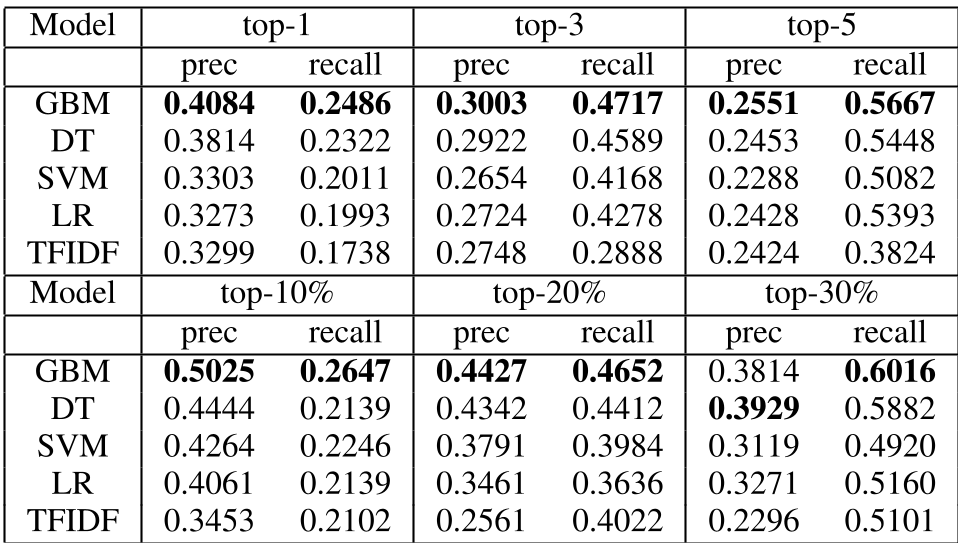 Table 1: Performance metrics showing GBM's superiority, especially when paired with the top-p% thresholding strategy.
When compared against industry leaders of the time (Yahoo! Keyword API and KEA), the authors' method offered a much better Recall-Precision trade-off. While Yahoo! was "picky" (high precision, very low recall), the proposed GBM model successfully captured the diversity of user interests across the dataset.
Critical Analysis & Future Outlook
This work serves as a foundational bridge between classical IR and modern social media analytics.
Takeaway: The success of the "top-p%" method is a crucial lesson for production systems—forcing a model to provide an answer for every input is often a recipe for poor performance in noisy domains.
Limitations: The paper acknowledges that it does not yet utilize the social graph. A user's interests are often correlated with their friends' interests. Future iterations of keyword extractors could significantly improve by using a user's "social neighborhood" as a prior for keyword probability.
Conclusion: As micro-content continues to dominate the web, the transition from frequency-based extraction to high-dimensional, model-based extraction is not just an optimization—it is a necessity.