
KGMEL: Bridge the Gap with Knowledge Graph Triples in Multimodal Entity Linking
KGMEL: Knowledge Graph-Enhanced Multimodal Entity Linking
KGMEL (Knowledge Graph-Enhanced Multimodal Entity Linking) is a novel framework designed to align textual mentions with knowledge base (KB) entities by integrating text, images, and structured Knowledge Graph (KG) triples. It achieves state-of-the-art results on three major benchmarks, including a peak HITS@1 improvement of 19.13%.
TL;DR
KGMEL is a high-performance framework for Multimodal Entity Linking (MEL) that moves beyond simple text-image alignment. By generating structured KG triples for mentions and using LLMs to match them against KB triples, it establishes a "semantic bridge" that resolves ambiguity. It sets a new SOTA on WikiDiverse, RichpediaMEL, and WikiMEL, with performance gains up to 19.13%.
The Missing Link: Why Text and Images Aren't Enough
In the world of Entity Linking, a "mention" (like "Thunderstruck" in a sports headline) needs to be mapped to a specific "entity" in a database (like the movie Thunderstruck or the AC/DC song). While adding images helps—seeing a basketball player in the frame narrows it down—most current models ignore the Knowledge Graph (KG).
The authors of KGMEL made two crucial observations:
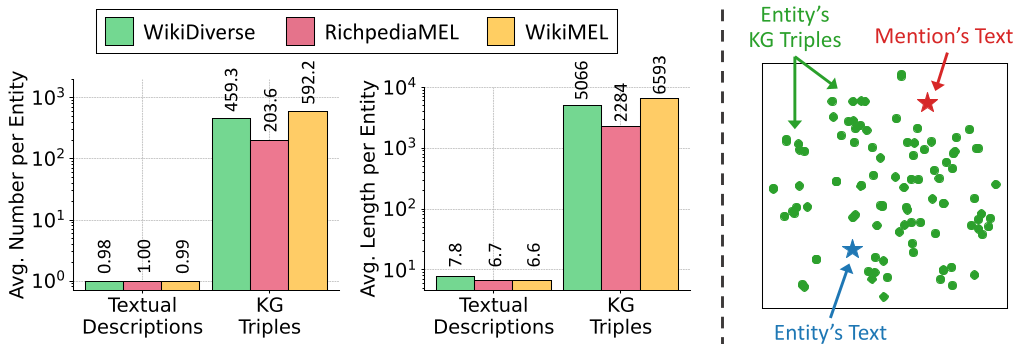
- Abundance: Entities in KBs like Wikidata have hundreds of triples (e.g.,
<Michael Jordan, occupation, basketball player>) which provide much more data than a single-line text description. - Semantic Bridge: Structured triples act as a connector. Even if the text of a tweet and a Wikipedia summary look different, their underlying KG triples often share common nodes (tails) and relations.
Methodology: Generate, Retrieve, Rerank
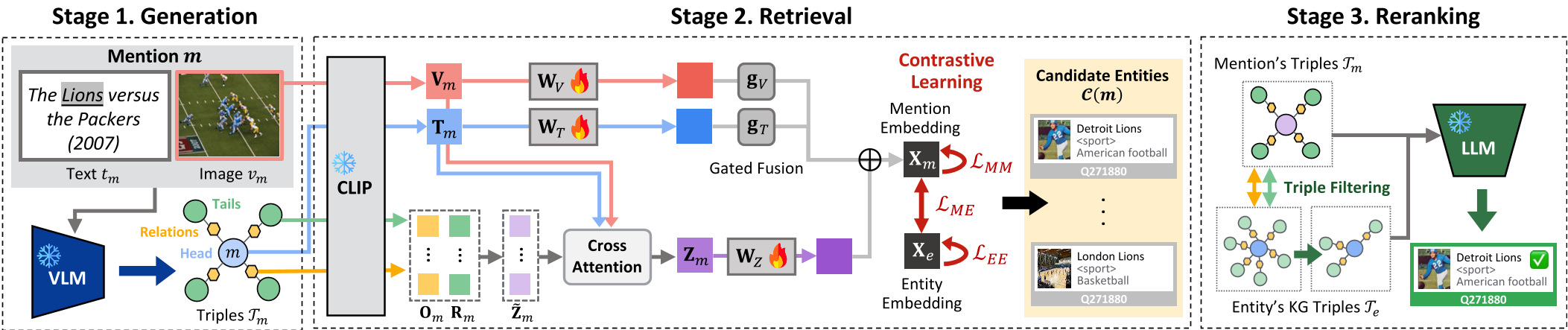
KGMEL solves the MEL problem through a sophisticated three-stage pipeline.
Stage 1: Triple Generation
Since raw mentions (like a caption from a tweet) don't come with triples, KGMEL uses a Vision-Language Model (VLM) like GPT-4o-mini to "hallucinate" accurate triples. It identifies the entity type, describes it based on visual and textual cues, and then structures that into (subject, relation, object) format.
Stage 2: Candidate Retrieval
Using the generated triples, the model learns a joint representation. It uses frozen CLIP encoders for text and images, and an MLP-based Triple Encoder. A dual cross-attention mechanism weights the importance of specific triples based on their relevance to the visual and textual context. The final "Gated Fusion" combines these three modalities into a single embedding for contrastive learning.
Stage 3: LLM-Based Reranking
Retrieval might return the top 16 candidates. To pick the winner, KGMEL doesn't just look at distance; it uses an LLM as a reasoner. It filters out thousands of irrelevant KB triples to only show the LLM the ones that actually correlate with the mention's context.
Experimental Results: Setting a New Standard
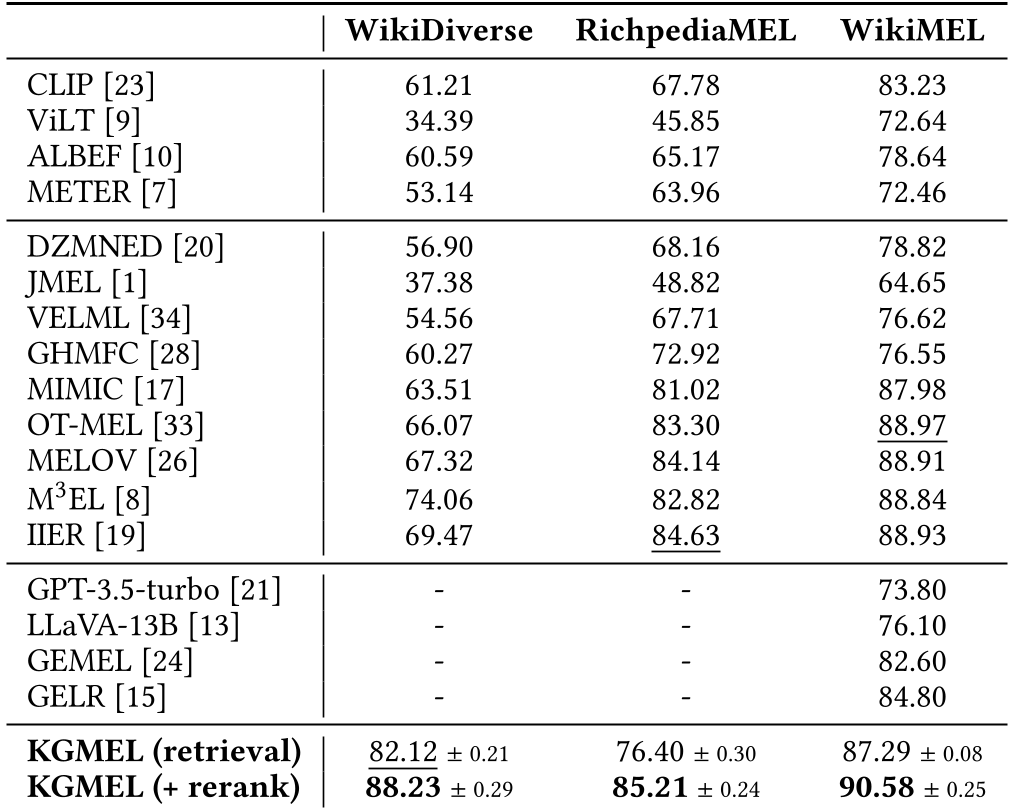
The results are clear: KGMEL is the new leader in MEL. It consistently outperforms established baselines like OT-MEL and MIMIC across all datasets.
| Method | WikiDiverse (H@1) | RichpediaMEL (H@1) | WikiMEL (H@1) |
|---|---|---|---|
| MIMIC | 63.51 | 81.02 | 87.98 |
| OT-MEL | 66.07 | 83.30 | 88.97 |
| KGMEL (+ rerank) | 88.23 | 85.21 | 90.58 |
A core "Aha!" moment from the ablation study is that removing the Triple Encoding (Z) results in a consistent performance drop, proving that including structured knowledge is not just redundant—it's essential for high-precision linking.
Critical Insight & Future Outlook
The brilliance of KGMEL lies in its treatment of LLMs/VLMs. Instead of using them as simple "black box" classifiers, it uses them as Structured Information Generators. This allows the system to bridge the "structured-unstructured" gap that has long plagued multimodal research.
Limitations: The framework relies on high-quality external LLMs, which could be costly in a production environment. However, as the authors show with LLaVA experiments, smaller open-source models are rapidly closing the gap, making this approach increasingly viable for real-time applications.
Conclusion: KGMEL proves that the future of Multimodal AI isn't just about better pixels or bigger text transformers—it's about how we integrate the structured knowledge that humans have already built into the learning process.