
Beyond Simple Motion: Kinetic Pseudo-Energy for Real-Time Gesture Recognition
Kinetic Pseudo-energy History for Human Dynamic Gestures Recognition
The paper introduces a "Kinetic Pseudo-Energy History" (psEk) approach for real-time Human-Computer Interaction (HCI) to automatically detect the boundaries of dynamic gestures. By integrating temporal resampling via cubic splines and K-Nearest Neighbor (K-NN) classification, the system achieves a 99% recognition rate for dynamic gestures and 100% for static poses using tri-axial accelerometer data.
TL;DR
Recognizing a gesture is easy; knowing exactly when it starts and ends in a continuous stream of movement is hard. This paper introduces a "Kinetic Pseudo-energy" method to solve the "gesture spotting" problem. By tracking the history of motion energy and using cubic splines to normalize performance speed, the authors achieved 99% accuracy in real-time digit recognition using simple accelerometers.
The "Spotting" Problem: Why Real-Time HCI is Tricky
In Human-Computer Interaction (HCI), the system is constantly bombarded with data. If you are wearing a smartwatch or holding a controller, the device sees every micro-movement.
The challenge isn't just identifying a "circle" gesture—it's distinguishing a meaningful "circle" from the random noise of you scratching your head or reaching for a coffee. Prior works often used Hidden Markov Models (HMMs), but these frequently suffered from high latency, only confirming a gesture after the user had already started the next one. This "lag" makes interfaces feel sluggish and unnatural.
Methodology: The Physics of Motion History
The authors propose a breakthrough based on a simple physical intuition: Kinetic Energy.
1. Kinetic Pseudo-Energy ()
Instead of looking at raw X, Y, Z acceleration, they look at the scalar magnitude of velocity. However, simple velocity isn't enough—if you wave your hand, there is a split second at the turn of the wave where velocity is zero. To prevent the system from thinking the gesture has ended prematurely, they track a History of pseudo-energy over frames.
By thresholding the mean of this history, the system gains "inertia," making it robust to sudden direction changes and momentary pauses.
2. Speed Invariance via Resampling
Different users perform gestures at different speeds. To compare a 0.5-second "flick" to a 1.2-second "flick," the authors use Cubic Spline Resampling. This technique stretches or compresses the movement into a fixed number of data points, ensuring that the classifier (K-NN) compares the shape of the motion rather than its duration.
 Note: Above is the algorithmic representation of the mean kinetic energy delay calculation.
Experiments and Results
The researchers tested their system using a Wii Remote (ADXL330 accelerometer). They recorded 200 sequences of users "drawing" numbers 0-9 in the air.
- K-NN & SVM Performance: Both reached an impressive 99% recognition rate.
- Static Poses: Reached 100% accuracy, successfully distinguishing between "neutral," "up," and "upside down" positions.
- Computation Efficiency: K-NN was the clear winner for real-time applications, processing the training/validation 300x faster than SVM.
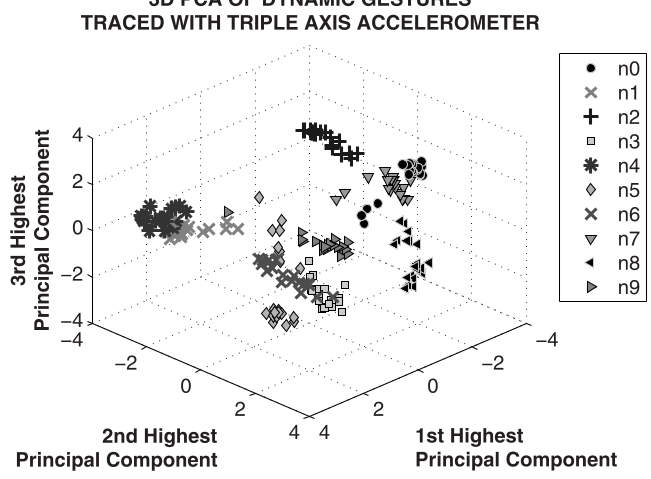 Fig 5: PCA visualization showing how different dynamic gestures (0-9) form well-defined clusters in feature space after kinetic normalization.
Critical Insights
The true value of this paper is not just the high accuracy, but the Inductive Bias it introduces. By moving from raw time-series data to a "pseudo-energy" domain, the authors filtered out the "what" (velocity) and focused on the "how much" (energy intensity).
Limitations & Future Scope
While highly effective for discrete gestures (like numbers), the current method might struggle with cyclic gestures (like continuous circular stirring) or fast transitions where one gesture blends into another. The authors acknowledge that future work must address these "fluid" transitions to create truly seamless HCI environments.
Final Summary
This research provides a robust framework for developers working on wearable tech and mobile motion sensing. By combining a physics-based trigger (Pseudo-energy) with a geometry-based comparison (Cubic Splines), they've created a path for low-latency, high-accuracy gesture interfaces that work regardless of how fast or slow a user moves.