
The Architecture of Resilience: How Cultural Learning Saved (and Strained) Ancient Social Networks
The effect of kinship cooperation learning strategy and culture on the resilience of social systems in the village multi-agent simulation
This paper presents a multi-agent simulation of pre-hispanic Pueblo Indians using Cultural Algorithms (CA) to model kinship-based resource exchange. By embedding Reciprocal Cooperation Learning strategies within a dual-inheritance framework (Population and Belief spaces), the study demonstrates how social systems evolve to become more resilient to environmental stressors like drought.
TL;DR
Why did the Pueblo Indians abandon the Mesa Verde region after 700 years? This paper argues that precipitation isn't the whole story. By using Multi-Agent Simulations powered by Cultural Algorithms, the researchers show that kinship-based cooperation and collective learning allowed these societies to scale and survive droughts. However, this survival strategy created a "Small World" network dependent on high-connectivity "hub nodes," leading to a fascinating dialectic between centralization and dispersal.
The Missing Link in Archaeological Modeling
For years, archaeologists like Kohler used tree-ring and soil data to model the farming practices of pre-hispanic societies. Yet, the math didn't always add up: models based purely on environmental factors (like rainfall) couldn't fully explain the massive depopulation of the Four Corners region.
The missing variable was Social Intelligence. Humans don't just react to drought individually; they cooperate, remember who helped them, and pass that wisdom down. The authors hypothesized that the transition from random survival to a structured "Culture" was the key to understanding the resilience—and eventual fragility—of these social systems.
Methodology: Embedding Culture into Algorithms
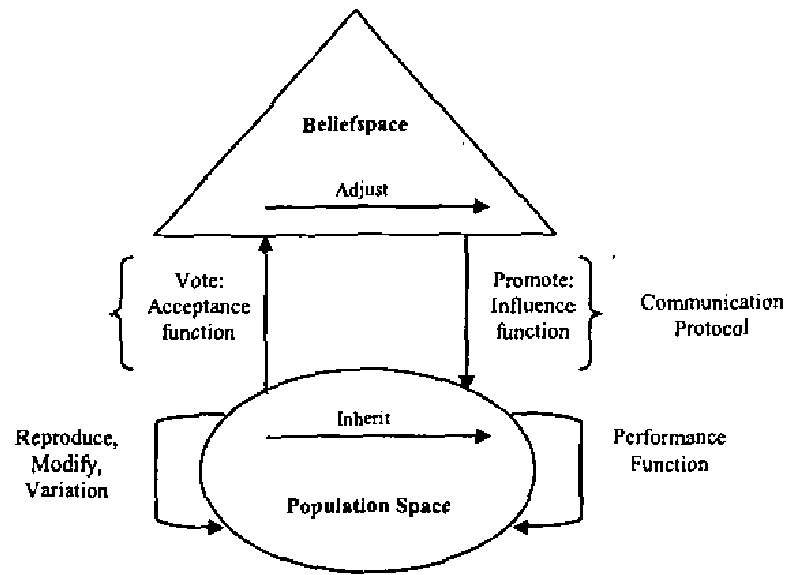
The core of this work is the Cultural Algorithm (CA) framework. It operates on two distinct but interacting levels:
- The Population Space: Individual households (agents) interact. They use a "Roulette Wheel" selection to decide which relative to ask for food. If a relative helps, the probability of asking them again increases.
- The Belief Space: This is the "Collective Memory." It tracks "Exemplars" (the most successful agents) and forms "Normative Knowledge" (generalizations about which types of kin—parents, siblings, etc.—are most reliable).
Agent State Dynamics
Agents move through states of "Satisfied," "Philanthropic" (surplus), "Hungry" (precautionary), and "Critical" (imminent starvation). The simulation triggers cooperation requests based on these internal states, effectively modeling human compassion and survival instincts.
Insights from the Evolution of Cooperation
The paper compares several cooperation strategies, ranging from zero cooperation to advanced learning with memory.
- Random Selection: Simply sharing food helps, but the network remains relatively simple and fragile.
- Individual Learning: When agents remember past interactions, the network grows in volume.
- Belief Space Integration: When the entire group learns who the best donors are, the system undergoes a phase transition. The network develops Hub Nodes—highly connected individuals who act as the "glue" for the entire society.
Performance Under Stress
The most striking result occurs during drought cycles (A.D. 1200+). Systems with advanced cultural learning (Normative and Situational knowledge) exhibited much larger populations and more complex networks.
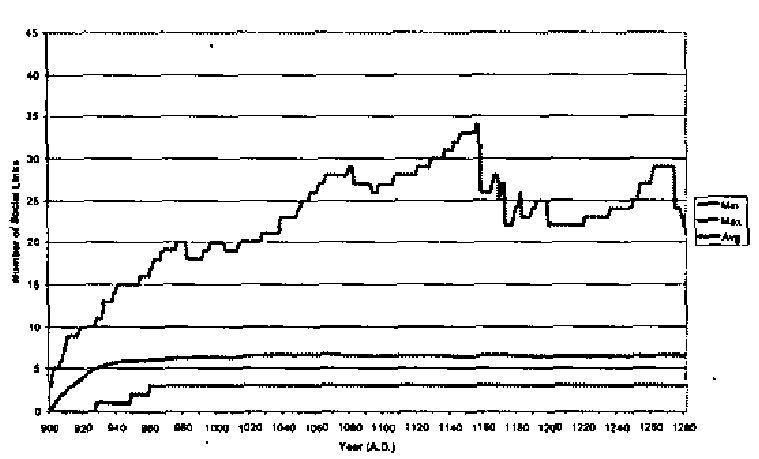 The charts above demonstrate that while the total network volume (complexity) increases with learning, it also becomes more volatile during environmental stress.
The Hub Node Paradox
The study identifies an Inductive Bias in social evolution: learning leads to centralization. As agents identify the "best" donors, those donors become hub nodes.
- The Benefit: A much more resilient system that "bounces back" quickly from localized food shortages.
- The Risk: Increased dependence. If a hub node—a central pillar of the community—moves or fails, the entire local network may collapse or be forced to migrate.
Critical Analysis & Conclusion
This research brilliantly bridges the gap between computer science and anthropology. It demonstrates that Culture is a survival technology. By formalizing "generalized reciprocity" through Cultural Algorithms, the authors provide a template for understanding how social structures mitigate environmental risk.
Takeaway for Future Research: The "Move Radius" experiment (Figure 13) showed that when agents are forced to spread out, social complexity plummets. This suggests that "Central Places" are not just geographical markers but are essential for the high-bandwidth cooperation required to sustain large populations. Future work should investigate if modern digital networks exhibit the same "hub-dependence" fragilities when faced with global stressors.
Final Verdict
Academic Contribution: SOTA in Agent-Based Modeling for Social Archaeology. Key Innovation: Linking Genetic Algorithms at the individual level to a shared Belief Space that constrains and guides mutation.