
Klout Score: Engineering a Global Metric for Social Influence
Klout score: Measuring influence across multiple social networks
The paper presents the Klout Score, a large-scale hierarchical framework for measuring user influence across 9 social networks (750 million users). It processes 45 billion daily interactions and signals from Wikipedia to generate a normalized influence score (0-100) using 3,600+ features and supervised learning.
TL;DR
Klout represents one of the most ambitious engineering feats in social data science: a production system quantifying the "influence" of 750 million users by processing 45 billion interactions daily. By moving beyond simple follower counts to a multi-dimensional, hierarchical framework, it identifies people who don't just have an "audience," but who actually drive reaction and action across the digital landscape.
Background: The Scalability Trap
In the early 2010s, social media influence was often conflated with vanity metrics like follower counts. Academic models such as PageRank were effective for static links, but social networks are dynamic, noisy, and fragmented. Most research-grade models failed when applied to 750 million users because they required loading the entire interaction graph into memory.
The authors from Lithium Technologies (Klout) propose a solution that is both computationally linear and theoretically robust, shifting the focus from "who you know" to "how others react to you."
Methodology: The Hierarchical Approach
The Klout Score's secret sauce lies in its Hierarchical Architecture. Influence is not calculated as a single flat number; it is built bottom-up:
- Feature Generation (The "Tuple" Approach): For every interaction, the system records five dimensions: Who reacted, When, on which Network, to What content, and How (Like, Share, etc.). This results in over 3,600 features.
- Network-Level Scoring: Supervised models (NNLS) are trained on ground-truth data (1 million human-labeled pairings) to weigh these features for each network (Facebook, Twitter, LinkedIn, etc.).
- Cross-Network Aggregation: These individual scores are then combined using an L2-norm (Euclidean) approach at the root level to generate the final 0–100 Klout Score.
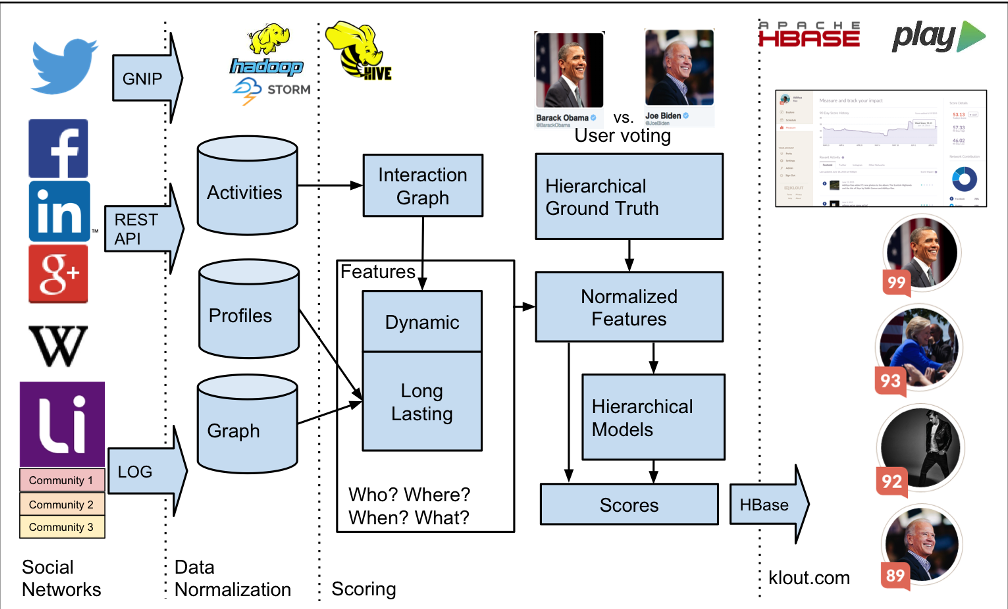 Figure 1: The batch processing pipeline utilizes Hadoop and Hive to process 18.46TB of data daily.
Deep Dive: Why Reactions Matter More Than Reach
The paper defines influence as the "ability to induce reactions." A user who prompts 100 reactions from 10 highly influential peers may be ranked higher than someone prompting 100 reactions from 100 low-influence bots. This "Who" dimension ensures the score is resistant to "sybil attacks" (fake followers).
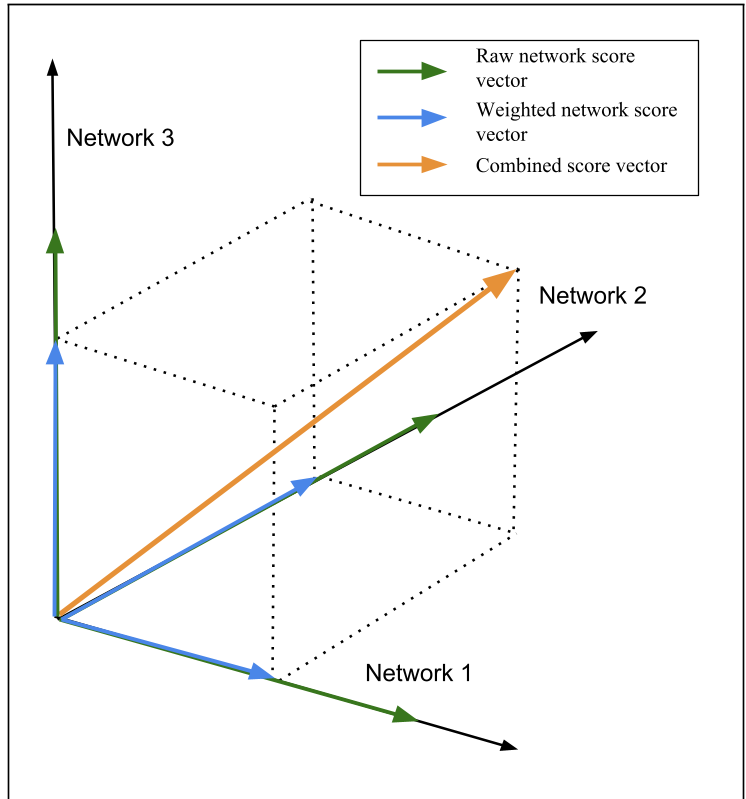 Figure 2: The hierarchical structure allows the system to add new networks (like Instagram or Wikipedia) without rebuilding the entire model.
Experiments & Results: Validating "Real" Influence
To prove the score wasn't just a random number, the researchers conducted a "Perk" experiment. They gave rewards to users across the score spectrum and measured how much "buzz" they generated.
- Information Spread: There is a clear monotonic relationship between Klout Score and the volume of reactions. A user with a score of 80 generates significantly more engagement than a user with 60.
- Benchmarking: When compared to official lists like ATP Tennis Rankings or Forbes' Most Powerful Women, Klout achieved an nDCG (normalized Discounted Cumulative Gain) of 0.87, proving it aligns with real-world recognition.
- Temporal Sensitivity: Unlike static rankings, Klout tracks with Google Trends. When a brand like Airbnb spikes in search interest, its Klout score follows suit, capturing the "pulse" of the internet.
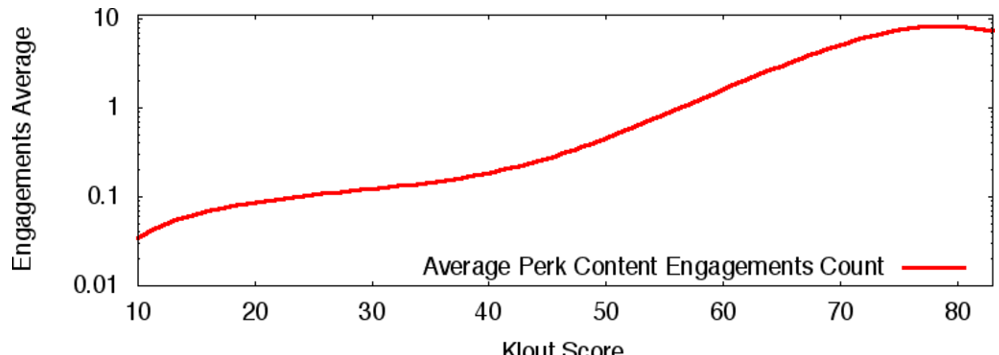 Figure 3: Experimental data showing that higher Klout scores directly translate to higher information spread.
Critical Insight: The Power Law of Digital Influence
The score is log-normalized. This is a critical design choice. On a scale of 0-100, moving from 70 to 80 is exponentially harder than moving from 10 to 20. This reflects the reality of social networks, where influence follows a power-law distribution—a few "super-connectors" dominate the discourse.
Conclusion & Limitations
Klout successfully transitioned from a social media curiosity to a robust technical framework. However, the authors admit it is a "partial representation." It struggles with offline influence that doesn't leave a digital footprint (though Wikipedia PageRank is a clever proxy).
For the modern AI practitioner, Klout’s legacy isn't the 0-100 number, but the Engineering Pattern: how to combine heterogeneous, high-velocity data streams into a single, interpretable metric at a global scale.