
KTN: Bridging the Gap Between Raw Audio and Social Semantics in Music Discovery
Know Thy Neighbor: Combining audio features and social tags for effective music similarity
This paper introduces Know-Thy-Neighbor (KTN), a novel method for music similarity measurement that overcomes the "cold-start" problem by bridging audio features and social tags. It leverages common neighbors in the audio space to bridge the gap toward high-quality tag-based semantic spaces for songs lacking metadata.
TL;DR
Calculating music similarity is hard because "sound" doesn't always equal "meaning." While human-generated social tags (like "chill," "90s rock") are accurate, new songs suffer from a cold-start problem with zero tags. This paper introduces Know-Thy-Neighbor (KTN), a method that uses audio signals to find "popular" neighbors that do have tags, then uses those tags to find the best musical matches.
The Problem: The "Glass Ceiling" of Audio Analysis
In the world of Music Information Retrieval (MIR), we've hit a wall. Traditional methods rely on MFCCs (Mel Frequency Cepstrum Coefficients)—essentially the "DNA" of the sound wave. However, research suggests there is a "glass ceiling" for audio-only methods; they can tell if two songs have similar textures, but they can't understand the cultural or emotional context that humans provide via social tags.
The dilemma?
- Social Tags are highly accurate but suffer from the Cold-Start Problem (no tags for new/obscure music).
- Audio Features are always available but are semantically shallow.
Methodology: The "Know-Thy-Neighbor" Logic
The authors propose that even if a song has no tags, its audio neighbors probably do. The KTN algorithm works in three distinct phases:
1. Weight Learning (The Hubness Factor)
Before processing queries, the system analyzes a training set . It identifies which tracks are "Hubs"—songs that frequently appear as neighbors to many other songs in both audio and tag spaces. These hubs are assigned higher weights because they are "representative" of certain musical clusters.
2. The Audio Proxy Search
When a user queries a new track (no tags):
- KTN looks at the Audio Feature Space first.
- It identifies neighbors.
- Among these, it selects the single neighbor with the highest weight (the most "hub-like" song).
3. The Semantic Transfer
Using that high-weight neighbor as a bridge, the system jumps into the Tag Feature Space (processed via Latent Semantic Analysis). It returns the nearest neighbors of that proxy song as the final result.
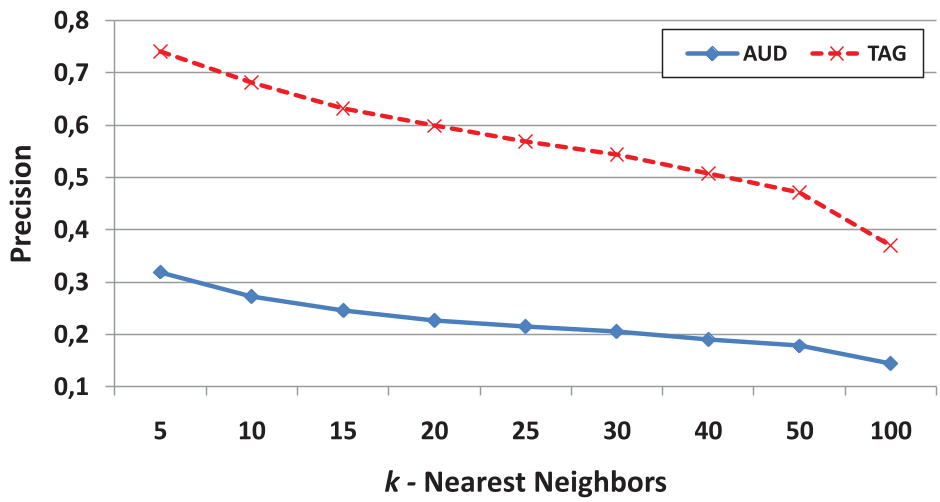 Fig 1: Proving that Tag-based similarity (top line) is fundamentally superior to Audio-based similarity (bottom line), justifying the need to reach the Tag space.
Experimental Results
The researchers tested KTN against a "forced" audio-only approach (AUD). Using genre consistency as a metric for precision, the results were clear:
- KTN > AUD: Bridging to the tag space, even indirectly, produces more accurate results than staying in the audio space.
- The Power of Weights: When (choosing the best of 3 neighbors), the performance was better than , proving that selecting a "hub" track as a proxy is more effective than just picking the single closest audio match.
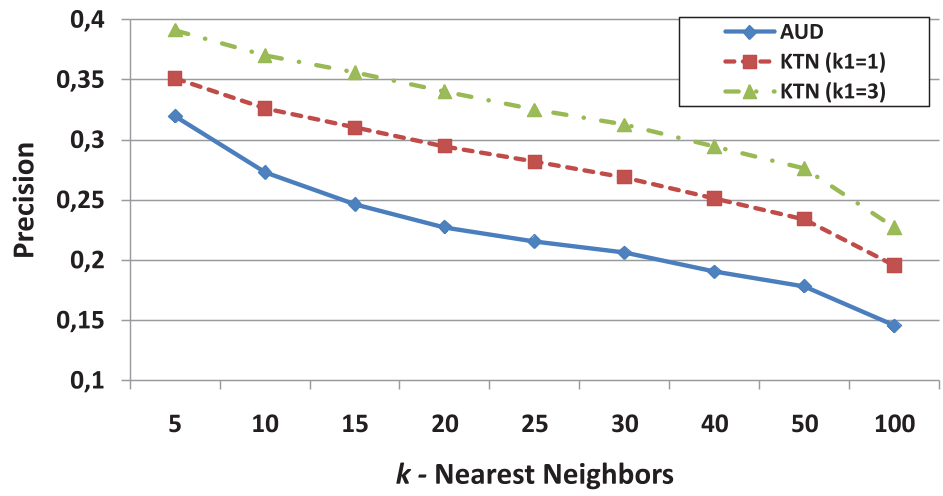 Fig 2: KTN consistently outperforms the standard Audio-based similarity approach (AUD) across different k-NN values.
Critical Insight: Why Hubness Matters
The most profound takeaway here is the use of Hubness. In high-dimensional spaces, certain points naturally become "popular" neighbors. While often seen as a problem in machine learning, KTN turns hubness into a feature. By picking a "hub" track as a proxy, the algorithm ensures that the jump from Audio to Tags is made through a statistically reliable and well-defined point in the data manifold.
Conclusion & Future Work
KTN provides a clever, mathematically grounded way to bypass the cold-start problem without waiting for humans to manually tag every new song on the internet. While the study focused on MFCCs and social tags, the framework is extensible. Future iterations could integrate data from music blogs, shared playlists, or even lyrics to further shatter the "glass ceiling" of music discovery.
Key Limitation: The method relies on the existence of a well-behaved training set with rich tags. If the query song is truly unique (a new genre), finding a "neighboring hub" in the audio space might still lead to a semantic mismatch.