
PhacePhinder: De-Anonymizing the Real World via Social Graph Fusion
Knowing Who You Are and Who You Know: Harnessing Social Networks to Identify People via Mobile Devices
PhacePhinder is a mobile-server framework that constructs a face recognition database by harvesting images and tags from social networks like Facebook. It synergizes Hidden Markov Models (HMM) for identification with a Fusion Probabilistic Latent Semantic Analysis (fusion PLSA) to establish social relevance between the mobile user and the identified person.
TL;DR
PhacePhinder is an end-to-end system that bridges the gap between mobile photography and social network intelligence. By harvesting tagged images from Facebook, it builds a cloud-based facial recognition engine that not only identifies a person in your camera viewfinder but also calculates the "social distance" between you—telling you exactly how you are connected through mutual friends or shared events.
Background Positioning
In the landscape of computer vision, this work sits at the intersection of Biometrics and Social Computing. While most facial recognition research focuses on accuracy in controlled environments, PhacePhinder treats identity as a node in a social graph, leveraging the Probabilistic Latent Semantic Analysis (PLSA) framework to transform raw pixels into social context.
1. The Core Challenge: Recognition "In the Wild"
Identifying faces from mobile photos is notoriously difficult due to "unconstrained" variables: varying poses, harsh lighting, and low-resolution sensors. Most existing systems suffer from:
- Search Space Explosion: Comparing a face against millions of users is computationally expensive and prone to false positives.
- Lack of Context: Knowing a name is one thing; knowing why that person is relevant to you is another.
The authors realized that social networks provide the "ground truth" labels (tags) and the relational topology (friendships) needed to solve both problems.
2. Methodology: Fusing Content and Connectivity
The technical heart of PhacePhinder is the Fusion PLSA model. Instead of just looking at who is friends with whom, it analyzes co-occurrence: if two people appear in the same photo, there is an 80% likelihood they share a social bond.
The Math of Connection
The model introduces a latent variable that links users to friends and photos . The conditional probability is defined as:
By adjusting a weight parameter , the system can prioritize explicit friendships or implicit photo co-occurrences. This allows the system to recommend "hidden" friends or calculate the most "meaningful" social path between two users.
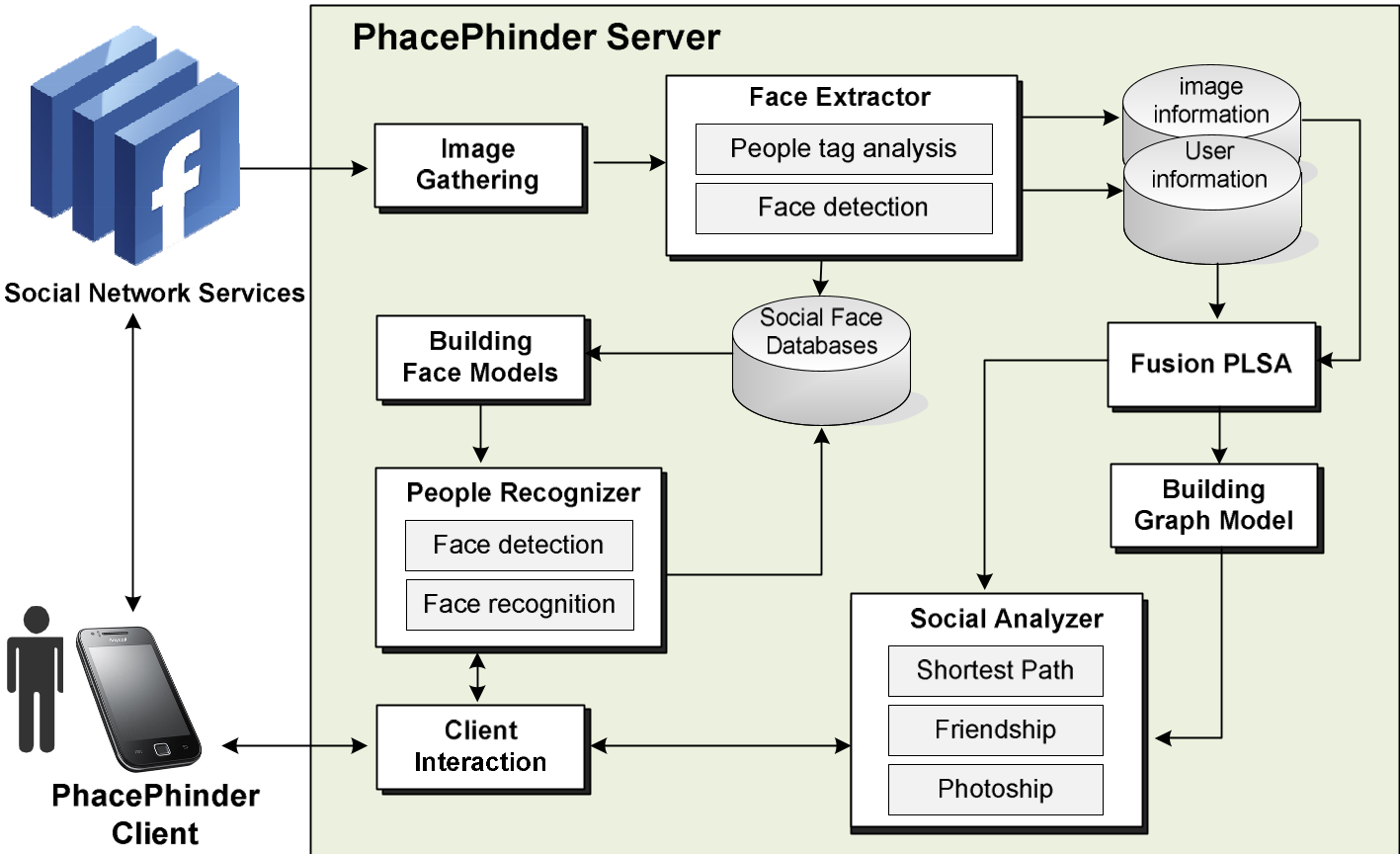 Figure 1: High-level architecture showing the flow from mobile client to the social graph constructor.
3. Implementation and Performance
The authors built a prototype on Android, using OpenCV for face detection and Hidden Markov Models (HMM) for the recognition backend.
Key Performance Metrics:
- Identification Accuracy: Achieving a 64% Top-3 hit rate.
- Contextual Pruning: By simply allowing the user to specify gender (a public attribute for ~97% of Facebook users), the system effectively halved the search space, significantly reducing the "confusion" of the HMM.
- Social Recommendation: The Fusion PLSA significantly outperformed traditional algorithms like PageRank and Katz in ranking relevance, especially for active users with over 30 uploaded images.
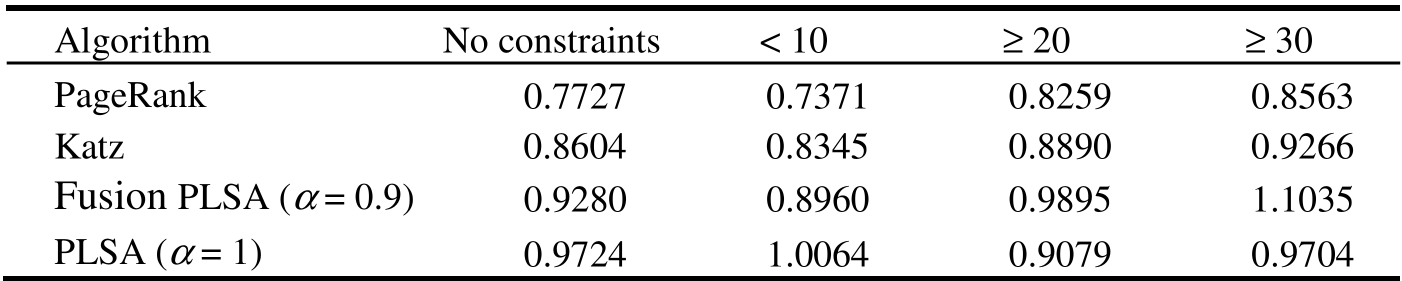 Table 3: Fusion PLSA demonstrating superior Mean Reciprocal Rank (MRR) as image data density increases.
4. Deep Insight: Why This Matters
The brilliance of PhacePhinder isn't just in the recognition—it's in the weighted social graph. By using as the edge weight in Dijkstra’s algorithm, the system finds the "shortest social path."
In user studies, subjects often preferred the PLSA-weighted path over a standard unweighted path. This proves that not all friends are equal; the frequency of appearing in photos together is a high-fidelity proxy for real-world intimacy.
5. Critical Analysis & Future Outlook
Limitations
- Recognition Bottleneck: The reliance on HMM is a byproduct of its era; modern Deep Metric Learning (ArcFace/FaceNet) would likely push the 48% accuracy much higher.
- Privacy Concerns: The paper explicitly mentions "eliminating personal anonymity." In today’s regulatory climate (GDPR/CCPA), the centralized harvesting of friend photos would face significant legal hurdles.
Future Prospect
The authors envision this technology migrating to Head-Mounted Displays (HMDs). Imagine walking into a conference and having a "HUD" that identifies the person approaching you and whispers, "This is John; he's a colleague of your friend Sarah." PhacePhinder provides the probabilistic foundation for that augmented social reality.
Final Takeaway: PhacePhinder proves that identity is not just a visual feature—it is a social one. By fusing CV with graph theory, we can move from "what" we see to "who" we know.