
Beyond Black Boxes: Why Knowledge Acquisition Still Outshines ML in Legal Analytics
Knowledge Acquisition for Categorization of Legal Case Reports
The paper presents a Knowledge Acquisition (KA) framework for categorizing legal case reports and generating catchphrases using the Ripple Down Rule (RDR) philosophy. By leveraging a small set of rule-based features including citation networks and term frequencies, the authors built a system that outperforms traditional Machine Learning (ML) models like SVM and Naive Bayes in the specialized legal domain.
TL;DR
In the high-stakes world of legal research, "catchphrases" are essential summaries used by professionals to navigate massive case law databases. This paper demonstrates that a human-in-the-loop Knowledge Acquisition (KA) framework, taking just two hours to build, can outperform complex Machine Learning models in categorizing legal reports by leveraging the inherent logic of legal citations and term importance.
The Bottleneck of Legal AI
The legal domain suffers from extreme "information overload." For lawyers, finding the right precedent is like finding a needle in a haystack. While Machine Learning (ML) is typically the go-to solution for text categorization, it faces a brick wall in law:
- Modeling Complexity: Legal concepts are not just about "keywords"; they are about how those words interact with specific statutes and previous rulings.
- Generalization Gap: ML models (like SVMs) often "overfit" to specific word patterns in training data but fail miserably when applied to new cases from a different year or court.
The Core Insight: Humans Know Where to Look
The authors propose that instead of letting a model guess weights, we should allow human experts to define rules using a structured set of features. They identified that legal cases are not islands—they exist in a citation network.
The Methodology
The framework utilizes two types of attributes:
- Document-Level (Citation Logic): Does this case cite other "Migration" cases? If 40% of the cited cases share a label, that's a massive signal.
- Term-Level (Contextual Frequency): Not just how often a word appears (TF), but how often it appears in the citations made by other judges.
 The system uses a binomial test to calculate the probability that a rule's success is not just a random fluke.
The "Incremental" Advantage
Taking inspiration from Ripple Down Rules (RDR), the system allows for error-driven refinement. If the system misclassifies a case, the user simply adds a "patch" or a new rule. This avoids the "catastrophic forgetting" or the need for total retraining common in ML models.
Experiments: Rules vs. Machines
The authors compared their Knowledge Base (KB) against Naive Bayes and SVM models. The results were telling:
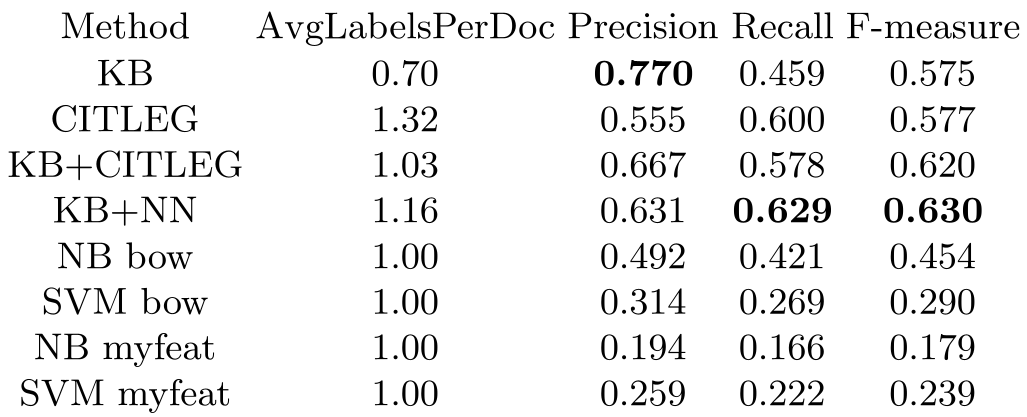 Table: Results on the unseen 2006 Test Set.
- Precision: The KB achieved 77% precision, far surpassing the bag-of-words ML models.
- Robustness: While SVM performance collapsed on the test set (dropping significantly in F-measure), the rule-based system remained stable.
- The Synergy: By using a Nearest Neighbor (NN) fallback (KB+NN), the system could handle cases that the manual rules hadn't reached yet, achieving the best overall balance of precision and recall.
Deep Insight: Expert Domains Require Expert Features
Why did ML struggle? The paper suggests that even with millions of words, modern learners fail to capture the interaction between features like "how many times a term appears in citing sentences" versus "its frequency in the current text."
In legal tech, a "feature" isn't just a token; it's a specific citation to the Migration Regulations 1994 (Cth). A human can see that connection in seconds; a machine needs thousands of examples to "maybe" guess it.
Conclusion & Future Outlook
The study concludes that for specialized domains, we shouldn't abandon "Knowledge Engineering." Instead, we should build tools that make it efficient. The authors are currently extending this to "Lower-Level Catchphrases"—extracting specific sentences that represent the core legal issue.
As we move into the era of LLMs, this research reminds us that structured citation data and human-defined logic remain the bedrock of reliable, high-precision vertical AI applications.
Note: This blog post is based on "Knowledge Acquisition for Categorization of Legal Case Reports" by Galgani, Compton, and Hoffmann.