
MMDRBN: Bridging the Semantic Gap in Video Emotion Tagging with Film Grammar
Knowledge-Augmented Multimodal Deep Regression Bayesian Networks for Emotion Video Tagging
This paper introduces the Multimodal Deep Regression Bayesian Network (MMDRBN) and its knowledge-augmented version for emotion video tagging. By stacking Regression Bayesian Networks (RBNs) and incorporating film grammar attributes, the model achieves SOTA performance on the LIRIS-ACCEDE database for both emotion recognition and regression tasks.
TL;DR
Researchers have developed a Knowledge-Augmented Multimodal Deep Regression Bayesian Network (MMDRBN) that goes beyond simple black-box deep learning. By combining the representative power of directed graphical models with the "art" of cinematography—Film Grammar—this model sets a new standard for predicting emotional responses to video content.
Background: Why Content-Based Emotion Tagging is Hard
Predicting the "expected emotion" of a video is notoriously difficult. A sunset might be peaceful in a romance movie but omen-filled in a thriller. Current SOTA methods often fail because:
- Shallow Fusion: Simply concatenating audio and visual features (Early Fusion) ignores the complex interplay between sound and sight.
- Independence Assumptions: Models like Deep Boltzmann Machines (DBM) assume hidden variables are independent, which is a poor fit for the highly correlated nature of multimedia data.
- Semantic Gap: Low-level features (pixels, frequencies) lack the "meaning" that human filmmakers use to evoke emotion.
The Proposed Solution: Directed Logic + Expert Knowledge
The authors propose two major innovations: the RBN architecture and Knowledge Augmentation.
1. Regression Bayesian Networks (RBN)
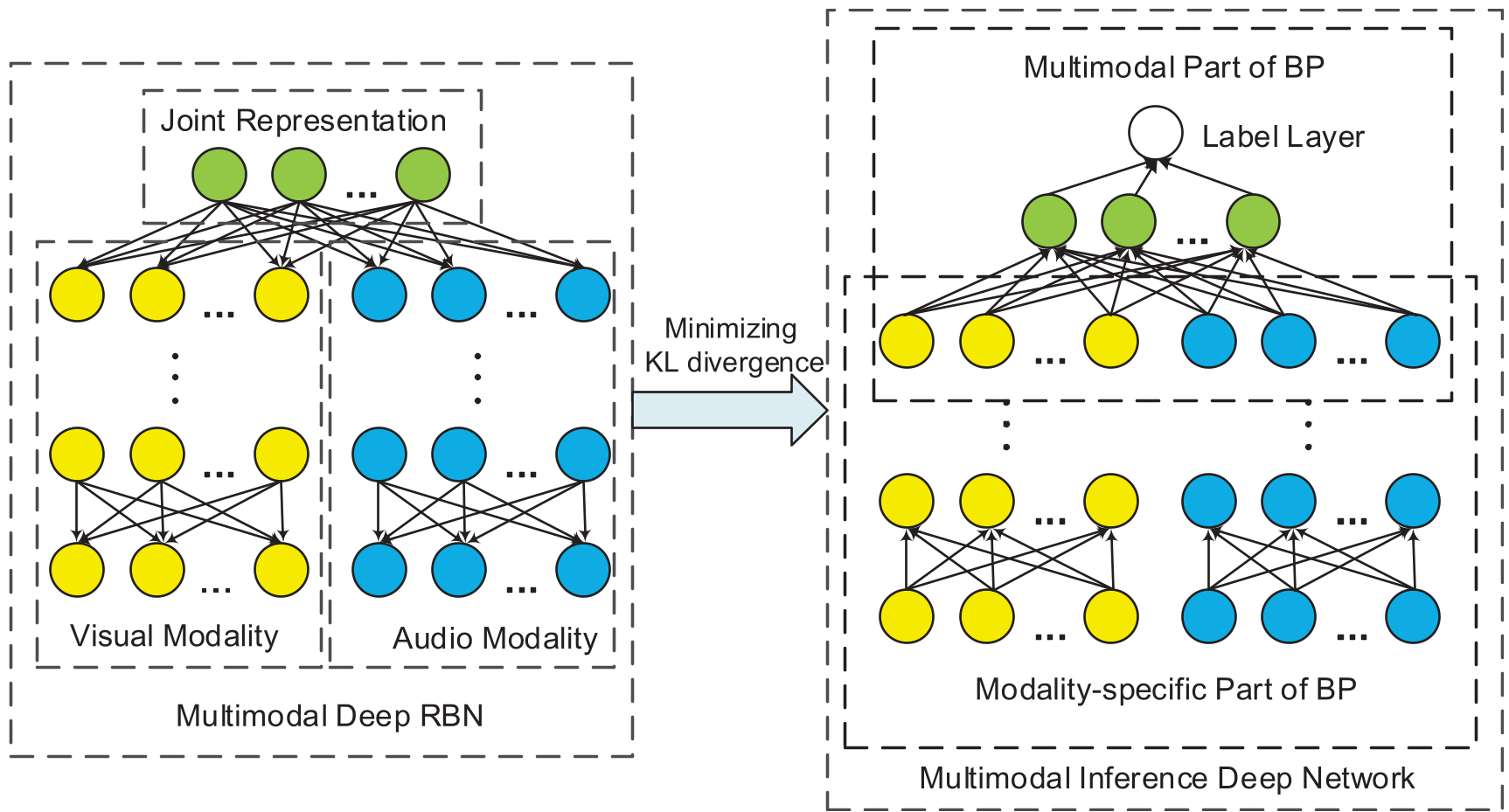
Unlike the Restricted Boltzmann Machine (RBM) which is undirected, the RBN uses completely directed links from the latent layer to the visible layer.
- Physical Intuition: In an RBN, latent variables must "compete" or "cooperate" to explain the visible data (the explaining-away effect). This allow the model to capture dependencies between hidden nodes, making it much more expressive than standard undirected models.
2. Infusing Film Grammar
The authors summarized decades of cinematography research to create a "Domain Knowledge Layer." They defined attributes such as:
- Visual Attributes: Lighting Key (High/Low key), Color Energy (Warm/Cool), and Tempo (Shot duration).
- Audio Attributes: Fundamental frequency (F0), Formant precision, and Spectral parameters.
By forcing the network to learn a joint representation that aligns with these semantically meaningful attributes, the model creates a "hybrid" feature space that is far more discriminative than raw data alone.
Experimental Performance
The model was rigorously tested on the LIRIS-ACCEDE database. The results show a clear hierarchy of performance:
- Raw Data < Multimodal Fusion (No Knowledge) < Multimodal Fusion (With Knowledge)
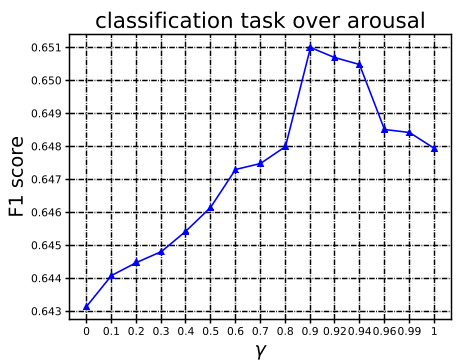 Figure: The t-SNE plot (c) clearly shows better class separation when domain knowledge is integrated, compared to pure data-driven features (b) or raw features (a).
Key Quantitative Results (MediaEval 2016):
| Method | Valence (PCC) | Arousal (PCC) |
|---|---|---|
| KCCA (Baseline) | 0.211 | 0.245 |
| MMDBM (Deep Undirected) | 0.186 | 0.202 |
| MMDRBN (Our - No Knowledge) | 0.387 | 0.416 |
| Knowledge-Augmented MMDRBN | 0.450 | 0.470 |
The jump from 0.186 to 0.450 in Valence correlation is a massive leap, proving that the RBN structure captures multimodal dependencies that traditional DBMs simply miss.
Deep Insight: Is the Model Overfitting to Rules?
One might ask: is the model just a rule-based system? The authors address this through an ablation study ( tradeoff). They found that while domain knowledge helps significantly, the data-driven deep network still provides the heavy lifting. The knowledge layer acts as a "regularizer" or a "guide," ensuring the latent features capture the nuances of professional filmmaking.
Conclusion and Future Outlook
This work demonstrates that the future of affective computing isn't just "more data" or "deeper layers"—it's about better inductive biases. By using directed graphical models to mimic causal explanations and film grammar to provide semantic grounding, the authors have built a bridge across the "semantic gap."
Limitations: The model relies on "Film Grammar" used by professionals. It may struggle with User-Generated Content (UGC) (e.g., raw TikTok clips), where creators often ignore traditional cinematography rules. Defining a "Grammar for the Masses" remains the next great challenge.
Final Takeaway: For technical leads in AI Video: Don't ignore the domain experts. Cinematography rules are not just "art"—they are the training labels we've been using for a hundred years of human visual history.