
The Power of Multi-Network Sharing: Redefining Viral Marketing in the Modern OSN Era
KNOWLEDGE‐BASED SYSTEMS
The paper introduces a novel information diffusion model and a Diversity-Constrained Influence Maximization (DCIM) framework designed for modern viral marketing. It focuses on cross-network sharing behaviors (e.g., sharing a YouTube link via Twitter) and proposes the Enhanced Greedy with Diversity Enforced at End (EGDEE) algorithm to optimize marketing reach across multiple online social networks (OSNs).
TL;DR
In the age of digital interconnectivity, being "influential" isn't just about how many followers you have on Facebook; it’s about how many of those followers will take your post and broadcast it to their Twitter, LinkedIn, or YouTube circles. This paper breaks away from 1970s sociology-based diffusion models to introduce a Diversity-Constrained Influence Maximization (DCIM) framework. It proves that by targeting users with diverse cross-platform footprints, marketers can achieve up to 10x the reach compared to traditional "most-followed" strategies.
Context: Why Traditional Models are Broken
For decades, academic and industrial viral marketing relied on two pillars: the Independent Cascade (IC) and Linear Threshold (LT) models. These models ask: "Can user A convince user B to buy a product?"
However, the authors argue this is a fundamental misunderstanding of modern Online Social Networks (OSNs). Modern influence is about Reach and Diversity.
- Physical vs. Digital: In the real world, connections are symmetric. In OSNs, they are directional (follow vs. followed).
- The Sharing Economy: Content doesn't just stay in one "silo." A viral video on YouTube spreads because users share the link in their private WhatsApp groups or Twitter feeds.
- Probability Estimation: Traditional models require knowing the "influence probability" between every pair of users—a feat practically impossible to achieve with privacy laws.
Methodology: Capturing the "Share"
The core of this work is a new mathematical definition of Marketing Reach (). Instead of a binary "active/inactive" state, they define potential influence based on:
- : The size of a user's other social networks (UON).
- : The probability a follower actually reads the content.
- : The probability a follower shares that content to their own UON.
The Architecture of Influence
The researchers move away from a global graph approach to a Follower-Based Model. To simplify the complex interactions when multiple parents influence one child, they link each child to their most influential parent ().
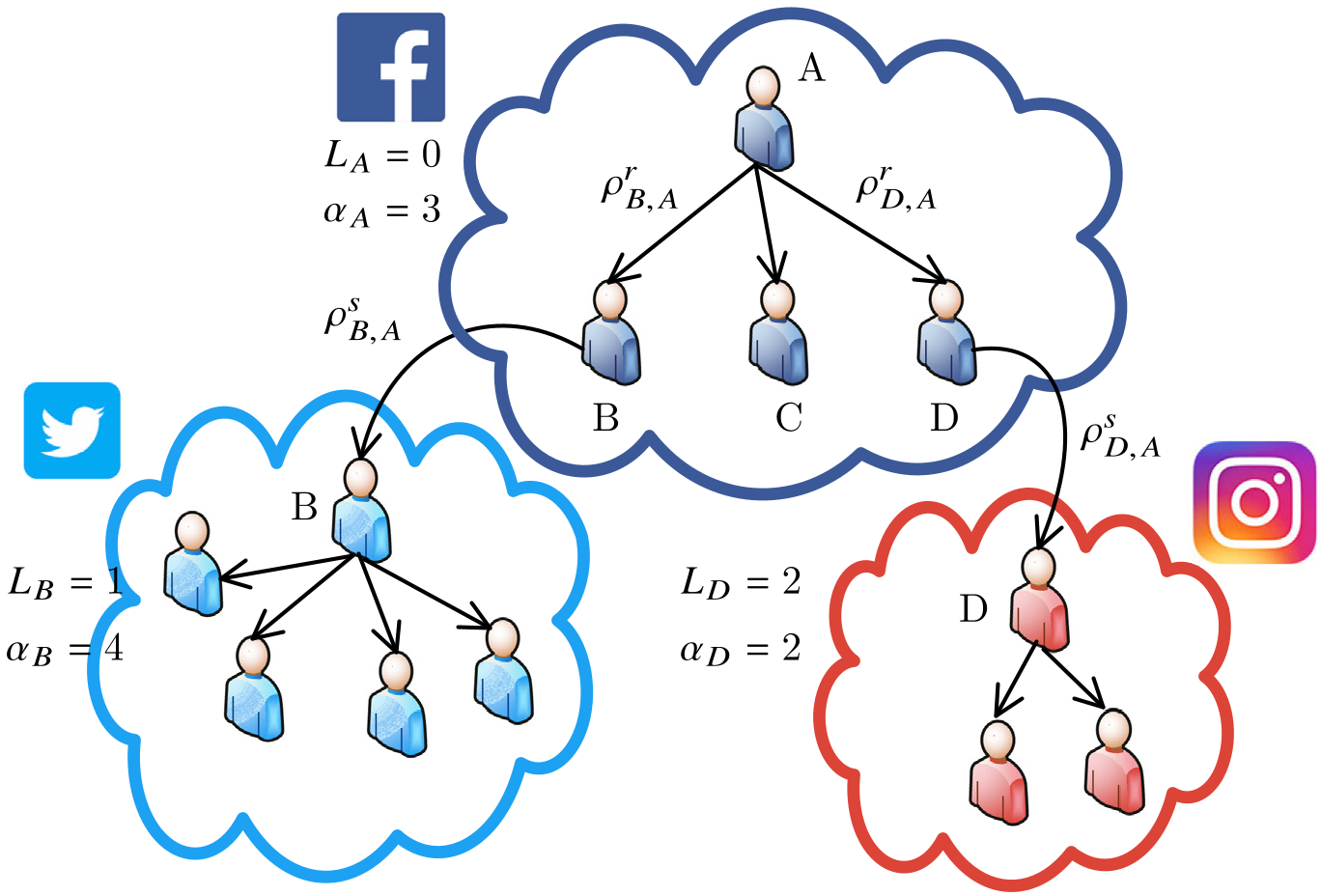 Figure: The interplay between a targeted network (TOSN) and secondary networks (UON).
To solve the optimization, they propose EGDEE (Enhanced Greedy with Diversity Enforced at End). The "Diversity" constraint is crucial: it ensures the ad doesn't just hit 1 million people on Facebook, but spreads across at least different platforms (e.g., Twitter, TikTok, Reddit), preventing "echo-chamber" marketing.
Experiments & Results: Quality Over Quantity
Using a combination of synthetic Barabási–Albert graphs and real-world SNAP datasets (Facebook/Twitter), the authors tested their greedy algorithms.
Performance vs. Baseline
Traditional algorithms like GNF (Greedy Number of Followers) focus on the "whales" of the target network. The results show this is a mistake. As seen in the figures below, the proposed EGDEE algorithm consistently outperforms centrality-based metrics.
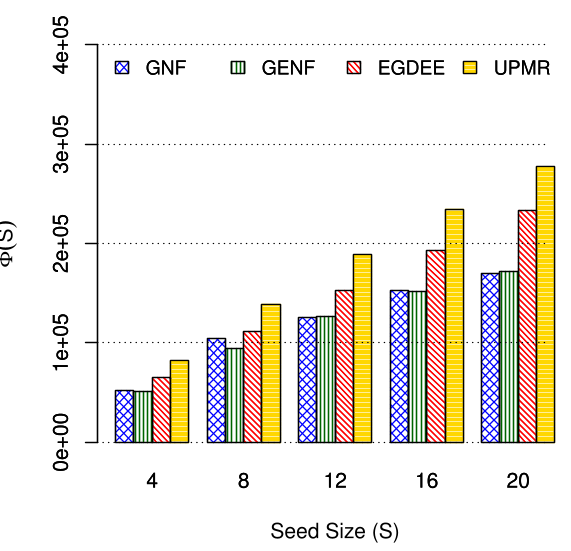 Figure: Marketing Reach comparison across different UON percentage densities. Note the massive gap between EGDEE and traditional metrics.
The "Diversity" Trade-off
One of the paper's most interesting findings is the "Diversity Tax." When a marketer forces the algorithm to spread across many different types of networks (Diversity Factor), there is a slight drop in total reach. However, this ensures the message penetrates multiple demographics, which is often more valuable for brand awareness.
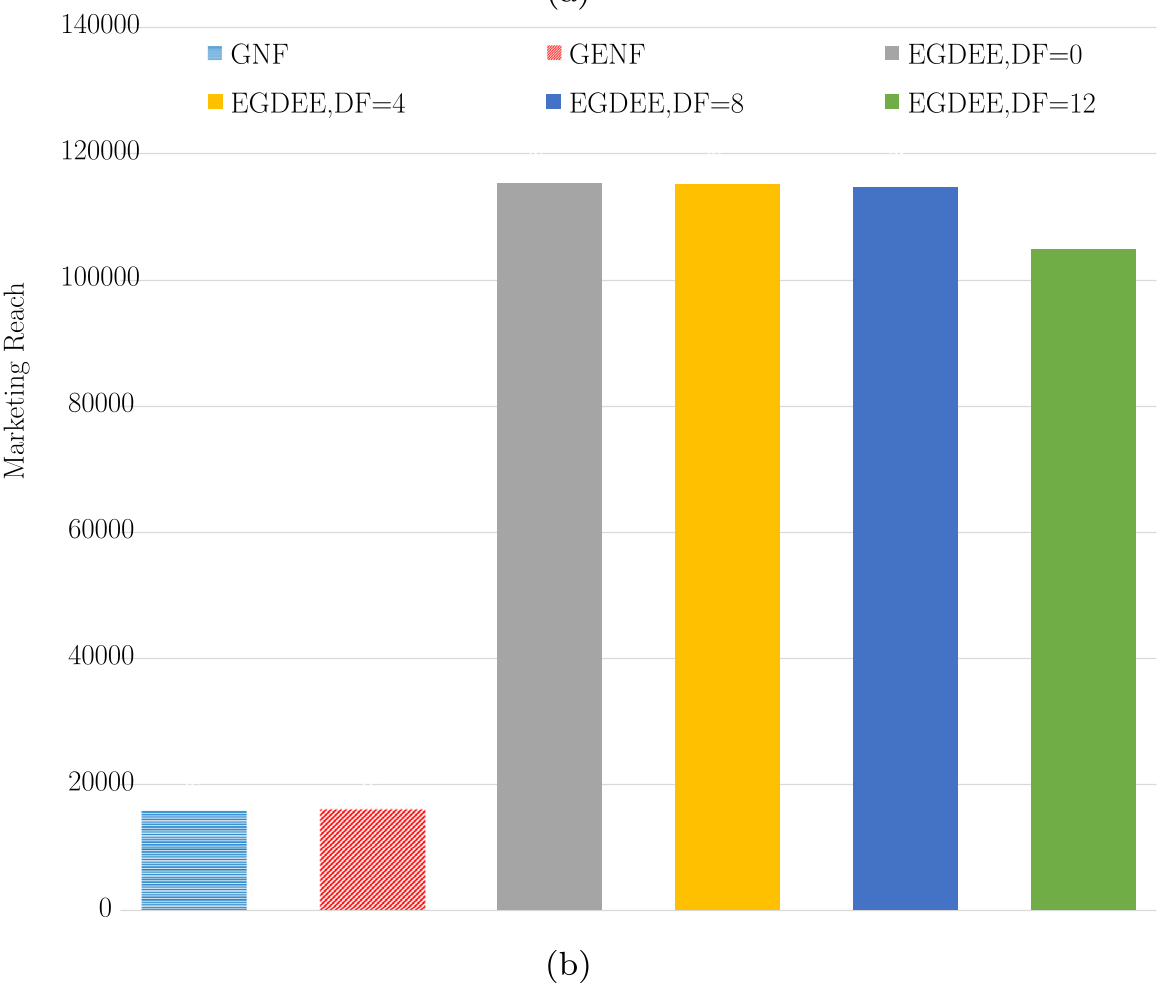 Figure: How increasing diversity shifts the concentration of reach across different platform types.
Critical Insight: Efficiency Matters
The most impressive part of the EGDEE algorithm isn't just its reach, but its speed. By pre-computing a Profit Matrix (), the actual seed selection for 12 users takes only 11ms, compared to 2510ms for traditional set-union methods. In a production environment where networks change in real-time, this near-instant optimization is a game-changer.
Conclusion & Future Outlook
This paper shifts the viral marketing paradigm from "finding the person with the most friends" to "finding the person with the most useful bridges."
Takeaways:
- Cross-Platform is King: An influencer's value is multiplicative, not additive, across their social accounts.
- Optimization Speed: With proper formula approximation (like the profit matrix), we can solve NP-hard influence problems in milliseconds.
- Future Work: The authors suggest the next step is Sentiment-Responsive Seed Sets—changing your marketing influencers in real-time if the network starts reacting negatively to a campaign.