
Beyond Connectivity: A Hybrid Approach to Trust Inference in Social Networks
KNOWLEDGE‐BASED SYSTEMS
This paper presents a cost-effective trust inference framework for social networks that predicts the trust rate between two non-adjacent individuals. It introduces a restricted traversal algorithm that identifies "Strong Trust Paths" by integrating weighted interest topic similarity with a novel topology-based trust propagation metric.
TL;DR
Trust is the invisible currency of social interaction. This paper proposes a cost-effective algorithm that predicts trust rates between strangers by combining weighted interest topics (semantic) and trust propagation ability (topology). By restricting path searches using "Small World" logic, the authors achieve SOTA accuracy with 32x faster performance than exhaustive methods.
Problem & Motivation: The "Large Scale" Bottleneck
In the digital wild, we often interact with people we don't know—think of choosing a seller on eBay or a reviewer on Epinions. Trust Inference aims to bridge this gap by scanning paths through mutual connections.
However, traditional methods face a dilemma:
- Exhaustive Methods (RN-Trust) are accurate but computationally "explode" in large networks.
- Breadth-First Heuristics (TidalTrust) often set thresholds too high, pruning away valuable "weak ties" that actually carry significant trust information.
- Semantic Methods (SWTrust) often treat all interest categories equally, failing to realize that "niche" interests are better trust indicators than "common" ones.
Methodology: The Twin Pillars of Trust
The authors suggest that trust isn't just about "who you know" (topology) but "what you care about" (semantics).
1. Weighted Topic Similarity (WTS)
Not all interests are created equal. If two people both like "Food" (a high-frequency topic), it tells us little. If they both like "Antique Watch Restoration" (low frequency), it’s a strong trust signal. The paper uses an exponential decay function to weight topics: This ensures that rare shared interests contribute more to the trust score.
2. Trust Propagation Ability (TPA)
A node's position matters. The authors define TPA based on the intensity of a node’s incoming and outgoing trust relations: Crucially, this can be pre-calculated offline, making real-time inference lightning-fast.
3. Restricted Traversal (The "Small World" Insight)
Guided by the "Six Degrees of Separation" principle, the algorithm limits the search depth () to 6 and the search width () to 9. Any path longer than 6 is considered too "noisy" to be reliable.
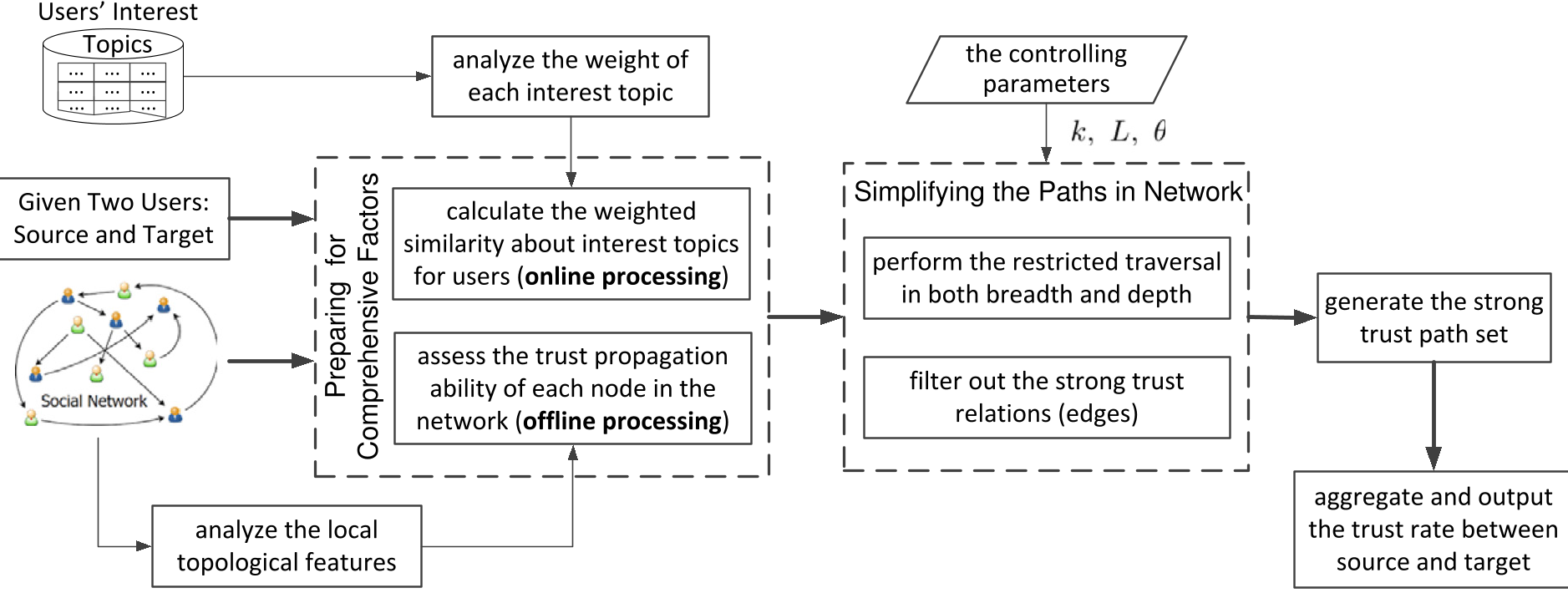 Figure 1: The framework showing offline pre-computation and online restricted traversal.
Algorithms for Neighbor Selection
The paper explores three ways to combine these scores:
- TI-HS (Hybrid Strategy): Uses the geometric mean of WTS and TPA.
- TI-TS-TP (Hierarchical): First filters by Topic Similarity, then validates by Topology. (This was the winner!)
- TI-TP-TS (Hierarchical): Topology first, then Topic Similarity.
Experimental Results & Critical Analysis
Testing on the Epinions dataset, the results were definitive.
- Effectiveness: TI-TS-TP reached an F-score of 91.53%, nearly matching the "Gold Standard" of searching every possible path (AllPaths at 92.55%).
- Efficiency: While AllPaths took 812ms per query, TI-TS-TP finished in just 25ms.
 Table 5: TI-TS-TP vs other SOTA algorithms. Note the massive gap in Online Time.
Sensitivity Analysis: Why ?
The authors validated their "Small World" heuristic by varying . Accuracy plateaus after , confirming that deeper searches only add computational cost without significant gains in trust precision.
Critical Insight & Conclusion
The real breakthrough here isn't just the math—it's the architectural split. By pushing the topology calculations (TPA) and topic weighting to an offline stage, the online inference becomes a lightweight search.
Takeaway for Practitioners: If you are building a recommendation engine or a peer-to-peer marketplace, don't just look at the graph. Weight the edges by topic rarity and use local topology to prune your search. It turns an nightmare into a snappy, production-ready feature.
Limitations: The model assumes interest topics are pre-categorized. In modern apps, these would need to be extracted via NLP/LLMs, which adds its own layer of complexity.