
KG-MDEFR: Bridging the Gap Between Explanability and Performance in Marine Engine Diagnostics
KNOWLEDGE‐BASED SYSTEMS
This paper introduces KG-MDEFR, an adaptive knowledge graph reasoning model designed for marine diesel engine fault diagnosis. It utilizes a layer-wise path generator and Gumbel top-K sampling to construct interpretable causal chains (Fault → Cause → Recommendation), achieving SOTA performance in both transductive and inductive reasoning scenarios.
TL;DR
The KG-MDEFR model revolutionizes marine diesel engine maintenance by converting "black-box" diagnosis into traceable causal paths. By combining adaptive path generation with semantic-aware sampling, it achieves a 0.923 MRR on complex fault graphs and provides maritime engineers with a "Fault → Cause → Action" reasoning chain that is both highly accurate and human-readable.
Background: The Interpretability Crisis in Industry 5.0
In the high-stakes environment of a ship's engine room, knowing that a fault exists is insufficient; engineers need to know why it happened and how to fix it. While deep learning has improved detection accuracy, its lack of transparency remains a barrier to adoption. This paper situates itself as a pivot toward Industry 5.0, where AI acts as an explainable partner to human experts by structuring domain knowledge (manuals, logs, reports) into a Knowledge Graph (KG).
Problem & Motivation: Beyond the Search Space Explosion
Existing KG reasoning methods face a dilemma:
- Embedding-based methods (TransE, RotatE) are fast but lack a "reasoning path"—they provide a result but no evidence.
- Path-based methods provide evidence but often fail in complex graphs due to the exponential growth of possible paths (the "path explosion" problem).
- Standard GNNs often aggregate "noise" from irrelevant neighbors because they lack query-specific guidance.
The authors' intuition was to build a model that creates a dynamic, task-specific subgraph for every query, filtering out noise through semantic understanding before the reasoning even begins.
Methodology: The Core Architecture
KG-MDEFR operates through four tightly coupled modules that transform a query (e.g., "Abnormal Vibration") into a diagnostic path.
1. Adaptive Path Generation
Instead of searching the entire graph, the model uses an incremental strategy. Starting from the query entity, it expands layer by layer ( max), keeping only the most promising "branches" of the causal tree.
2. Semantic-Aware Sampling (The Filter)
This is the model's "brain." Using a Gumbel Top-K sampling strategy, the model assigns relevance scores to candidate entities based on their semantic proximity to the query.
- Why Gumbel? It makes the discrete selection process differentiable, allowing the model to "learn" which paths are useful through backpropagation (using a Straight-Through Estimator).
3. Structural Masking & Edge Attention
To ensure the model doesn't just guess based on names but actually understands the graph structure, it implements an Edge Attention mechanism. It calibrates the weight of a relation (e.g., has_reason) by looking at the triple as a whole ().
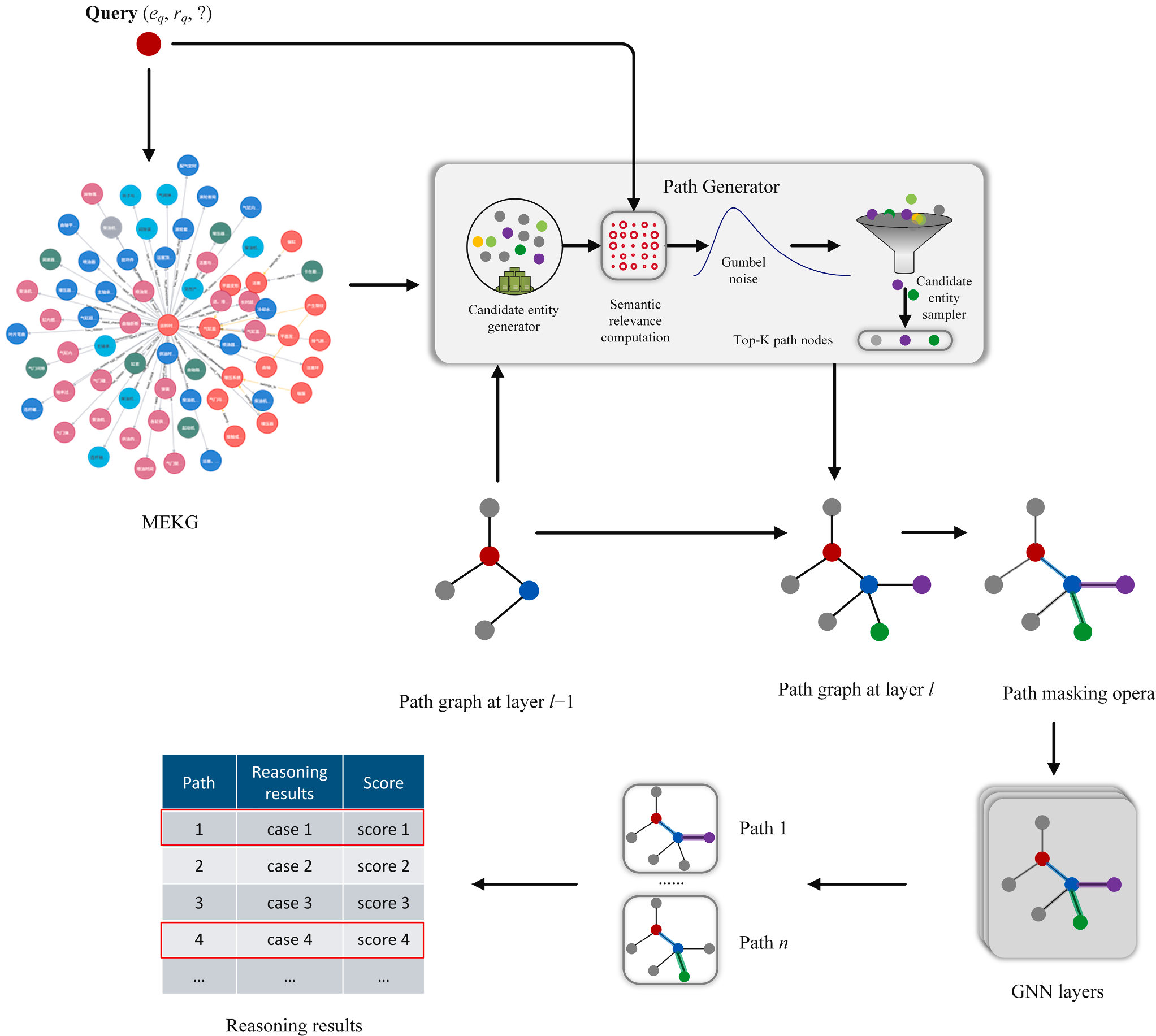 Figure 1: The KG-MDEFR Framework, illustrating the flow from Query Triple to Interpretable Path.
Experiments: SOTA Results and Inductive Strength
The model was tested on the MDEKG, a specialized graph containing over 6,552 triples extracted from marine technical manuals.
Transductive Performance
KG-MDEFR outperformed traditional models like NBFNet and R-GCN across all metrics. For the critical has_reason relation, it achieved a Hit@10 of 0.9692, meaning the correct cause was in the top 10 suggestions nearly 97% of the time.
Inductive Reasoning (The "Unseen" Challenge)
In real-world shipping, new types of equipment or rare faults appear. KG-MDEFR showed exceptional generalization, achieving an MRR of 0.6785 on entities it had never seen during training—significantly higher than GraIL (0.6141).
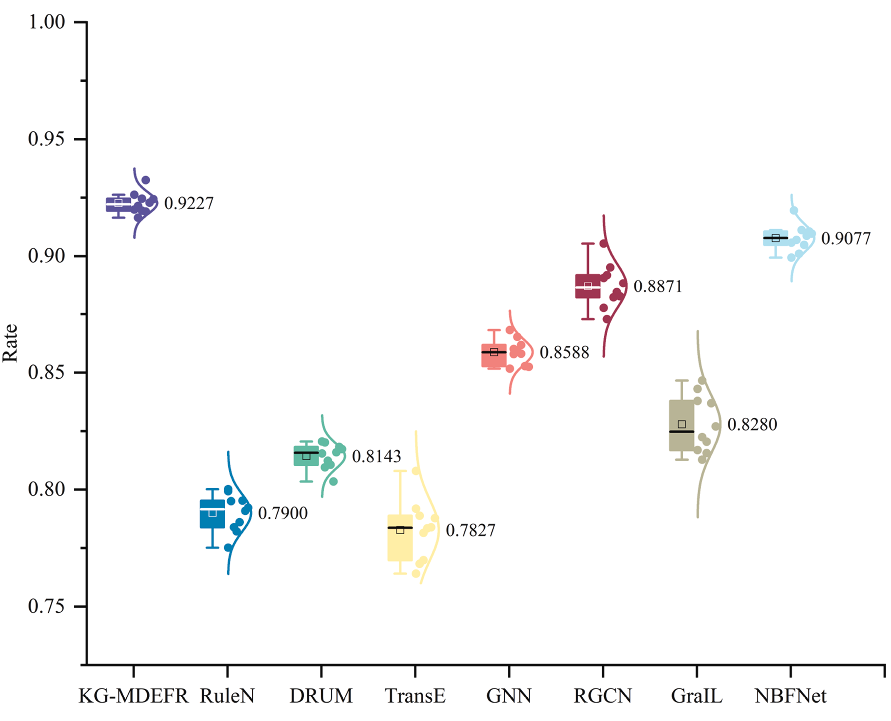 Figure 2: Comparative performance across different metrics, highlighting the superiority of KG-MDEFR.
Deep Insight: Why it Works
The "secret sauce" revealed in the ablation studies is the Joint Optimization of the sampler and the reasoner. By forcing the path-selection mechanism to satisfy the final diagnostic goal, the model learns a "semantic preference."
For a query like "Power Drop," the model automatically learns to give high sampling weights to "Injection Delay" and "Fuel Shortage" while ignoring irrelevant nodes like "Coolant Temperature." This mimics the intuition of a senior marine engineer.
Critical Analysis & Conclusion
Takeaway: KG-MDEFR is a practical, deployable solution (35ms latency) that provides what industrial operators crave: traceable evidence.
Limitations:
- Data Quality: The model is only as good as the Knowledge Graph. If the technical manuals are incomplete, the reasoning will be too.
- Temporal Blindness: The current version treats the graph as static. It doesn't yet account for the sequence of events over time (e.g., how a minor vibration over 10 days leads to a major failure).
Future Work: The authors suggest incorporating Temporal Graph Neural Networks to capture fault evolution, a move that would take this from a diagnostic tool to a truly predictive maintenance engine.