
DCM & CI2: Empowering Nodes with Decision-Making in Competitive Social Networks
KNOWLEDGE‐BASED SYSTEMS
This paper introduces the Decidable Competitive Model (DCM), an extension of the Linear Threshold (LT) model designed for competitive influence maximization (CIM). It leverages community detection to propose CI2, an efficient algorithm that minimizes the seed set required to outperform a competitor's influence spread.
TL;DR
In the landscape of viral marketing, we've moved past the "single-player" era. This paper introduces a more human-centric propagation model called DCM (Decidable Competitive Model) and an lightning-fast algorithm CI2. By allowing nodes a "thinking period" and exploiting community structures, the authors solve the competitive influence maximization problem with unprecedented speed and realism.
Problem & Motivation: The "Thinking" Gap
Most influence models treat nodes as passive relays—once a threshold of influence is hit, they "activate." But in the real world, consumers reflect. If two different brands target you, you don't just pick the first one; you wait, observe, and decide based on the majority or intensity of signals.
Previous models like WPCLT or K-LT lacked this temporal decision-making depth. Furthermore, calculating influence spread in massive graphs is a nightmare of computational complexity (NP-hard and W[2]-hard). The authors' insight is twofold:
- Give nodes a delay () to decide.
- Don't simulate the whole world; focus on the "urban clusters" (communities) where influence actually brews.
Methodology: DCM and the CI2 Algorithm
1. The Decidable Competitive Model (DCM)
DCM extends the Linear Threshold model. When a node's total incoming influence weight exceeds its threshold , it enters a "Thinking State" for timesteps. After this period, it adopts the state ( or ) that exerted the most total weight during that window.
2. The CI2 Algorithm: Divide and Conquer
Instead of running global simulations, CI2 follows a three-step pipeline:
- Community Detection: Uses the SLPA (Listener-Speaker) algorithm to find clusters.
- Local Candidate Selection: Finds influential nodes locally within each community.
- Greedy Selection: Picks the best candidates across communities to form the final seed set.
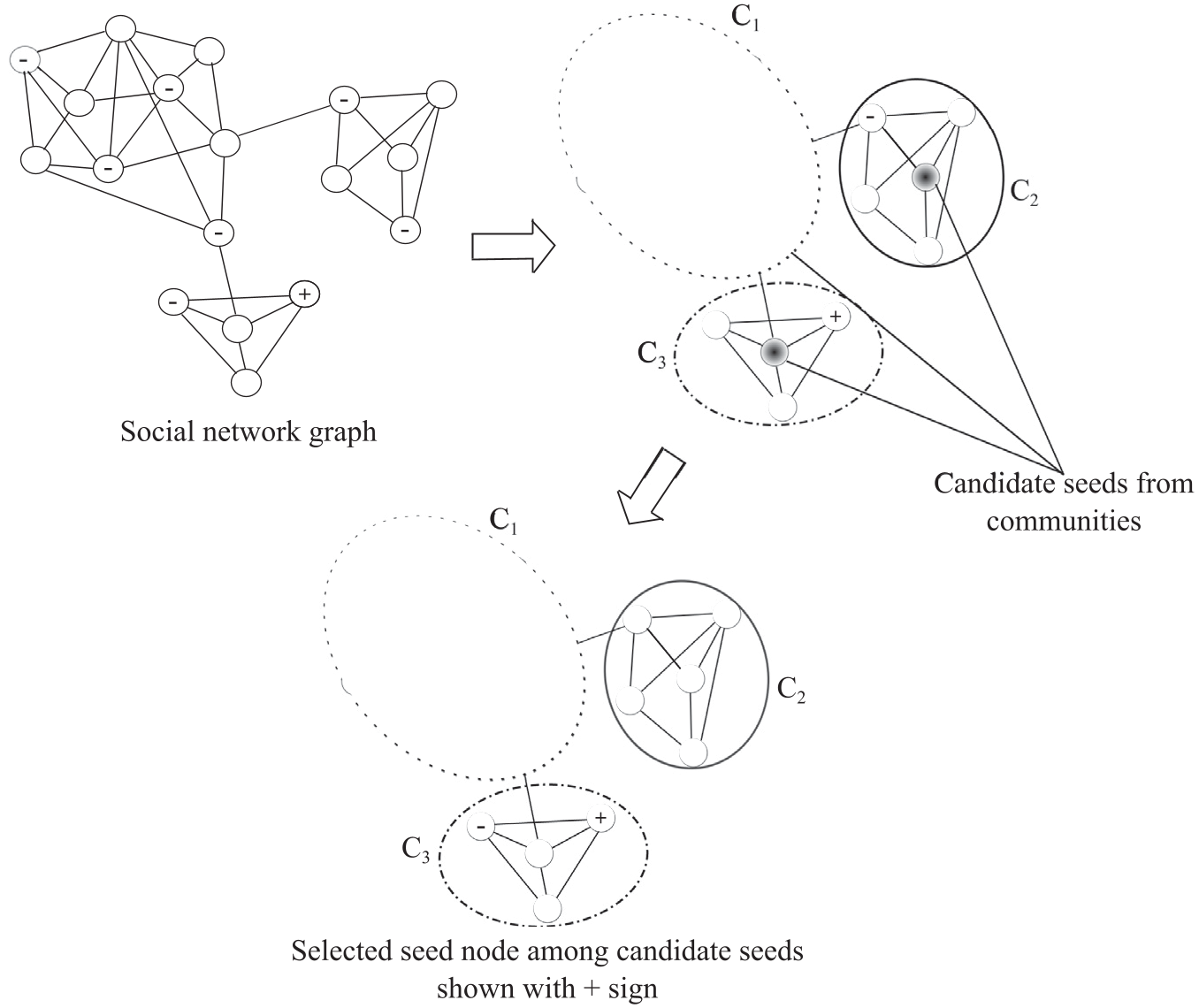 Figure: The CI2 community-based algorithm workflow.
Experiments: Speed vs. Quality
The authors tested CI2 across three massive datasets: NetHEPT (15K nodes), Slashdot (82K nodes), and Amazon (262K nodes).
Performance Gains
The results prove that "thinking time" matters. As the delay increases, the quality of seed nodes improves because the model captures more complex interactions, though it requires more computation.
Efficiency Breakthrough
The most striking result is the efficiency of community-based localizing. By shifting from global computation to local community spread estimation, the team achieved a massive reduction in runtime without sacrificing accuracy.
 Table: Comparison of spread calculation error. CI2 stays within a tiny margin of error compared to the prohibitively slow Monte Carlo simulations.
Critical Analysis & Conclusion
Takeaway
The DCM model adds a layer of psychological realism to viral marketing. It acknowledges that influence is a competition and that humans are not instantaneous switch-flippers. The CI2 algorithm provides a practical roadmap for marketers to find "hubs" in social networks without needing supercomputers.
Limitations
- Border Nodes: The current CI2 focuses heavily on inside-community influence. However, information often bridges communities through "weak ties" or border nodes. The authors acknowledge this as a future focus.
- Static Graph: Real social networks are temporal and evolving; DCM currently assumes a snapshot in time.
Future Outlook
The marriage of Community Detection and CIM marks a shift toward localized AI agents for social simulation. Future work could integrate deep learning to predict threshold dynamically based on node features, making the "Thinking State" even more personalized.
Final thought: This paper serves as a bridge between pure graph theory and behavioral economics, proving once again that in social networks, the local structure is where the global action happens.