
Gaming with Soul: Mining Personality Traits for High-Precision Recommedations
KNOWLEDGE‐BASED SYSTEMS
This paper proposes a personality-based computer game recommender system that identifies Five-Factor Model (OCEAN) traits from social messages. By matching the personality profiles of games (mined from Steam reviews) with those of players (mined from user-generated texts), the system achieves a significant improvement over baseline tag-based recommendations.
TL;DR
Is your favorite game a reflection of who you are? This research explores a novel game recommender system that matches players to games based on the Big Five personality traits (OCEAN). By analyzing Steam reviews and user social messages using text mining, the system moves beyond simple tags to capture the psychological resonance between human and software, outperforming Steam’s own recommendation engine.
Background & Motivation: Beyond the Surface of Genres
In a digital marketplace like Steam, with tens of thousands of titles, "Action" or "Strategy" tags provide only a superficial filter. Why does one player love the high-stress chaos of a shooter while another seeks the meticulous planning of a simulation?
The authors argue that Personality is the hidden driver. Prior works have hinted that "Extraverts" prefer party games while those "Open to Experience" seek adventure and platformers. However, manually mapping these is impossible at scale. The authors’ insight was to treat text as a window into the soul—using the linguistic cues in user reviews and social posts to automatically generate psychological profiles for both players and the games themselves.
Methodology: The "OCEAN" Pipeline
The core of the system relies on identifying traits across five dimensions: Openness, Conscientiousness, Extraversion, Agreeableness, and Neuroticism.
1. Data Acquisition & Preprocessing
The system scraped over 3 million reviews from Steam. To ensure quality, they focused on the "Most Helpful" reviews (top 250 per game) and required participants to provide social content of at least 200 words.
2. Personality Recognition Models
The authors tested two primary engines:
- Personality Recognizer: A tool utilizing M5' Regression Trees to map linguistic features to personality scores.
- myPersonality Recognizer: A custom-built lexicon-based approach that assigns "personality scores" to individual keywords based on the famous myPersonality Facebook dataset.
3. Architecture for Matching
The research evaluated how to define a game's "personality":
- Game-Centric (GC): "A game is what people say it is." It aggregates the traits found in the text of the reviews.
- User-Centric (UC): "A game is who plays it." It averages the traits of the players who enjoy the game.
 Figure 1: The overarching workflow from data acquisition to personality-based recommendation.
Experiments: Beating the Steam Baseline
The system was tested using three recommendation strategies: User-based (matching your profile to a game's), Game-based (matching a game you like to similar "personality" games), and a Hybrid approach.
Key Performance Metrics:
- Superior Accuracy: The configuration
GC-PR-GB(Game-Centric, Personality Recognizer, Game-Based) achieved a mean rating of 3.64, significantly higher than Steam’s native tag-based system (3.26). - Reliability: The Fleiss’ kappa value was 0.69, indicating a "substantial agreement" among reviewers regarding the quality of the recommendations.
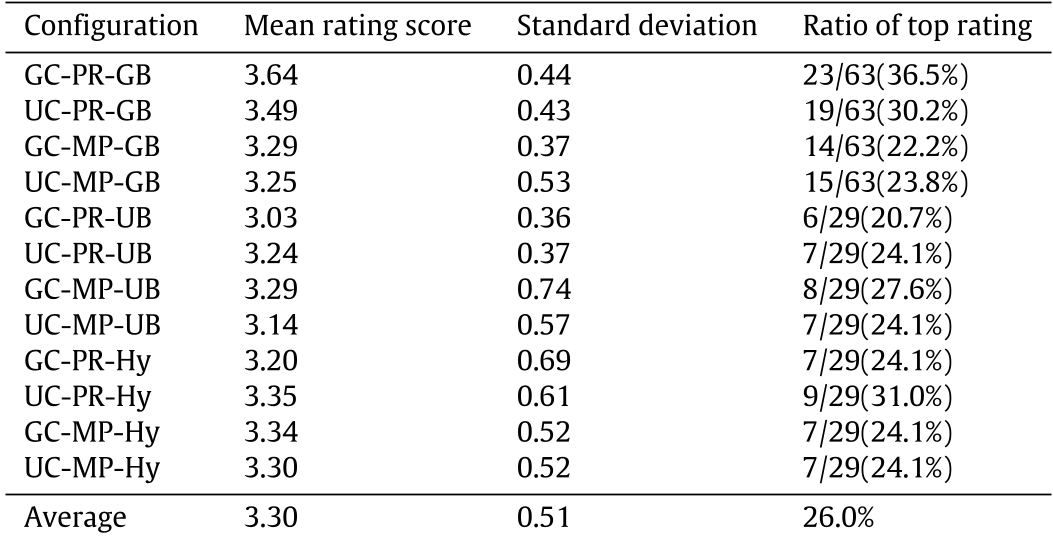 Table: Comparison of various configurations against user satisfaction scores.
Deep Insight: Why Personality Works
The study highlights that similar games receive similar reviews because they evoke similar emotional and linguistic responses. This "affective linguistic" footprint is more stable than dynamic user behavior. The success of the "Game-Based" personality match suggests that once a player finds their "psychological anchor" (a game they love), the system can find its "tempered siblings" with high precision.
Critical Analysis & Future Outlook
While the results are promising, the study has limitations:
- Static Personalities: It assumes player interests don't change over time.
- Dataset Scale: The custom
myPersonalityrecognizer was limited by the volume of its training data.
Takeaway: This work proves that the future of recommendation isn't just about "what you bought," but "who you are." We can expect future AI agents in gaming platforms to act more like psychologists, understanding our moods and temperaments through our digital footprints to curate experiences that truly resonate.
Main Technical Contributions:
- A new text-based personality identification scheme for software artifacts.
- The first application of Big Five personality logic to the Steam gaming ecosystem at scale.