
The Power of k-Bridges: Cracking the Code of Multi-Community Influence
KNOWLEDGE‐BASED SYSTEMS
The paper introduces the concept of the k-bridge, defined as a user who connects k different sub-networks or distinct communities within a social platform. Using an Apriori-inspired algorithm, the authors detect these users across Yelp, Reddit, and patent inventor networks, establishing that k-bridges act as critical hubs for cross-domain information diffusion and influence.
TL;DR
In a world of hyper-segmented social circles, the most valuable users aren't just the loudest—they are the ones who span the most worlds. This paper introduces the k-bridge, a user connecting k different communities, and provides a formal framework to detect them. By analyzing millions of data points from Yelp, Reddit, and Patent databases, the research proves that k-bridges are the ultimate "cross-pollinators" of information, exhibiting unique structural properties that make them indispensable for viral marketing and trend forecasting.
Problem & Motivation: Beyond the Simple Bridge
In classic sociology, a "bridge" is a simple link between two groups. But modern platforms are multi-relational. A Yelp user isn't just a "foodie"; they might also be a "traveler," a "fitness enthusiast," and a "nightlife critic."
Existing SOTA methods often overlook the depth of this connectivity. The researchers realized that as k (the number of communities) increases, the behavior of the user changes. They hypothesized that a "strong bridge" (high k) possesses an intrinsic "influence backbone" that simple users lack. The goal was to move from a binary definition of bridges to a scalable, quantitative measure of cross-domain influence.
Methodology: The k-Bridge Extraction Algorithm
The core innovation lies in the Anti-Monotone Property of k-bridges: if a user connects 5 communities, they by definition connect any subset of 4, 3, or 2 of those communities.
The Algorithm
Inspired by the Apriori algorithm used in market basket analysis, the authors designed a "bottom-up" extraction process:
- L1 Generation: Identify users in single macro-categories.
- Join & Filter: Intersect user sets to find 2-bridges, then 3-bridges, and so on.
- Thresholding: Using
min_supto ensure results are statistically significant.
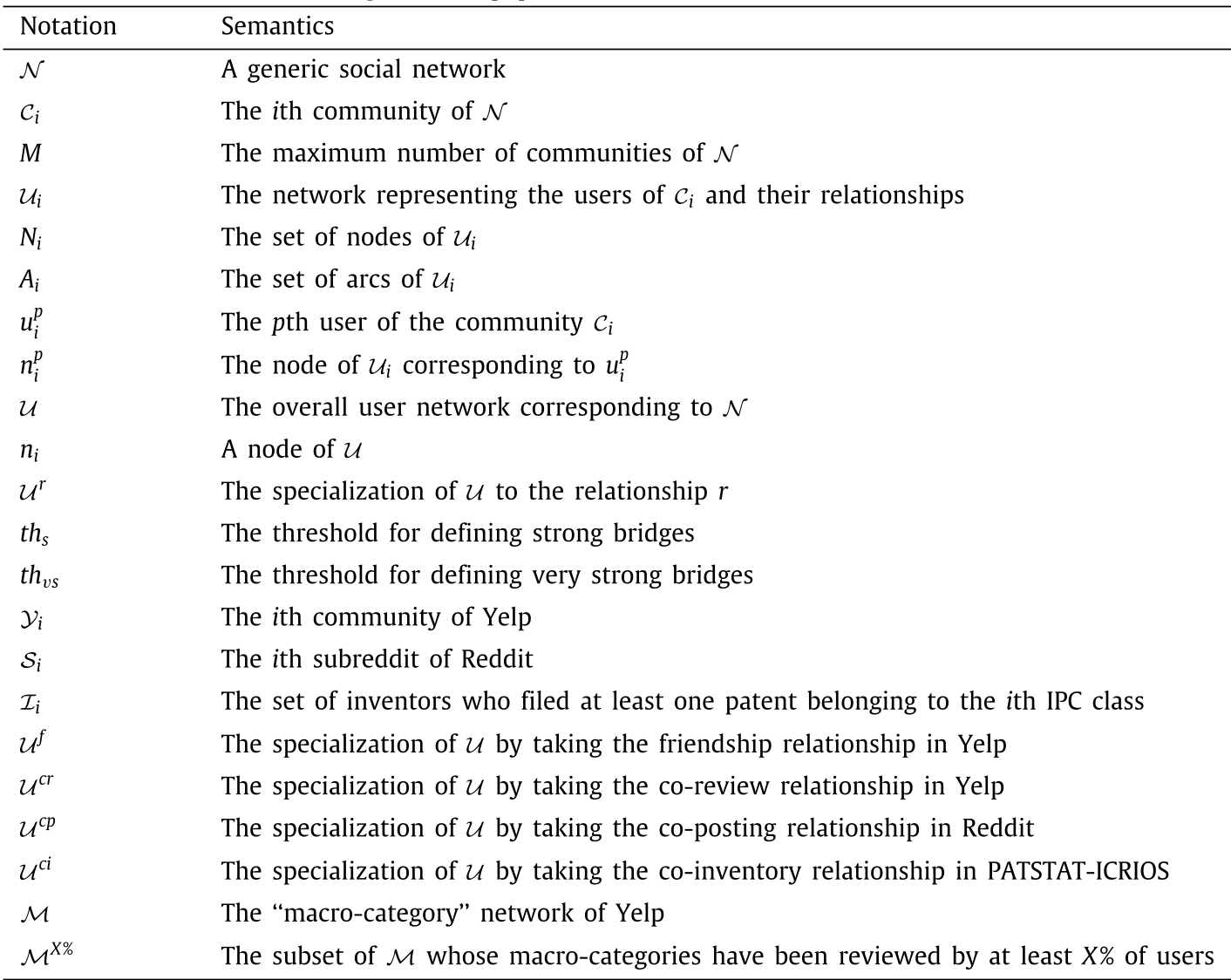
The authors specialized this model across three distinct environments:
- Yelp: Communities defined by macro-categories (e.g., Restaurants, Beauty & Spas).
- Reddit: Communities defined by Subreddits.
- PATSTAT: Communities defined by International Patent Classification (IPC) classes.
Experimental Insights: The Backbone of Influence
The results across all three platforms were remarkably consistent, suggesting that the k-bridge is a fundamental social construct.
1. The Power Law Distribution
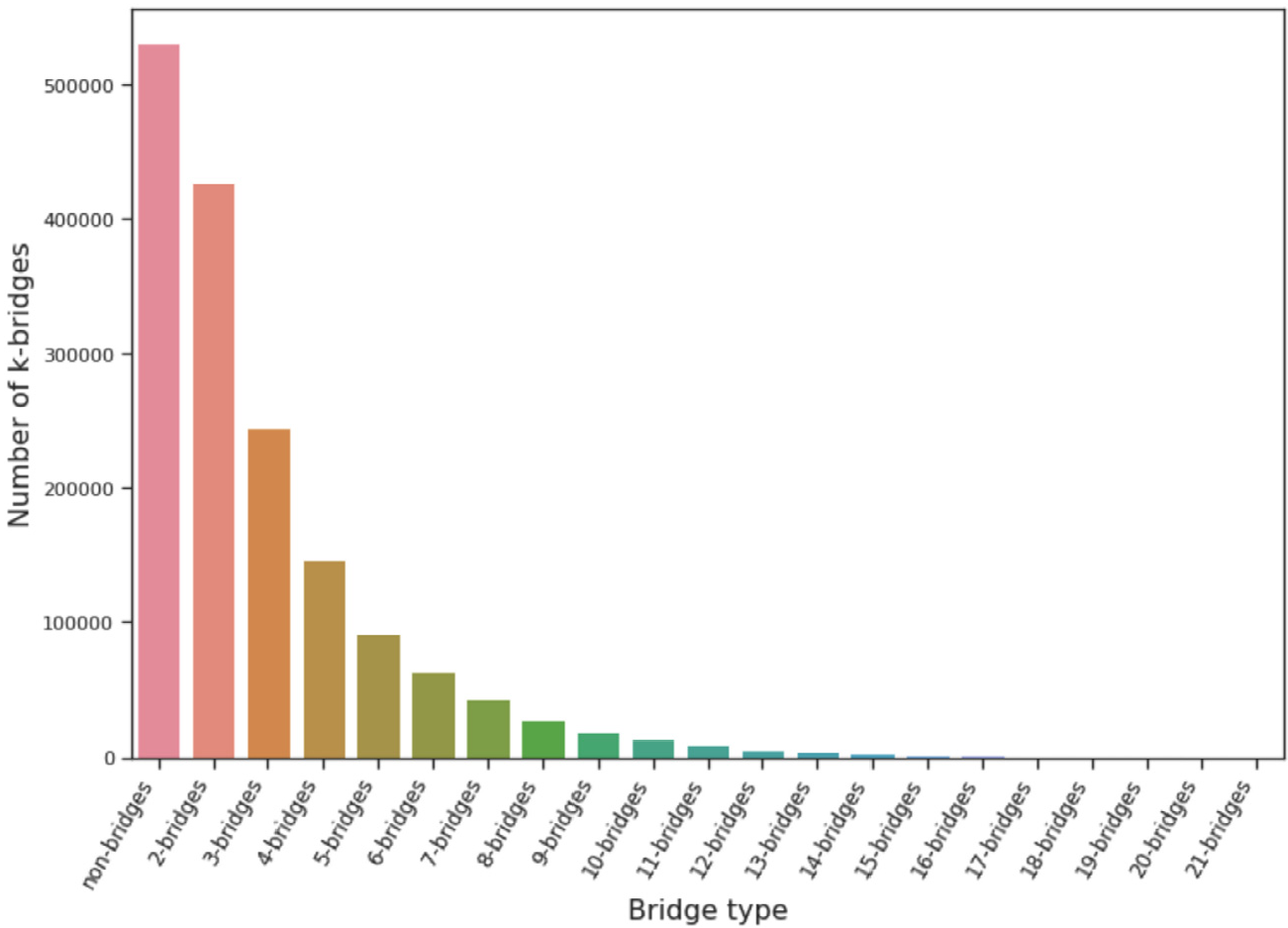
Just like node degrees in a standard social graph, the "bridge-ness" of users follows a Power Law. Most users are non-bridges (k=1), but a tiny "tall head" of users spans 10+ categories.
2. Friendship vs. Co-Activity
A fascinating finding was the difference between Friendship Networks () and Co-Review Networks ():
- In friendship networks, bridges don't necessarily cluster.
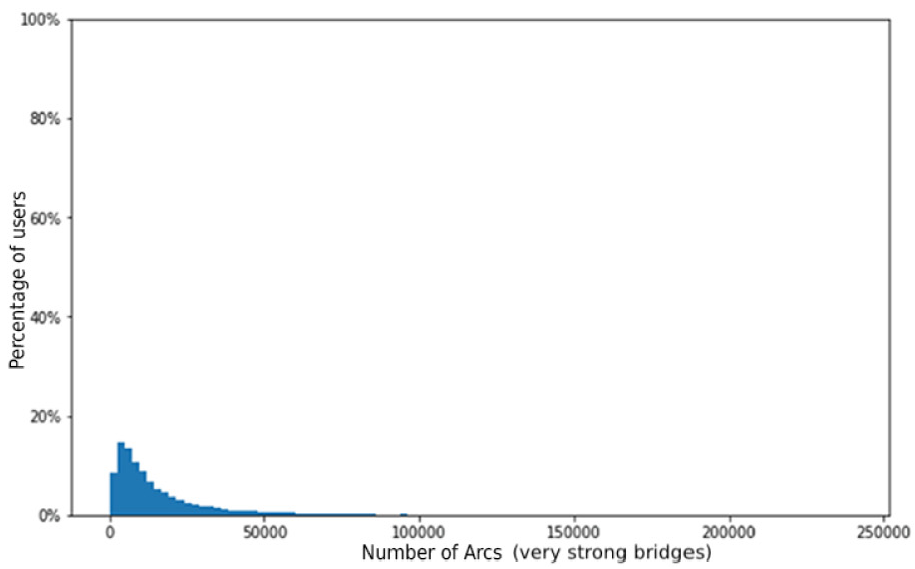
- In Co-Review/Co-Posting networks, there is a clear backbone. Bridges tend to interact with other bridges. This suggests that the "action" of bridging categories creates a structural elite of users who unknowingly coordinate information across the platform.
Business Use Cases: Precision Influence
The paper concludes with two high-value applications for the industry:
Case A: Viral Marketing Targeting
Instead of flooding a category with ads, a business expanding from "Restaurants" to "Nightlife" should identify 3-bridges who already exist in both categories plus a third (like "Event Planning"). These users have the highest "conversion potential" because they already possess the vocabulary and trust of both target audiences.
Case B: Product Expansion Discovery
By analyzing which categories k-bridges move between most frequently, businesses can discover latent association rules. If many 4-bridges frequently review "Home Services" and "Beauty & Spas," a service combining these (e.g., mobile at-home spas) has a pre-built audience.
Critical Analysis & Future Work
The study is robust due to its multi-platform validation (Yelp, Reddit, Patents). However, a limitation is that it treats all categories as equally "distant." In reality, bridging "French Restaurants" and "Italian Restaurants" is easier than bridging "Mining Patents" and "Soft Drinks."
Future directions could involve weighting the "bridge strength" by the semantic distance between the communities. Nevertheless, the k-bridge framework provides a powerful new lens for identifying the true gatekeepers of the modern social web.