
MPPSO: Shattering the Dimensionality Barrier in Feature Selection with Multi-Population Swarms
KNOWLEDGE‐BASED SYSTEMS
The paper introduces Multi-Population based Particle Swarm Optimization (MPPSO), a novel wrapper-based feature selection method. It combines random initialization with Relieff-based heuristic seeding and utilizes a time-varying mirrored S-shaped transfer function to achieve state-of-the-art classification accuracy across 29 benchmark datasets.
Executive Summary
Feature selection remains one of the most persistent bottlenecks in machine learning pipelines. As datasets grow in dimensionality, the search space expands exponentially, making it an NP-Hard challenge. This paper presents Multi-Population based Particle Swarm Optimization (MPPSO), a sophisticated evolution of the standard PSO.
TL;DR: By initializing dual populations—one random and one heuristic-driven (via Relieff)—and employing a specialized time-varying transfer function, MPPSO achieves superior classification accuracy and radical feature reduction (up to 84% reduction on large datasets) compared to traditional meta-heuristics.
The "Local Optima" Trap in Swarm Intelligence
Standard Binary PSO (BPSO) is prized for its low computational overhead, but it has a "blind spot": Inertia. When a swarm is initialized randomly, it often converges too quickly on a sub-optimal feature subset. If the initial particles are far from the global optimum in a high-dimensional space, the social and cognitive components of the velocity equation () simply aren't enough to pull the swarm out of local minima.
Methodology: The Power of Two Populations
The core innovation of MPPSO lies in its Initial Solution Generation Mechanism (ISGM). Instead of betting on a single group of random particles, MPPSO creates two competitive trajectories:
- Random Search: Ensures stochastic exploration of the manifold.
- Relieff-Guided Search: Uses the Relieff algorithm to weight features based on their relevance to the target class, providing "intelligent seeds" for the swarm.
1. The Multi-Population Mechanism
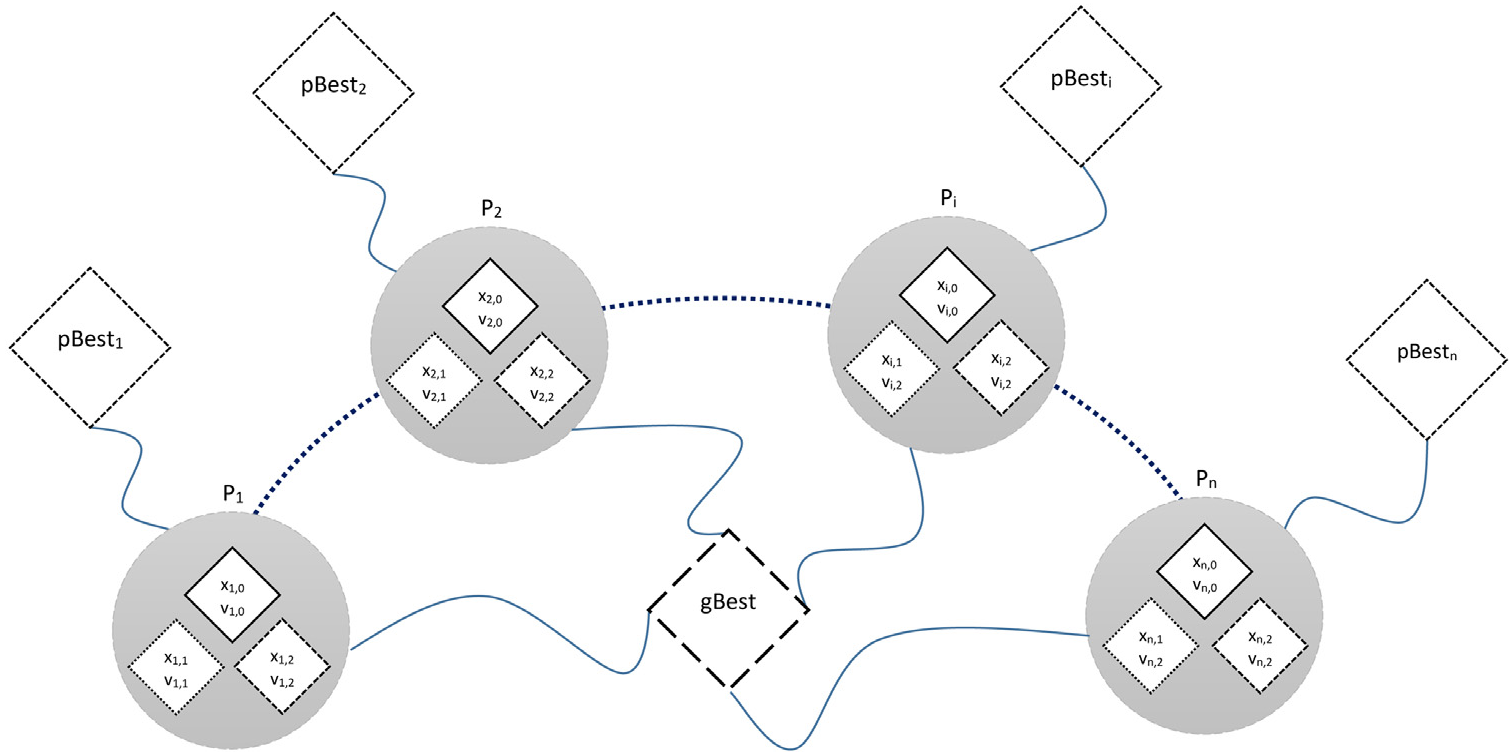
As shown in the architecture below, each particle manages two potential solutions. The search space is navigated by updating velocities independently across these populations before performing a greedy selection.
2. Time-Varying Mirrored S-Shaped Transfer Function
To bridge the gap between continuous velocity and binary feature masks ( or ), the authors utilize a TVMS transfer function. By varying the slope parameter over time, the algorithm shifts from wide-scale exploration (early stages) to fine-grained exploitation (late stages), ensuring the final subset is highly refined.
Experimental Results: High-Dimensional Superiority
The authors tested MPPSO on 29 datasets, ranging from small UCI sets (9 features) to massive ASU sets (up to 4862 features).
SOTA Comparison
MPPSO didn't just win; it dominated in high-dimensional contexts. In the WarpAR10P dataset (2400 features), MPPSO achieved 89.54% accuracy compared to BPSO’s 65.65%.
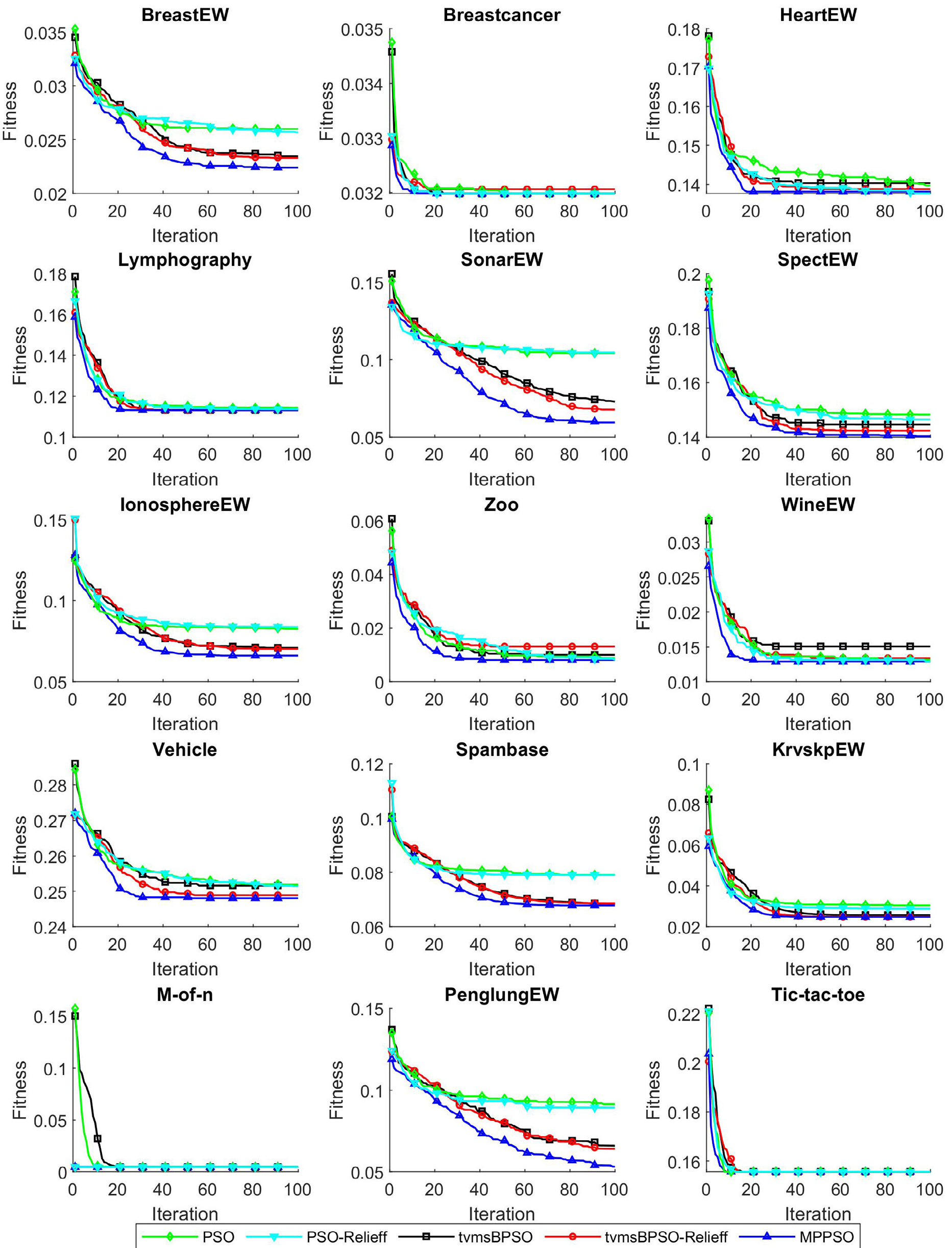 The convergence plots reveal that MPPSO (green line) stabilizes at a much lower fitness value (error) faster than its competitors on complex datasets.
Feature Compression Power
For the Semeion dataset, the number of features was slashed from 265 to an average of 95.1, while maintaining a classification accuracy of 99.53%. This underscores the method's ability to identify and discard noisy, redundant features that plague standard classifiers.
Deep Insight & Conclusion
The success of MPPSO suggests a shift in meta-heuristic research: Initialization is as important as the update rule. By embedding "filter" knowledge (Relieff) into a "wrapper" framework (PSO), the authors create a hybrid that inherits the speed of filters and the accuracy of wrappers.
Limitations: The primary trade-off is computational time. MPPSO takes roughly 3x longer than standard BPSO because of its dual-solution management. However, for mission-critical applications where accuracy and model interpretability (fewer features) are paramount, this overhead is a marginal price to pay.
Future Outlook: The multi-population approach is "architecture-agnostic." We expect to see this strategy applied to other modern optimizers like Whale Optimization (WOA) or Grey Wolf Optimizer (GWO) to tackle even more complex, multi-modal search spaces.