
The D-C Model: Strategically Containing Competition in Social Networks
KNOWLEDGE‐BASED SYSTEMS
The paper proposes the Diffusion-Containment (D-C) model, an extension of the Linear Threshold (LT) model, to manage competitive influence spread in social networks. It focuses on maximizing one participant's containment influence (C-influence) to minimize an opponent's diffusion influence (D-influence) using a sub-modular greedy algorithm.
TL;DR
Instead of trying to "block" your competitors in a social network—which is often impossible or illegal—this paper proposes the Diffusion-Containment (D-C) model. By extending the Linear Threshold (LT) framework, the authors show how a participant can strategically select "Containment Seeds" to minimize an opponent's spread. They prove the containment function is sub-modular, enabling a greedy algorithm that achieves near-optimal results (1-1/e).
Problem & Motivation: Beyond Simple Blocking
In the real world, brands like Apple and Samsung compete for "word-of-mouth" dominance. Traditional research focused on Influence Maximization (finding the best seeds for one person). When competition was introduced, early solutions suggested "blocking" the opponent's paths.
However, the authors argue that:
- Blocking is unrealistic: In online social media, you cannot prevent an opponent from seeding their own content.
- Blocking is expensive: It requires constant surveillance and intervention at the link level.
The Insight here is shifted toward Containment: using your own positive influence to "occupy" the minds of users so they are less susceptible to the opponent's influence.
Methodology: The D-C Model
The D-C model introduces a game-theoretic approach to vertex activation. Each node can be in one of three states: D-state (captured by opponent), C-state (captured by you), or I-state (Inactive).
1. The Interaction Strategy
The model uses a payoff matrix to determine how nodes flip. If a node and its neighbor both choose the same influence (e.g., both D), they get a higher payoff (). If they choose opposite influences, the payoff is 0. This creates a "local coordination" effect.
2. Threshold Mechanism
Unlike the standard LT model where a node activates when a sum of weights exceeds a fixed , the D-C model defines dynamic thresholds for both D-influence () and C-influence ():

3. The Greedy Approach
The authors prove that the function representing the "reduction of D-influence" is monotone and sub-modular. This is the "Holy Grail" of discrete optimization because it means a simple greedy algorithm (adding the best seed one by one) is guaranteed to be within ~63% of the absolute best possible seed set.
(Note: Algorithm 2 in the paper outlines this iterative selection process.)
Experimental Results
The researchers tested their model on two types of networks:
- Synthetic Networks: 1,000 to 2,000 nodes with power-law distributions.
- Wiki-vote Network: A real-world dataset of 7,115 nodes.
Key Findings:
- Greedy is King: In almost every scenario, the Greedy algorithm for selecting C-seeds resulted in a higher "Containment Value (Q)" than choosing nodes with the highest degree (MaxDegree) or random selection.
- Scalability of Effort: The effectiveness of containment increases as the ratio of your seeds () to their seeds () increases, but it hits diminishing returns after the ratio exceeds 2.0.
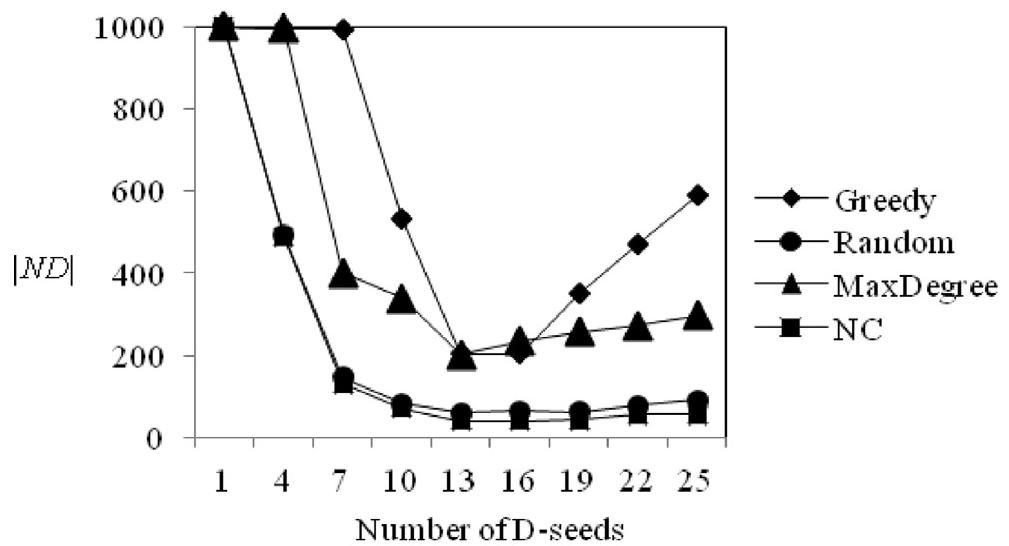 Fig 4: Greedy algorithm (top line) maintaining superior containment as the opponent's seeds increase.
Critical Analysis & Conclusion
Takeaway
The D-C model moves social network strategy from a "defensive" blocking mindset to an "offensive" containment mindset. For marketing and public health (stopping rumors), this provides a mathematically rigorous way to decide where to spend a limited budget to neutralize a competitor.
Limitations
- Complexity: While the greedy algorithm is efficient, calculating the activation probabilities () across many timesteps can still be computationally heavy for massive networks of millions of nodes.
- Parameter Tuning: The "Infected Degree" () and "Payoffs" () are assumed to be fixed, but in reality, these vary wildly across different demographics.
Future Outlook
The next step for this research is adapting to large-scale social networks with millions of edges by utilizing localized greedy heuristics or parallelized propagation calculations.