
Beyond "Good" and "Bad": Decoding Linguistic Risk Appetites in Large-Scale Emergency Response
KNOWLEDGE‐BASED SYSTEMS
This paper proposes a Multi-Criteria Large Group Emergency Decision-Making (MCLGEDM) framework that integrates social media mining and Generalized Asymmetric Linguistic D Numbers (GALDN). It utilizes a generalized sigmoid scale function to account for individual linguistic risk appetites and achieves superior ranking consistency in emergency response scenarios.
TL;DR
In the chaos of a major emergency (like a chemical explosion), decision-makers must act fast with incomplete data. This paper introduces a framework that mines public concerns from social media to set decision criteria and uses Generalized Asymmetric Linguistic D Numbers (GALDN) to fuse expert opinions. Unlike previous models, it accounts for "Linguistic Risk Appetites"—the idea that a "Good" rating from a risk-averse expert means something very different from a "Good" rating from a risk-seeker.
The Problem: The Subjectivity of Words
When an emergency strikes, we assemble dozens of experts. We ask them: "Is this rescue plan good?"
Academic literature often treats the linguistic term "Good" as a fixed numerical value (e.g., 0.7 on a scale of 0-1). However, this ignores psychological utility. A risk-averse expert might only label a plan "Good" if it is nearly certain to succeed, while a risk-preferring expert might use "Good" for any plan with high potential upside.
Furthermore, under time pressure, experts often leave gaps in their evaluations. Traditional models break down when the "information framework" is incomplete.
Methodology: The GALDN Framework
The authors solve this by merging two powerful concepts:
- GALTS (Generalized Asymmetric Linguistic Term Sets): This uses a sigmoid function to map words to numbers based on two parameters . These parameters shift the "S-curve" of the semantics to match the expert's risk profile.
- D Number Theory: Unlike Evidence Theory, D Number theory doesn't require the sum of beliefs to equal 1, making it perfect for representing "I don't know" or "Incomplete data."
Step 1: Mining the Public Pulse
Instead of experts deciding what's important behind closed doors, the model crawls social media (Sina-Weibo). Using TF-IDF, it identifies what the public cares about (e.g., casualties, pollution, accountability) and turns these into weighted decision criteria.
Step 2: The Architecture of Fusion
The core of the method is a multi-step fusion process:
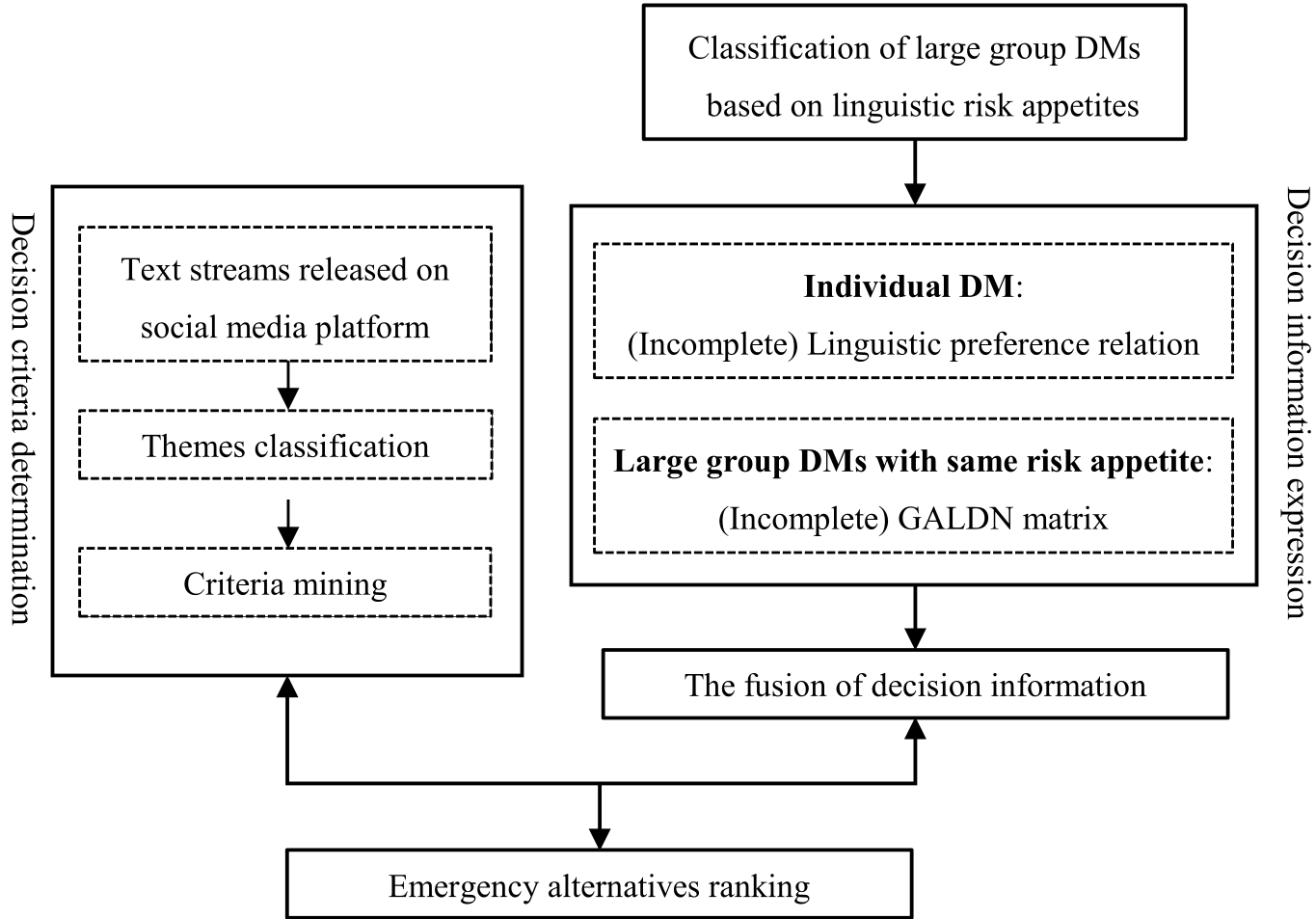
The process involves:
- Expert Clustering: Grouping experts into 5 clusters (Strong Preference to Strong Aversion).
- Consistent Matrix Construction: Using additive consistency to fill in gaps when experts only provide partial comparisons.
- GALDN Fusion: Fusing cluster-level opinions without the "information distortion" typically caused by repeated averaging in large groups.
Case Study: The Tianjin Explosion
The paper validates this against the 2015 Tianjin warehouse explosion. 110 experts evaluated four rescue alternatives ranging from immediate firefighting to delayed anti-chemical missions.
Semantic Differences
Notice how the "S-curve" shifts based on risk appetite:
 Expert Risk Profiles
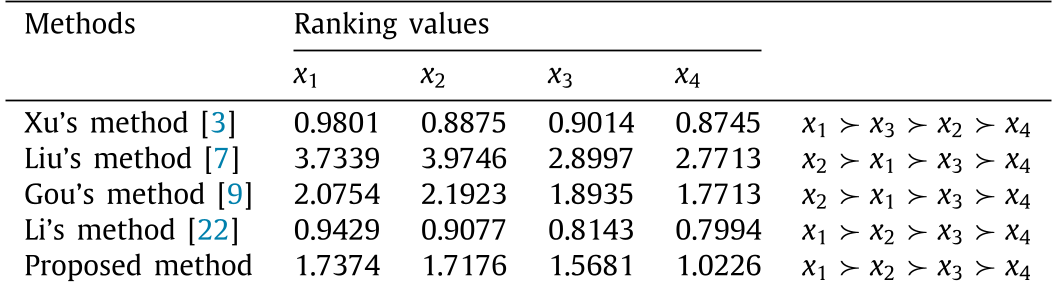
The results showed that while most methods agreed on the best alternative (Plan ), the internal ranking of secondary plans changed significantly when risk appetites were included. This is crucial for contingency planning where the "second-best" option must be clearly understood.
Results & Performance
Compared to methods like Liu et al. or Gou et al., the proposed method:
- Preserves Qualitative Nuance: No "averaging out" of extreme expert opinions.
- Handles Incompleteness: Can still reach a decision even if 20% of the expertise matrix is missing.
- Computational Efficiency: By fusing at the GALDN level rather than per-individual, it scales to thousands of experts without lag.
Critical Insight & Future Outlook
This work represents a shift toward Human-Centric AI in decision support. It acknowledges that experts are not sensors; they are psychological beings.
Limitations: The model assumes risk appetites are static during the event. In reality, a disaster's progression might turn a risk-taker into a risk-averter. Future research into Dynamic Opinion Evolution will be the next frontier in emergency management.
Conclusion: By combining social media mining with "risk-aware" linguistic math, we can finally build emergency systems that truly represent the complexity of human judgment under fire.