
SIPF+: Deciphering Urban Interests through the Lens of Social Dependency
KNOWLEDGE‐BASED SYSTEMS
The paper presents SIPF+ (Social-aware Interesting Place Finding Plus), an unsupervised maximum likelihood estimation (MLE) framework designed to identify "interesting" urban locations using social sensing data. By jointly modeling user travel experience and social dependencies through an Expectation-Maximization (EM) algorithm, it achieves SOTA performance in location recommendation across real-world datasets like Brightkite and Gowalla.
Executive Summary
TL;DR: SIPF+ is a principled, unsupervised learning framework that identifies truly "interesting" places in a city by analyzing sparse social sensing data. Unlike previous methods that simply count "check-ins," SIPF+ filters out noise caused by social biases (like friends visiting the same place) and accounts for the diverse travel experiences of users.
Background: Within the academic coordinate system, this work sits at the intersection of Truth Discovery and Urban Computing. It moves beyond the heuristic-based "Point of Interest" (POI) recommendations to a rigorous statistical model that treats location interestingness as a hidden variable to be inferred.
The "Colleague" Trap: Why Simple Counting Fails
Most travel apps assume that if a place has many check-ins, it must be interesting. However, this logic is fundamentally flawed due to Social Dependency.
Imagine a group of colleagues who work at a mundane office building. They check in every day. A naive algorithm might flag this office as a top "interesting" destination simply due to the high volume of traffic. Previous SOTA methods either ignored this or assumed all users were independent actors—a rarity in our hyper-connected world.
Methodology: The SIPF+ Framework
The core innovation lies in treating "Place Interestingness" and "User Travel Experience" as two sides of the same coin, solved jointly via an Expectation-Maximization (EM) approach.
1. Modeling the Social Web
The authors introduce a User-Dependency Matrix (). Using community detection (SLPA), they partition users into independent groups. If users within a group visit the same spot, the algorithm "penalizes" the weight of those visits, recognizing they aren't independent endorsements.
2. The EM Engine
The model defines the likelihood of observing a set of check-ins given the latent interestingness of a place.
- E-Step: Estimates the probability that a place is interesting based on current user weights.
- M-Step: Updates the "Travel Experience" (reliability) of each user based on how often they visit places confirmed as interesting by the rest of the "independent" crowd.
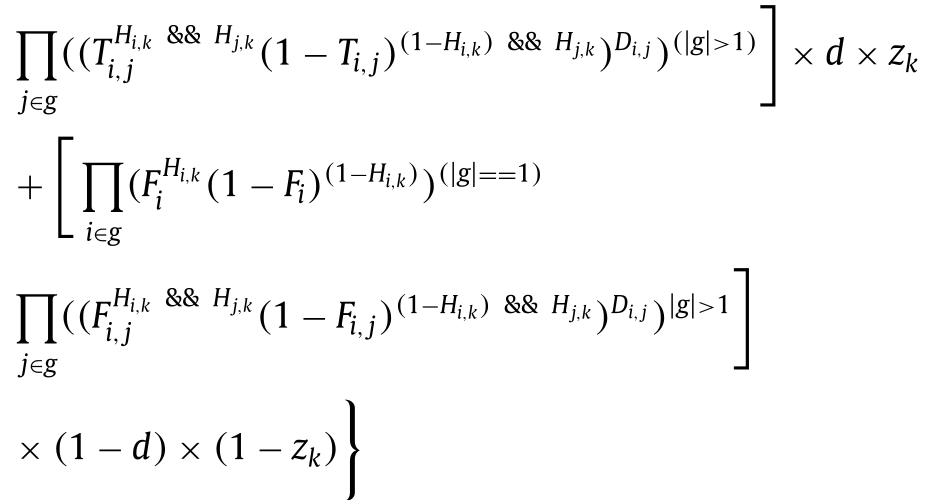 Figure 1: The Likelihood Function incorporating social-aware parameters.
Experimental Results
The authors put SIPF+ to the test using Brightkite and Gowalla datasets for Chicago and San Francisco.
Quantitative SOTA Performance
Compared to baselines like GeoSoCa and iGSLR, SIPF+ consistently yielded better precision and recall. Specifically:
- Precision Enhancement: Improved by ~6% in San Francisco trials.
- Ranking Quality: SIPF+ achieved the highest NDCG@n, meaning its "Top 10" recommendations aligned much more closely with expert travel guides (TripAdvisor/CityPass) than any other method.
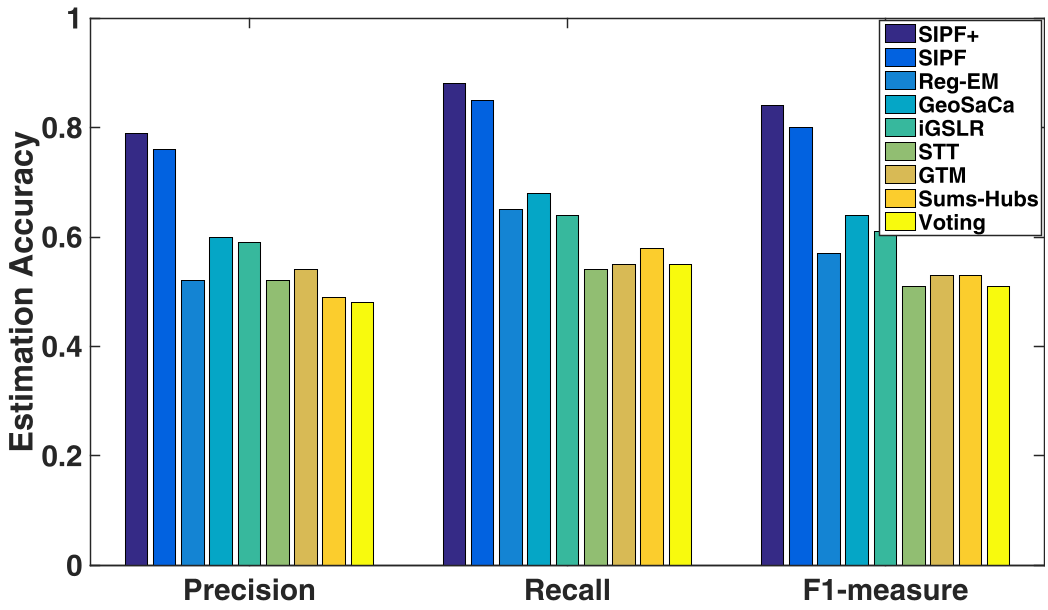 Figure 2: Performance gains in San Francisco (Gowalla dataset).
Case Study: Hidden Gems identified
While traditional baselines often suggested utility locations (like medical centers or schools), SIPF+ successfully identified cultural landmarks like the Cable Car Museum and the Contemporary Art Museum by filtering out routine social-bond visits.
Critical Insight & Future Outlook
Takeaway: The real value of SIPF+ is its unsupervised nature. It doesn't need a labeled "Ground Truth" to start; it learns the reliability of the crowd from the crowd.
Limitations: The current model assumes locations are independent. In reality, a "Museum District" has spatial dependencies (visiting one museum makes you likely to visit the next).
Future Work: The logical next step is to integrate Physical Dependency into this social framework. As the authors suggest, incorporating "context" (time of day, user background) could transform this from a pure estimation tool into a real-time, context-aware city guide.
Editor's Note: This paper is a significant step toward "Socially Intelligent" systems that understand not just what we do, but why we do it in the context of our social circles.