
JAM: Decoding Dynamic Preferences in Event-Based Social Networks with Signed Attention
KNOWLEDGE‐BASED SYSTEMS
The paper introduces JAM (Joint Attention Model), the first framework specifically designed for next-event recommendation in Event-Based Social Networks (EBSNs). It utilizes a dual-attention mechanism to integrate rich contextual information and capture dynamic user preferences, achieving significant performance gains over SOTA methods like Event2vec and PRME-G.
TL;DR
Recommending the "next event" (like a concert or a tech talk) is uniquely difficult because events expire quickly and user interests are volatile. The Joint Attention Model (JAM) solves this by using a dual-attention framework: one to understand what an event is through context fusion, and another—Signed Multi-Head Attention (SMHA)—to understand why a user might attend or avoid the next event based on positive and negative historical impacts.
Context Matters: The EBSN Challenge
Unlike Netflix or Amazon, where items (movies, books) remain relevant for years, Event-Based Social Networks (EBSNs) like Meetup deal with "perishable" items.
- Cold Start by Design: Most events are new; there is no historical data for them.
- Context-Heavy: An event isn't just an ID; it’s a specific mix of Time, Location, URL tags, and Participants.
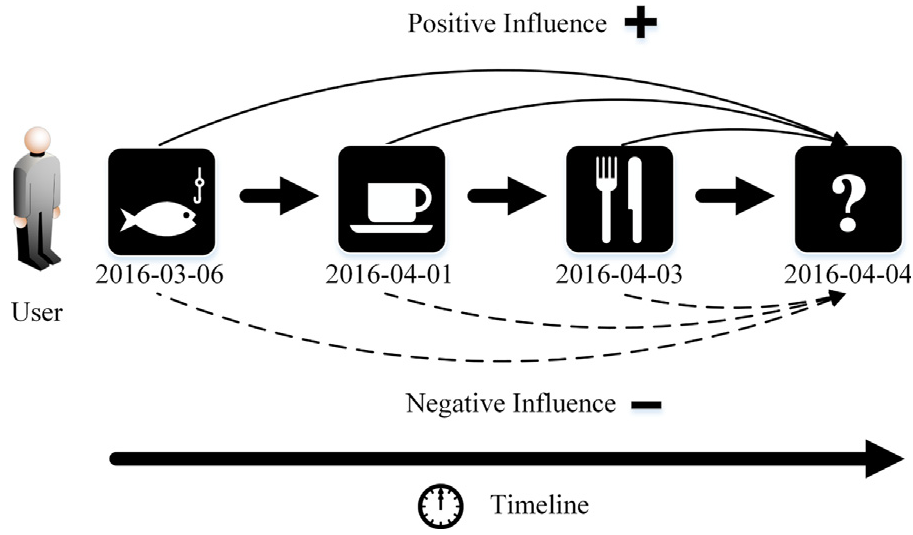
- The "Boredom" Factor: Traditional models assume if you liked fishing once, you'll like it forever. JAM acknowledges that a bad experience or simply "having had enough" (negative inhibition) influences your next move.
Methodology: The Joint Attention Model (JAM)
The JAM framework is split into two tightly coupled modules:
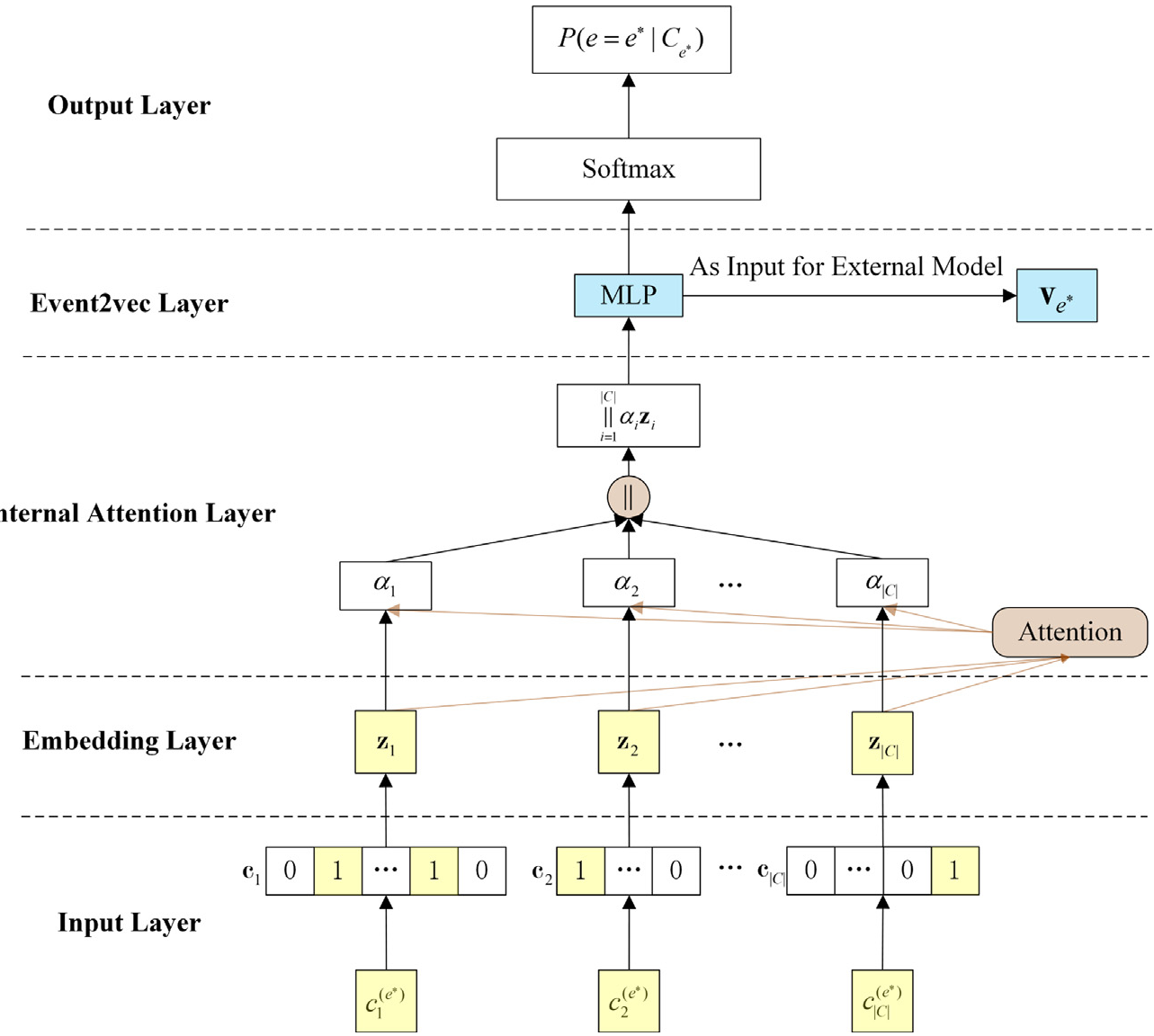
1. Internal Model: Building the Event Embedding
Since events have no history, JAM describes them through their "DNA"—their contexts.
- Context Fusion: It maps Time, Location, URLtag, and Participants into vectors.
- Adaptive Weighting: Not all contexts are equal. A user might choose an event primarily for the location, while another chooses for the participants. The internal attention layer learns these weights adaptively.
2. External Model: Signed Multi-Head Attention (SMHA)
This is where the temporal logic happens. Most sequential models (like RNNs or LSTMs) only look at the positive sequence. JAM introduces Signed Multi-Head Attention.
- Positive vs. Negative Heads: Some attention heads capture excitement (positive weights), while others capture inhibition (negative weights).
- Higher-Order Fusion: A "meta-attention" layer then decides how to balance these positive and negative signals to predict the next event vector.
Experimental Results: SOTA Performance
The authors tested JAM against classic Matrix Factorization (MF) and SOTA sequential models like Event2vec on real-world Meetup data.
- Precision & Recall: JAM maintained a huge lead, especially at
K=1, suggesting that its top recommendation is highly accurate. - Ablation Insight: The study showed that the "Internal Model" (Context Fusion) is the heavy lifter. Without proper event representation, even the best sequential model fails.
- SMHA Effectiveness: Using 2 attention heads (one positive, one negative) provided the best balance, proving that negative feedback—even if implicit—is a vital signal in social dynamics.

Critical Insights & Future Outlook
Why does it work? JAM succeeds because it treats "Participants" as a context. In social networks, who is going is often more important than what is happening. By embedding participant lists into the event vector, the model implicitly captures social influence.
Limitations: The model currently treats all participants equally. In reality, a "close friend" attending an event has a much higher influence than a stranger.
Future Work: The authors suggest moving toward Group Recommendations, where the system doesn't just look at one user's history, but the collective preferences of a group of friends deciding where to go together.
Conclusion
JAM represents a shift in sequential recommendation by moving beyond "positive-only" sequences and deep-diving into the rich, heterogeneous context of social events. It’s a robust framework for any "cold-start" heavy domain where item attributes and social ties define the user experience.