
Deciphering Consensus: The Evolution of Social Network Group Decision Making
KNOWLEDGE‐BASED SYSTEMS
This paper provides a comprehensive review of Consensus Reaching Processes (CRP) in Social Network Group Decision Making (SNGDM), classifying existing literature into two dominant research paradigms: trust relationship-based CRP and opinion evolution-based CRP. It establishes a unified framework for understanding how social structures influence decision-making outcomes and identifies SOTA challenges in large-scale and dynamic networks.
TL;DR
Reaching a group consensus is no longer just about averaging scores; it's about the "social graph." This paper formally categorizes the Social Network Group Decision Making (SNGDM) landscape into two distinct paradigms: Trust-Based and Opinion Evolution-Based. By leveraging social network analysis (SNA), researchers are now able to predict how opinions drift, identify influential "opinion leaders," and automate the feedback loop required to bring dissenting voices into harmony.
Problem & Motivation: Beyond the Voting Box
Traditional decision-making models treat experts like isolated islands. However, in the real world, we are influenced by who we trust. Prior models failed in three major ways:
- Ignoring Social Influence: They didn't account for the fact that a "senior" or "trusted" expert's opinion carries more weight than others.
- Static Assumptions: Weights were often assigned a priori, whereas in social networks, weight (importance) is a function of the network topology.
- The "Why" of Modification: Traditional feedback mechanisms tell a user to "change their mind" without explaining why. In SNGDM, advice is more acceptable if it comes from a trusted peer.
Methodology: The Two Pillars of SNGDM
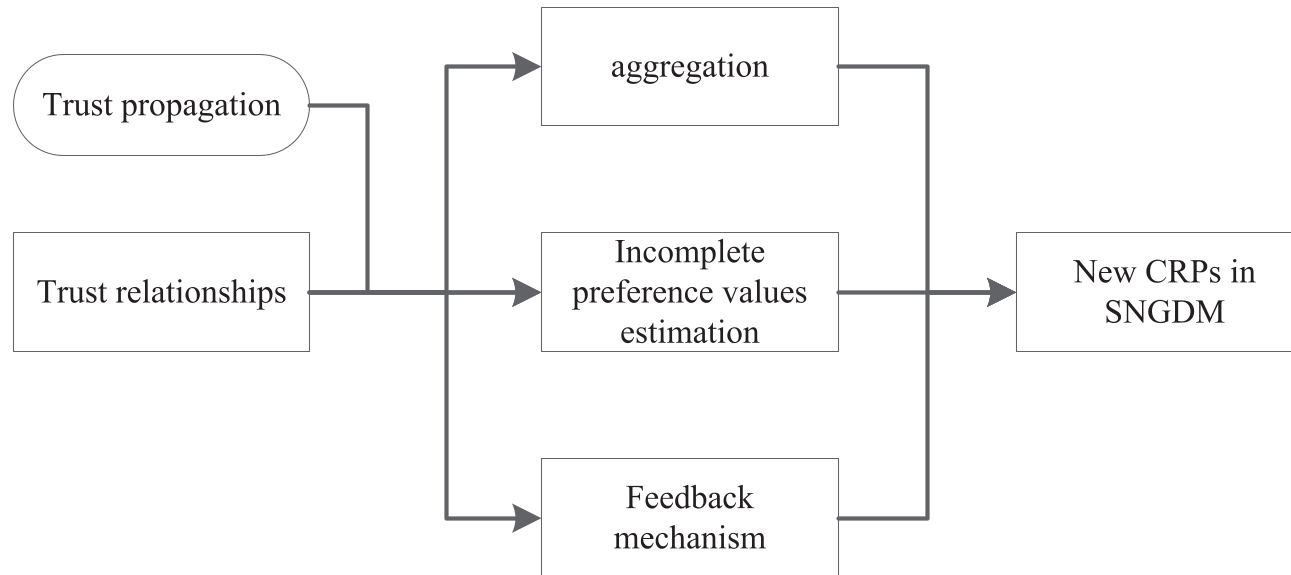
1. The Trust-Relationship Paradigm
This paradigm views the social network as a static graph used to "fix" the decision-making process.
- Aggregation: Instead of simple averages, it uses In-degree Centrality to calculate relative importance degrees ().
- Trust Propagation: If expert A trusts B, and B trusts C, the system can estimate A's trust in C using -norms or product operators.
2. The Opinion Evolution Paradigm
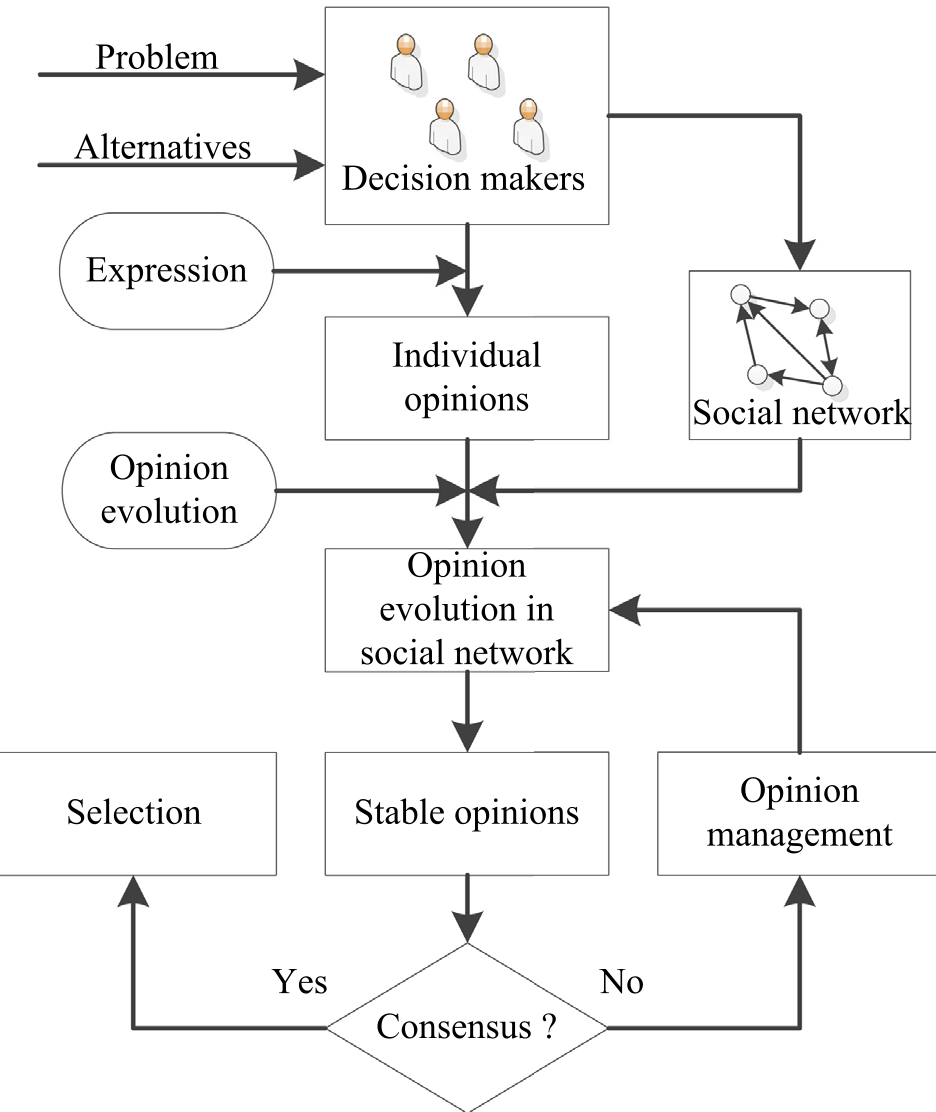
This is the "physics" of consensus. It models how opinions change over time through interaction. Using the DeGroot Model (), the system simulates whether a group will reach consensus, polarization (two camps), or fragmentation (chaos).
- Opinion Management: If the natural evolution doesn't lead to consensus, the model suggests "Opinion Management" strategies, such as adding edges (introducing experts to each other) or adjusting the influence of "informed agents" (media/bots).
The Math of Influence: Opinion Leaders
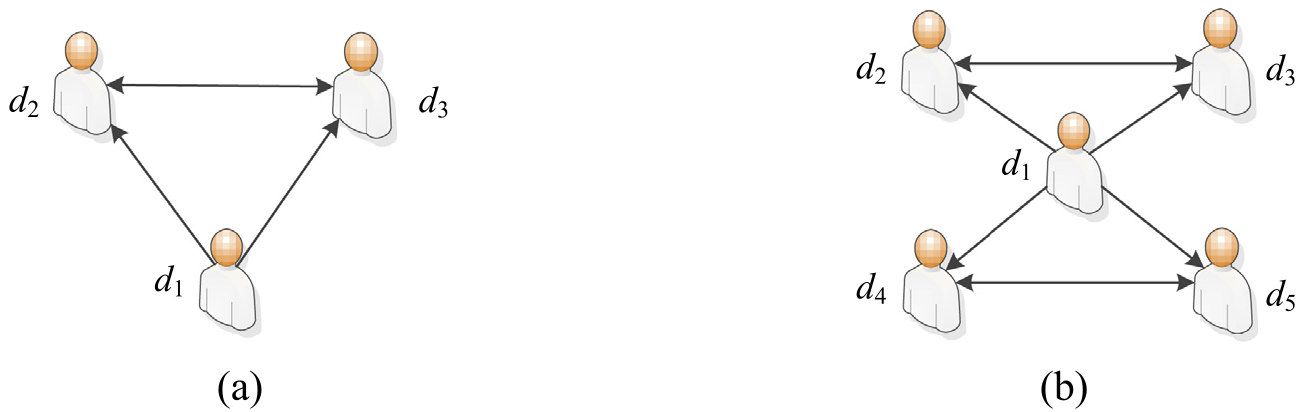
A pivotal insight of this work is the definition of Opinion Leaders. According to the Social Network DeGroot (SNDG) model, consensus is only guaranteed if the set of opinion leaders is non-empty.
Theorem: All decision makers can form a consensus if and only if there exists at least one opinion leader whose influence permeates the network.
Experimental Insights: Making Advice Acceptable
One of the most practical takeaways is the Trust-Guided Feedback Mechanism. When the group consensus level is low, the system identifies "dissenters." Instead of asking them to move toward the global average, it suggests moving toward the opinion of their most trusted peer. This utilizes the psychological "social tie" to minimize resistance to change.
Critical Analysis & Future Horizons
While the paper masterfully structures the field, it highlights significant gaps:
- Scale: Most current models struggle with "large-scale" environments (e.g., Twitter-level crowds).
- Dynamics: Trust is not static; it breaks and forms in real-time. Future CRPs must handle "Dynamic Social Networks."
- Manipulation: The move toward SNGDM introduces risks of "strategic behavior," where agents manipulate trust scores to bias the group outcome.
Conclusion
This review marks a shift from viewing consensus as a mathematical optimization problem to viewing it as a sociological process. By bridging Social Network Analysis with Group Decision Making, we can design systems—from corporate boards to decentralized protocols—that are not only more accurate but more human-centric.