
Proximal Three-Way Decisions: Bridging Geography and Social Connectivity
KNOWLEDGE‐BASED SYSTEMS
This paper introduces Proximal Three-Way Decision-making (PTWD), a novel framework for social network analysis that utilizes Delaunay triangulation and proximity set theory. By mapping social interactions into spatial and relational structures, it establishes a metric-free decision model consisting of acceptance, deferment, and rejection.
TL;DR
This research pioneers Proximal Three-Way Decision-making (PTWD), a method that uses the geometry of Delaunay Triangulations to analyze social networks. By categorizing relationships as Strongly Near, Near, or Far, the authors provide a formal mathematical bridge between where people are (spatial) and who they know (friendship), enabling better decision-making in advertising, retail, and social advocacy.
Problem & Motivation: Beyond "Are We Friends?"
In the era of Location-Based Social Networks (LBSNs) like Foursquare or Facebook Check-ins, social interactions are no longer just strings of text—they are anchored in physical space. However, existing analytical models often struggle with two things:
- Binary Limitations: They see connections as either "existing" or "not," ignoring the "boundary" cases.
- Metric Dependence: They rely heavily on exact distances (kilometers/miles), which don't always reflect the topological reality of a community.
The authors argue that "nearness" is more than just distance; it is a structural property. They leverage Rough Set theory's philosophy (3-way decisions) but adapt it to the Euclidean plane through proximity structures.
Methodology: The Geometry of Nearness
The core of the paper lies in the dual relationship between Voronoï Tessellations and Delaunay Triangulations.
1. The Three Proximal States
The PTWD model defines three types of "Proximity Relators":
- Strongly Near (): Nodes that form a triangle in a Delaunay mesh (Multi-nodal communication). Action: ACCEPT.
- Near (): Nodes connected by a single edge (Bi-nodal communication). Action: DEFER.
- Far (): Nodes that are not visible to each other or share no geometric bond. Action: REJECT.
2. Architecture of a Social Triangle
The following diagram illustrates how Voronoï regions (the cell) translate into Delaunay edges (the connections).

The paper defines several local properties to quantify these decisions:
- Visibility: Can node A see node B without node C blocking the path?
- Clustering Magnitude: How many triangles share a specific node?
- Density: The global saturation of the network.
Experiments: Real-World Evidence from Gowalla
The researchers tested their PTWD model on the Gowalla dataset, comparing two distinct graphs:
- The Spatial Graph: Based on where users check in.
- The Friendship Graph: Based on who is friends with whom.
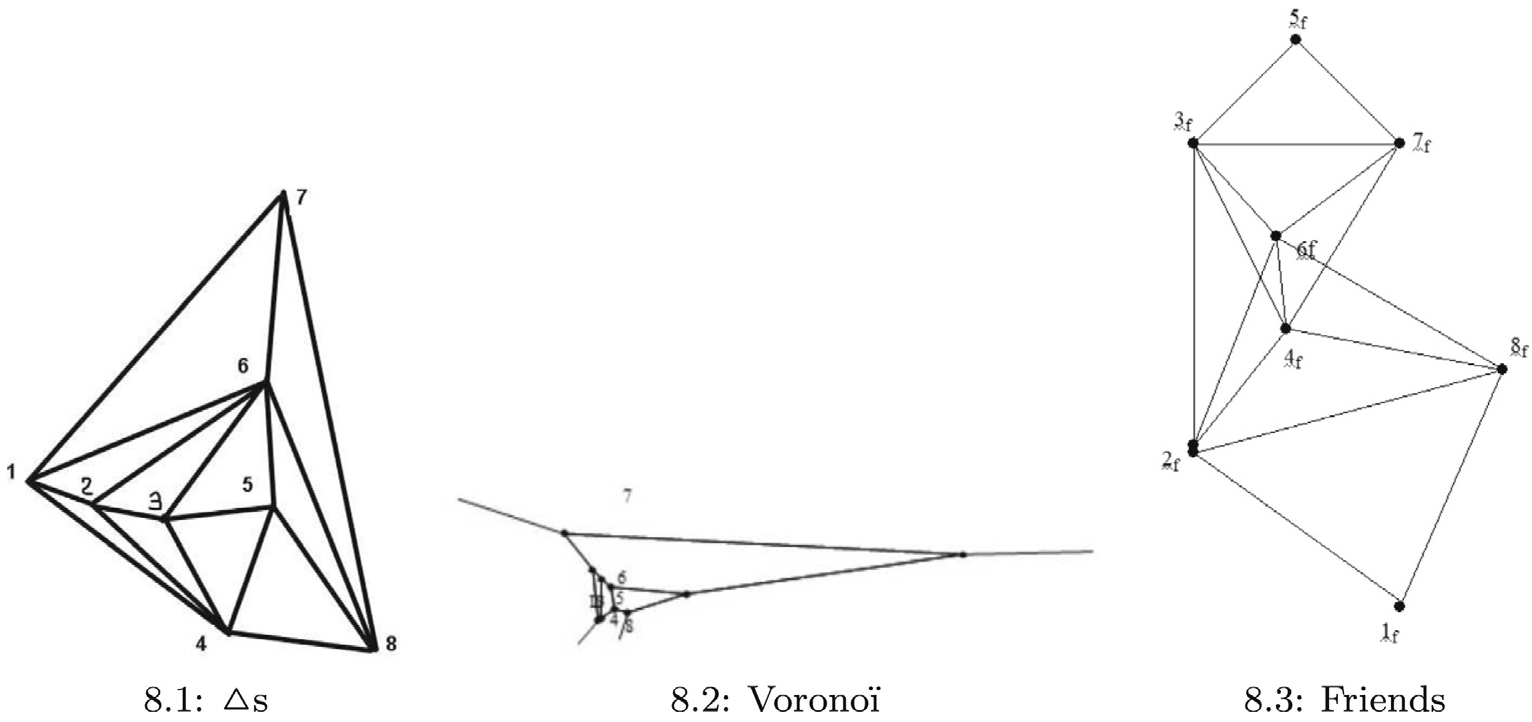
Key Insights from the Data:
- Local Density vs. Global Reach: As network size increases, the number of "Similar Triads" (users who are both social friends and spatial neighbors) increases, leading to spatial homogeneity.
- The Power of Deferment: Many "Near" relations (bi-nodal) eventually convert to "Strongly Near" (triads) as the community matures, showing why the "Deferment" action in Three-Way Decisions is vital for growing networks.

Critical Analysis & Conclusion
Takeaway
PTWD provides a rigorous mathematical foundation for identifying "supernodes" in social networks. By using geometry instead of just probability, it offers a visual and intuitive way to understand social clusters.
Limitations
- Location Accuracy: The model is sensitive to "erroneous check-ins" or users with missing location data (which resulted in a 50% data reduction in this study).
- Computational Expense: Constructing Delaunay triangulations for hundreds of millions of points in real-time is a high-cost operation.
Future Outlook
This work sets the stage for "Context-Aware AI" in social apps. Future iterations could integrate Temporal Proximity—analyzing not just where you are, but when you are there—to create a 4D Proximal Decision model.