
Structuring Success: SoC-Constrained Team Formation via Self-Organizing Mechanisms
KNOWLEDGE‐BASED SYSTEMS
Shi et al. propose a novel team formation framework in social networks that incorporates Span of Control (SoC) constraints. They introduce a Self-Organizing mechanism to dynamically assign leader/member roles and develop the MSCR algorithm, which achieves SOTA performance by minimizing communication costs through a skill-to-cost ratio strategy.
TL;DR
Modern research on team formation has long focused on finding the right "experts." However, finding experts is only half the battle; managing them is the other. This paper introduces Span of Control (SoC) constraints to social network team formation, ensuring that no leader is overwhelmed. By utilizing a Self-Organizing mechanism and the MSCR algorithm, the authors provide a way to build hierarchical, efficient teams that outperform traditional single-leader models in both cost and scalability.
The Management Bottleneck: Why More Experts ≠ Better Teams
Most existing SOTA methods for team formation (e.g., Lappas et al.) treat the problem as a search for a subgraph that covers required skills while minimizing communication cost. While mathematically sound, these models suffer from a "Flat Structure Bias." They assume a single leader can effectively coordinate with dozens of experts.
In management science, the Span of Control is a well-known principle: a leader can only effectively manage a limited number of subordinates (typically 5-12). Ignoring this leads to:
- Communication Overload: Leaders become bottlenecks.
- Coordination Failure: Large teams without sub-structures lose agility.
- Static Roles: Fixed leader/member designations don't account for the evolving topology of a growing team.
Methodology: Self-Organization and MSCR
The authors tackle these issues through a three-pronged methodological innovation.
1. Span of Control (SoC) Integration
The problem is redefined to ensure that every sub-team is bounded by a maximum size . This necessitates dividing a large project team into smaller, manageable units, each with its own sub-leader.
2. The MSCR Algorithm (Maximum Skill-to-Cost Ratio)
When choosing a new member, instead of just picking the "nearest" expert, the MSCR algorithm calculates a ratio: This ensures that the selected expert provides the maximum "skill coverage" for every unit of "communication distance" added to the team.
3. Self-Organizing Mechanism
Instead of pre-assigning roles, the system dynamically evaluates the team's topology. When a new expert joins:
- If the current leader's SoC is full, the mechanism compares two options: making the new expert a sub-leader or promoting an existing member.
- It chooses the configuration that yields the minimum total communication cost.
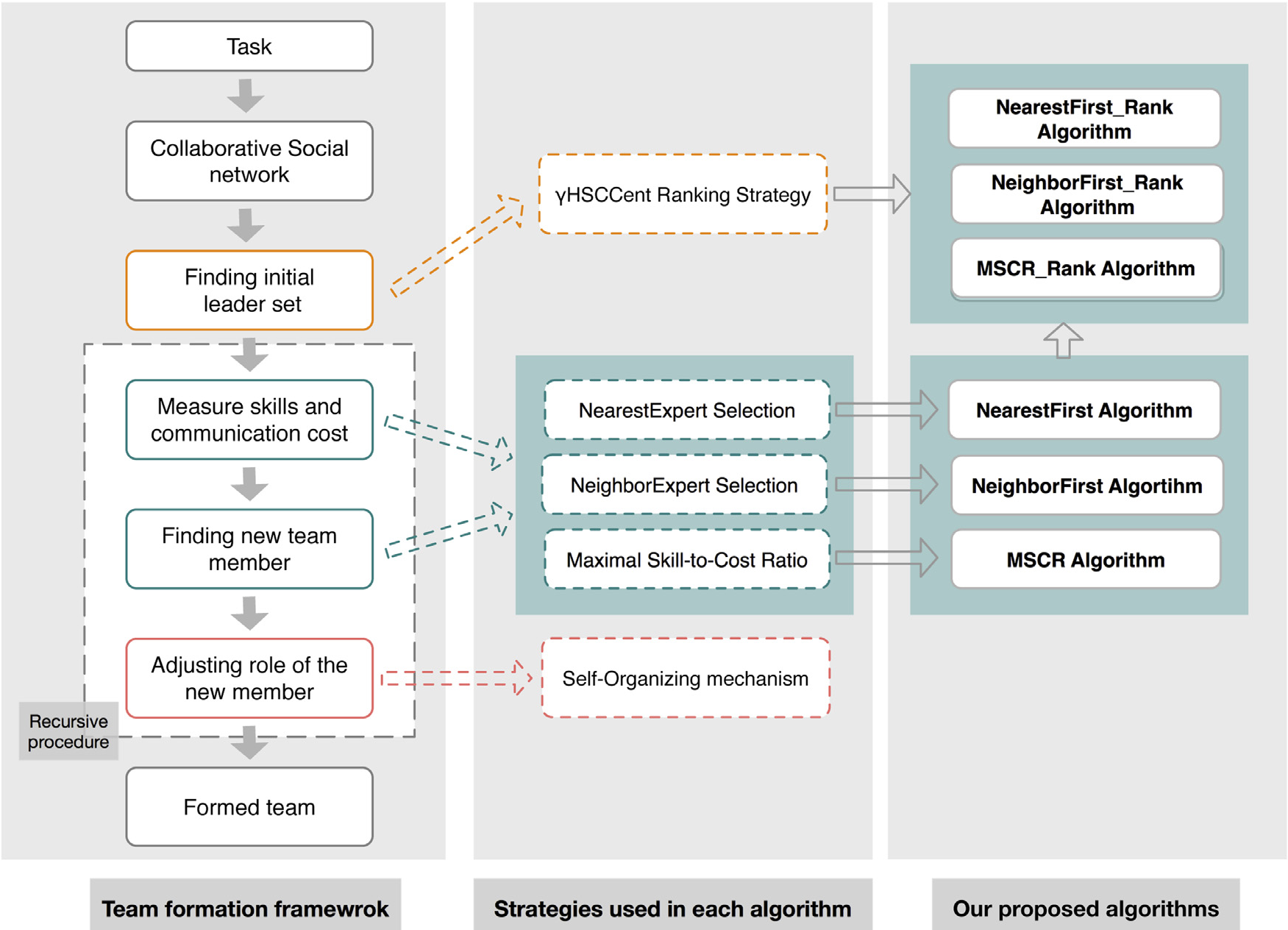 Figure 1: The framework of the proposed SoC-constrained team formation process.
Pruning the Search Space: -HSCCent
To avoid an exhaustive search (which is ), the authors introduce a ranking strategy called -Hop Skill-based Closeness Centrality (-HSCCent).
- It prioritizes experts who are "central" to holders of the required skills within a local -hop neighborhood.
- This allows the algorithm to find optimal leaders much faster, reducing the search space by up to 17%.
Experimental Insights
The researchers tested their methods on a massive DBLP dataset (academic co-authorship).
- Cardinality Efficiency: MSCR formed teams that were consistently smaller than those produced by the
Best_Leaderbaseline, reducing administrative overhead. - Communication Cost: Teams formed under SoC 12 (the managerial ideal) showed significantly lower communication costs than flat-structured teams.
- Qualitative Success: Visualization shows that the MSCR algorithm identifies key "academic authorities" (like Jiawei Han or Philip Yu) to act as natural leaders, clustering sub-experts around them based on specific research domains.
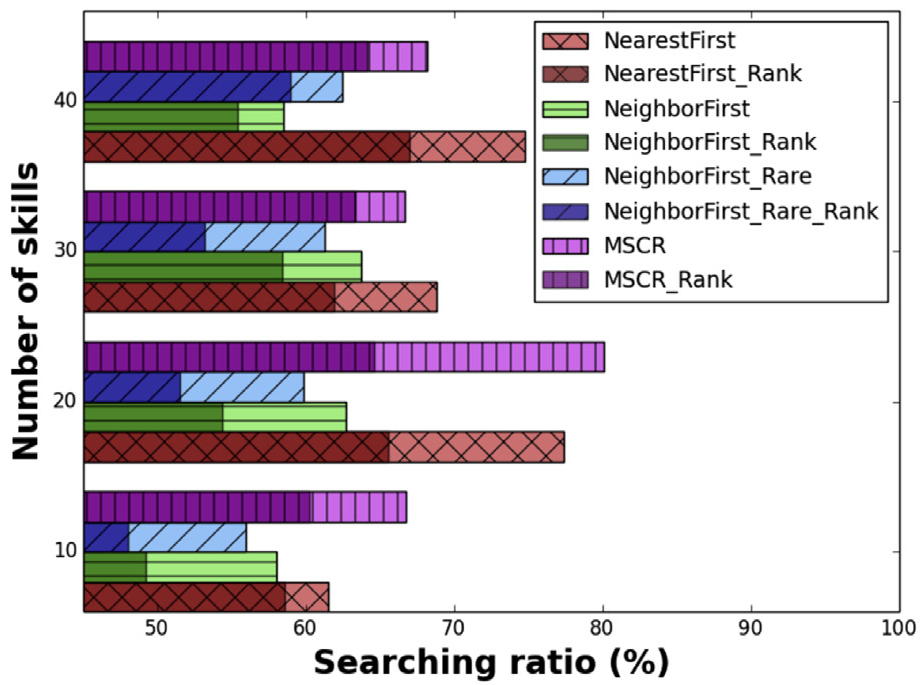 Figure 2: Performance comparison of different algorithms across varying skill requirements.
Final Takeaway
This work bridges the gap between Combinatorial Optimization and Organizational Psychology. By treating "leadership capacity" as a hard constraint rather than an afterthought, the proposed SoC-constrained algorithms create teams that are not just "smart on paper," but "functional in practice." For developers of enterprise collaboration tools or freelancer platforms, integrating role-adjustment and SoC constraints is the next step toward AI-enabled organizational design.
Limitations & Future Work
- Static Weights: The model assumes collaboration weights (Jaccard distance) are static; real-world relationships evolve.
- Uniform SoC: Different leaders have different capacities; a "Personalized SoC" would be a valuable extension.