
HAR-SI: Bridging the Knowledge Gap with Social Intelligence in Scientific Networks
KNOWLEDGE‐BASED SYSTEMS
The paper proposes HAR-SI (Hybrid Article Recommendation with Social Information), a novel recommendation framework tailored for Scientific Social Networks (SSN). It integrates social tag information into Content-Based Filtering (CBF) and friend relationships into Collaborative Filtering (CF), achieving SOTA performance on the CiteULike dataset.
TL;DR
Researchers are drowning in a sea of publications. HAR-SI is a novel hybrid recommendation engine that fixes the "sparsity" problem of traditional algorithms by injecting social tags and friend networks into the recommendation loop. It achieves a 10%+ lead over existing SOTA methods by proving that whom you follow and how you tag is just as important as what you read.
The "Isolation" Problem in Academic Search
Why do Google Scholar or traditional digital libraries sometimes fail us?
- CBF (Content-Based) Bottleneck: They look at keywords. If you use a different term for the same concept (vocabulary mismatch), the system misses it.
- CF (Collaborative Filtering) Sparsity: In a library of millions of papers, a single researcher only reads a few dozen. This "sparse matrix" makes it impossible for standard algorithms to find "users like you."
The authors of HAR-SI realized that Scientific Social Networks (SSNs) like ResearchGate or CiteULike offer two untapped "gold mines": Social Tags (subjective human descriptors) and Friend Circles (implicit trust networks).
Methodology: The Dual-Engine Approach
HAR-SI doesn't just pick one algorithm; it improves two and fuses them.
1. Improved CBF with Semantic Tags
Instead of just indexing Titles and Abstracts, HAR-SI integrates Social Tags. Tags represent how the community perceives a paper, which is often more accurate for retrieval than the author's formal language. They use Language Modeling (LM) to calculate the probability that a specific article "generated" the researcher’s interest profile.
 Figure 1: The Four-Stage HAR-SI Workflow—Data Acquisition, Improved CBF, Improved CF, and Hybrid Fusion.
2. Improved CF with Social Friends
The authors assume that a researcher's taste is influenced by their social circle. They use Probabilistic Matrix Factorization (PMF) but add a "Social Regularization" term. This forces the model to ensure that the latent features of a user are similar to those of their friends.
The math reflects a "Social Constraint": Your personal profile should gravitate toward the average of your friends' profiles .
Experimental Showdown
The researchers tested HAR-SI against 7 baselines using the CiteULike dataset (2,065 users, 85k articles).
Key Findings:
- The Power of Hybridity: HAR-SI consistently beat standalone models.
- Precision vs. Recall: As shown in the results table, HAR-SI maintains high precision even when the "Top-M" recommendations increase—a rarity in recommendation systems.
- The Factor: The best results were found when the model gave more weight to the Improved CBF (), suggesting that in science, content still reigns supreme, but social metadata provides the necessary context to find it.
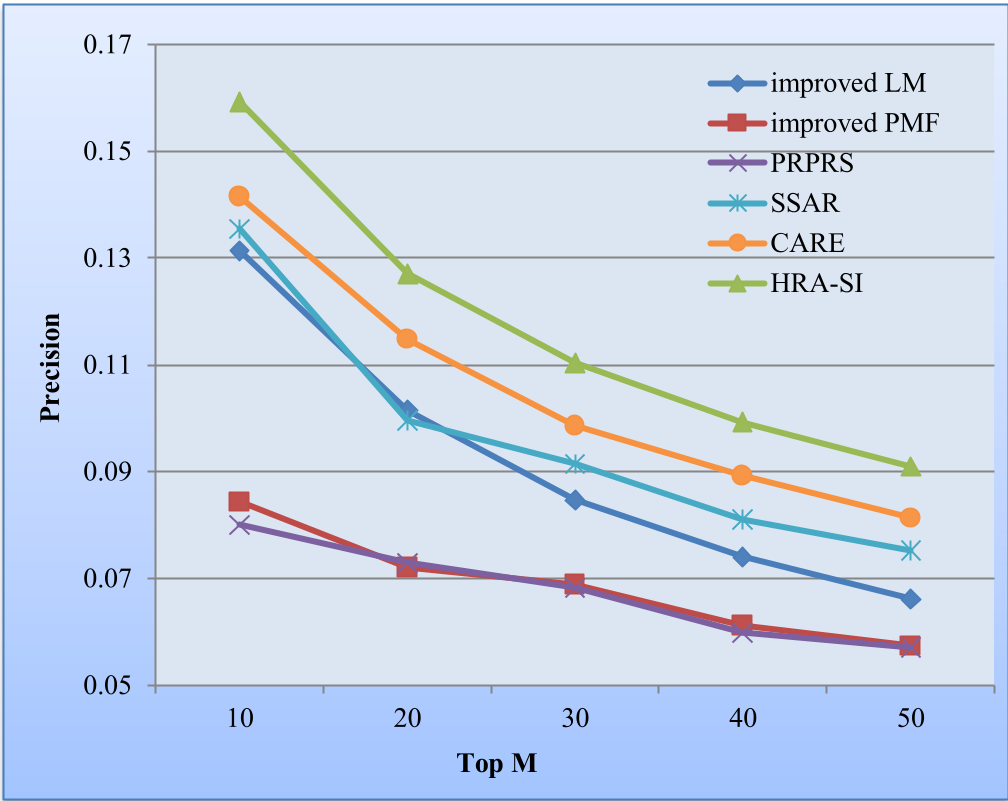 Figure 2: Precision@M comparison showing HAR-SI outperforming CARE and SSAR.
Critical Insight & Perspectives
Why does this work? In e-commerce (Amazon/Netflix), "items" are often homogeneous. In science, items are complex ideas. The "Social Tag" acts as a bridge between the formal language of the author and the natural language of the reader.
Limitations: The current model relies on explicit friend requests. In many networks, these are rare. Future work could benefit from "implicit" friendship mining—analyzing who cites whom or who attends the same conferences.
Conclusion
HAR-SI proves that recommendation is not just a mathematical matching of strings; it is a social process. By integrating the "social graph" into the "knowledge graph," we can effectively solve the information overload problem in the scientific community.