
Leadership and Bounded Confidence: A New Frontier in Social Network Consensus
KNOWLEDGE‐BASED SYSTEMS
This paper proposes a novel Consensus Reaching Process (CRP) for Social Network Group Decision Making (SNGDM) using Interval Fuzzy Preference Relations (IFPRs). The core method integrates individual leadership identification via network partitioning and bounded confidence levels to generate automated, acceptable feedback advice, achieving consensus in complex social environments.
TL;DR
Reaching a consensus in a group isn't just about averaging numbers; it's a social dance of trust and ego. This paper introduces an automated consensus-reaching algorithm for Social Network Group Decision Making (SNGDM) that respects two human realities: we listen to leaders, and we ignore advice that sounds too radical (Bounded Confidence). By using Interval Fuzzy Preference Relations (IFPRs), the model provides a robust way to handle uncertainty and social influence simultaneously.
Background: Why Decision Making is Hard in Social Networks
In the age of Weibo and Facebook, experts are no longer isolated nodes; they are part of a dense trust web. Existing Group Decision Making (GDM) models often treat experts as if they exist in a vacuum. When these models suggest a "consensus," they often fail because:
- Lack of Trust: Experts are more likely to change their minds if the suggestion comes from someone they respect (a "Leader").
- The Rejection Zone: If a moderator suggests an opinion too far from an expert's own, the expert simply digs their heels in. This is known as Bounded Confidence.
Methodology: The Core Engine
The paper introduces a three-stage framework: Network Partitioning, Consensus Measurement, and Feedback Adjustment.
1. Identifying the "Influencers"
Using a network partition algorithm, the social graph is broken into sub-networks. Within these, "Leaders" are identified based on reachability and trust. If you are an expert who needs to adjust your opinion, the system first looks for a leader within your trusted circle.
2. The Feedback Logic: Why it Works
The brilliance of the model lies in its feedback adjustment rules. Instead of just pushing the "group average" onto a dissenter, it follows a hierarchy of advice:
- Preference A: A leader's opinion that is within your confidence interval.
- Preference B: If no leader is close enough, it takes the best leader's opinion and "stretches" it just enough to enter your acceptance zone.
 Figure 1: The proposed consensus-reaching framework integrating social networks and feedback.
3. Mathematical Intuition
The experts use Interval Fuzzy Preference Relations (IFPRs). Unlike a simple score (e.g., "7/10"), an IFPR allows an expert to provide a range (e.g., "[0.6, 0.8]"), capturing human hesitation and lack of perfect information.
Results & Simulation
The authors tested the model on a hypothetical team-building exercise with 20 members and 4 alternatives (Climbing, Pedestrianism, Camping, Cycling).
- Initial Consensus: 0.7947 (Below target).
- After 9 Rounds: 0.8508 (Consensus reached).
- The Winner: Camping ().
The simulation analysis (shown below) proves that the model converges regardless of the number of alternatives (), though experts with higher "bounded confidence" (more open-minded) lead to significantly faster results.
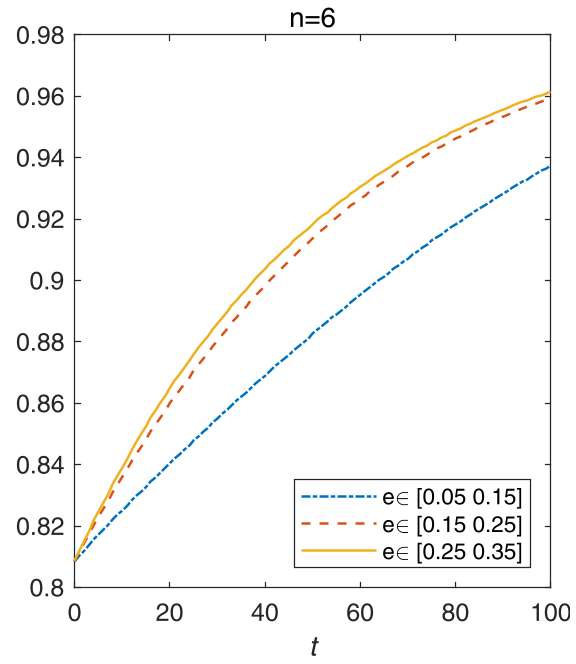 Figure 2: Performance analysis showing the rise of consensus over iterations ().
Critical Insight & Conclusion
Most GDM research focuses on the mathematical optimality of a choice. This paper shifts the focus toward psychological acceptability. By acknowledging that experts have "ego-boundaries" (bounded confidence) and social hierarchies (leadership), the model creates a much more realistic path to agreement.
Takeaway for the Industry: Automated negotiation and decision-support systems must move away from "absolute truth" and toward "social influence" modeling. The next step? Integrating real-time trust degree updates as experts interact during the decision process.
Limitations: The model assumes "bounded confidence" levels are known and fixed. In real life, our willingness to listen might change as the conversation progresses—a challenge for the next generation of AI decision-makers.