
Beyond the Text: Refining Sentiment Analysis via Personality Profiling
KNOWLEDGE‐BASED SYSTEMS
The paper introduces PbSC (Personality-based Sentiment Classification), a novel refinement framework for microblog sentiment analysis. It leverages a rule-based system to predict users' Big Five personality traits and uses these traits to extract group-specific sentiment features, significantly improving classification performance across various machine learning baselines.
TL;DR
Most sentiment analysis tools treat every user the same, missing the nuance of how different people express joy, anger, or sadness. This paper introduces PbSC, a framework that first identifies a user's personality (using the Big Five model) and then uses specialized classifiers to decode their specific emotional "slang." By doing so, it pushes the accuracy of sentiment classification to new heights on microblogging platforms like SinaWeibo.
The Missing Link: Why General Sentiment Analysis Fails
In the world of 140-character tweets, language is messy. A "conscientious" person might express positivity through words about achievement and hard work, while an "extrovert" might rely on high-energy emoticons and social slang. Traditional machine learning models (SVMs, Naive Bayes) attempt to build a global dictionary, which often washes out these personalized signals. The authors argue that personality is the latent variable that dictates word choice, and ignoring it is like trying to translate a language without knowing the dialect.
Methodology: The PbSC Architecture
The proposed method follows a three-stage pipeline:
- Rule-Based Personality Prediction: Instead of relying on noisy labels, the authors used psychological insights to create rules based on text (e.g., frequency of work-related words for Conscientiousness) and behavior (e.g., frequency of @-mentions for Extroversion).
- Specialized Feature Extraction: For each personality group (e.g., High Extroversion, Low Agreeableness), a specific sentiment classifier is trained. This allows the model to learn that for a "Low Agreeableness" user, words like "fool" or "collision" are strong negative indicators that might be less significant in a general model.
- Ensemble Integration: A meta-classifier combines the outputs of all specialized classifiers and a "general" classifier to provide a final, refined sentiment score.
 Figure 1: The framework of personality-based refinement for sentiment classification.
Key Insights from the Data
The authors' analysis uncovered fascinating links between personality and sentiment expression:
- Conscientious Users: Use words like "effort," "support," and "responsibility."
- Extroverts: Favor direct, high-arousal expressions like "ha-ha," "yeah," and "awesome."
- Introverts (Low Extroversion): More likely to use internal, reflective emotional words like "sincerity," "unhappy," or "insomnia."
 Table 1: Examples of textual features extracted for different personality groups.
Experimental Performance
The researchers tested PbSC against several traditional algorithms and three State-Of-The-Art (SOTA) systems from the SemEval competition (NRC_Canada, TeamX, and Webis).
The results were conclusive:
- Baseline Boost: Adding personality refinement improved the F1-score of a standard Decision Tree from 82.40% to 83.28%.
- SOTA Improvement: Even the highly optimized Webis ensemble saw its F1-score climb from 93.81% to 94.05% when personality traits were integrated.
- Ablation Success: Removing any single personality group from the ensemble resulted in a performance drop, proving that every trait (Extroversion, Conscientiousness, Agreeableness) contributes unique value to the sentiment decoding process.
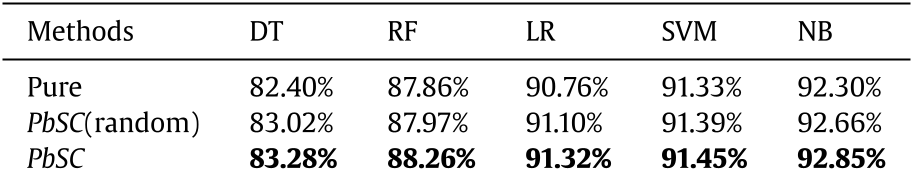 Table 2: Comparison between Pure models and the PbSC refined versions.
Critical Perspective & Future Work
While the rule-based approach for personality prediction ensures high precision, it may suffer from low recall—meaning it can only classify users who post frequently enough to trigger the rules.
The authors suggest that future iterations could incorporate Deep Learning (CNNs/RNNs) to learn these personality representations automatically from raw text. Furthermore, extending this to "Fine-grained Emotion Analysis" (e.g., distinguishing between anger and disgust) could provide even deeper insights for social management and business intelligence.
Conclusion
This paper serves as a powerful reminder that context is king. By moving from "what was said" to "who said it," the PbSC framework provides a blueprint for a more empathetic and accurate generation of AI-driven social media analytics.