
Bridging ASR and Paralinguistics: The Power of Posterior-Thresholding (PTFE)
KNOWLEDGE‐BASED SYSTEMS
The paper introduces Posterior-Thresholding Feature Extraction (PTFE), a novel three-step framework for paralinguistic speech classification. It leverages frame-level Deep Neural Network (DNN) posteriors to generate utterance-level features, achieving up to 19% relative error reduction when combined with standard descriptors like ComParE functionals.
TL;DR
Computational paralinguistics—the study of how we speak rather than what we say—has long been divided between simple global statistics and complex, task-specific models. This paper introduces Posterior-Thresholding Feature Extraction (PTFE), a robust, task-independent framework that takes the high-resolution "frame-level" wisdom of speech recognition and distills it into powerful utterance-level features. By combining these with standard descriptors, the author achieves significant performance gains (up to 19% error reduction) across physical load, emotion, and eating condition detection.
Problem: The Macro-Micro Gap
In Automatic Speech Recognition (ASR), models analyze tiny frames of 10-25ms. In paralinguistics, however, researchers usually summarize an entire 5-second clip into a single vector of means and standard deviations (the "ComParE" approach).
The issue? Important paralinguistic cues—like the specific sound of a "crisp" being eaten or a sharp intake of breath during physical exertion—are local events. Global averages "wash out" these critical moments. While methods like Bag-of-Audio-Words (BoAW) try to fix this via unsupervised clustering, they ignore the label information during feature creation.
Methodology: The PTFE Workflow
The author proposes a elegant three-step pipeline that brings supervised frame-level intelligence to the utterance level:
- Frame-level DNN Training: A Deep Neural Network is trained to classify individual frames based on the utterance's label. Even if a single frame can't tell you "this speaker is tired," the DNN learns to assign higher probabilities to the types of sounds associated with that state.
- Posterior Thresholding: Instead of a simple "majority vote," the method calculates the ratio of frames that exceed a specific probability threshold (e.g., how many frames have a >0.2 probability of "Anger"? >0.4? >0.8?). This effectively creates a cumulative histogram of the DNN’s confidence.
- Utterance-level SVM: These histogram values become a new feature set, which is then fed into a Support Vector Machine for final classification.
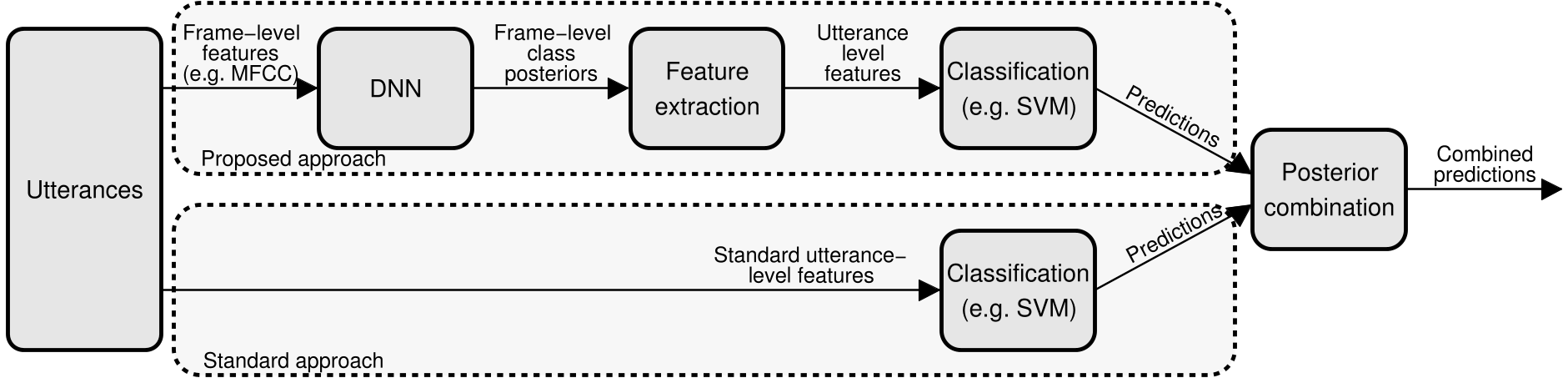 Figure 1: The general scheme of the PTFE workflow, transitioning from frame-level DNNs to utterance-level SVMs.
Why It Works: Visualizing Posteriors
The breakthrough is in the "Posteriors." As shown below, the DNN identifies regions of interest (e.g., eating sounds) quite accurately. By thresholding these scores, we capture both the intensity and duration of these paralinguistic events without needing manual segment labels.
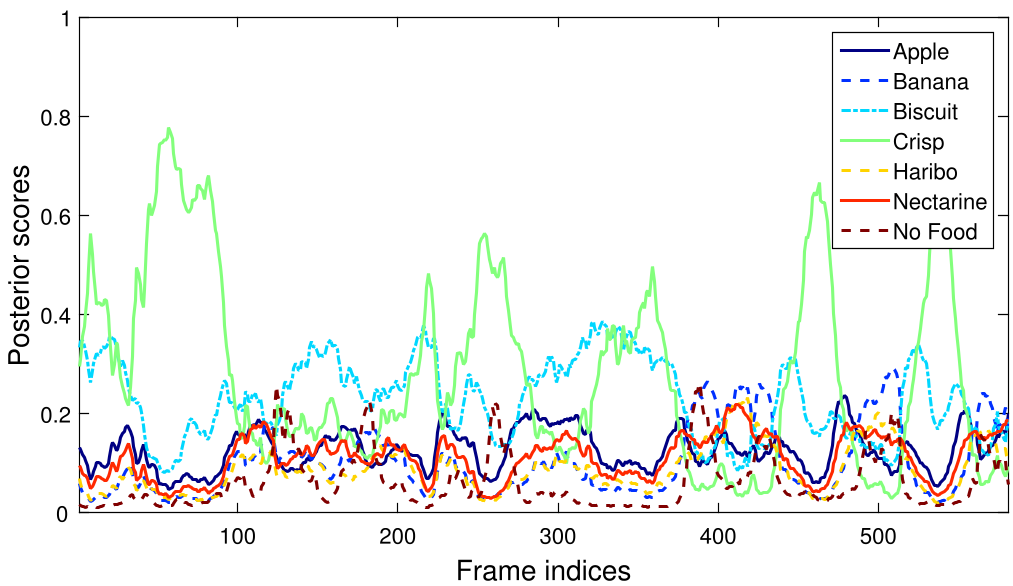 Figure 2: DNN output for an utterance from the Eating Condition corpus. The model successfully "spots" the regions corresponding to the correct class.
Experiments & Results
The author tested PTFE on four distinct datasets: Physical Load (German), Emotion (Hungarian), Eating Condition (German), and Cognitive Load (English).
Key Findings:
- Consistent Improvement: PTFE plus standard ComParE features outperformed the baseline in every single task.
- Relative Error Reduction: Achieved up to 19% RER in some configurations.
- Competitive with Heavyweights: On the Eating Condition task, the method approached the performance of Fisher Vector analysis—a much more computationally expensive and complex technique.
 Table 2: Results on Physical Load. Note how "ComParE + PT features" achieves a UAR of 74.0%, significantly beating the baseline.
Critical Analysis & Conclusion
Takeaway
The PTFE framework is a "best of both worlds" solution. It utilizes the discriminative power of DNNs at the frame level but retains the robustness of SVMs for final decisions, where data is often scarce (only a few hundred utterances).
Limitations & Future Work
- Data Scarcity: The method struggled on the Cognitive Load task, likely because the DNN needs sufficient frame variety to learn meaningful patterns.
- Computational Iteration: The author suggests a "robust posterior" method involving 250 DNN training iterations to avoid bias, which can be time-consuming compared to simple feature extraction.
- Future Path: Integrating this thresholding logic directly into an end-to-end differentiable network (e.g., an "Attention-over-Thresholds" layer) could further optimize performance.
Final Verdict: PTFE is a highly practical, task-agnostic tool for any audio researcher looking to squeeze more performance out of standard classification tasks using established ASR tools.