
CrowdBNMVI: Fusing Bayesian Logic with Human Intuition for Precise Data Imputation
KNOWLEDGE‐BASED SYSTEMS
This paper introduces CrowdBNMVI, a hybrid missing value imputation framework that integrates Bayesian Networks (BN) with Crowdsourcing. It uses a relevance-based BN to model attribute dependencies and employs crowd workers to provide high-quality external information for highly uncertain or influential missing data points.
TL;DR
Data incompleteness is a silent killer of model performance. While machines are good at spotting patterns, they lack the "world knowledge" needed to fill in gaps when data is severely sparse. This paper presents CrowdBNMVI, a framework that uses Bayesian Networks to handle what the computer can infer and selectively "outsources" the most difficult or influential missing values to human crowd workers, achieving a 26% boost in accuracy over traditional methods.
The Problem: The "Information Blind Spot"
Machine learning models like KNN or SVM are popular for imputation, but they have a fundamental flaw: they are "closed-world" systems. If all the entries for a specific medical symptom or an Olympic event are missing or corrupted, the model has no external context to fix them.
Existing "open-world" solutions like Web-scraping or Knowledge Bases often introduce more noise than they resolve. Crowdsourcing is the logical next step, but it faces a Cost-Accuracy Dilemma: human labor is expensive and potentially inconsistent.
Methodology: Bayesian Networks Meet the Crowd
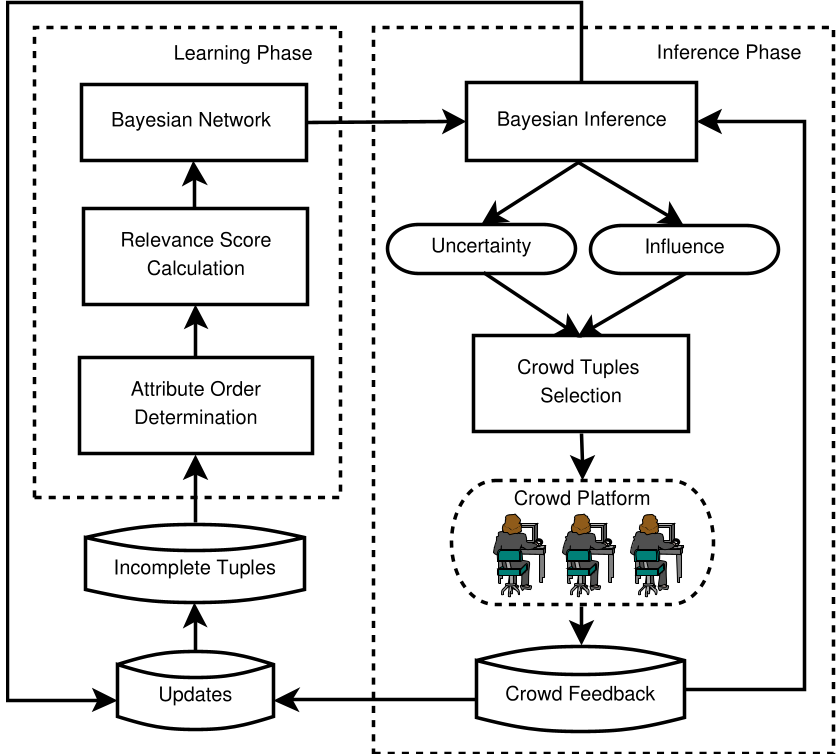
The authors address the challenge through a two-phase architecture: Learning and Inference.
1. Building the Network on Shaky Ground
Standard BN construction (like K2) assumes complete data. The authors propose a Relevance-based Construction that uses Pearson Correlation to build a Directed Acyclic Graph (DAG) based on attribute reliability.
- Insight: Instead of finding causal links (which is hard with missing data), they focus on relevant dependencies, allowing the model to fill in a value based on its most reliable parents.
2. Intelligent Crowdsourcing: Who do we ask?
The core innovation lies in the Crowd Tuple Selection strategies. To minimize cost ( tasks), they don't pick at random:
- Uncertainty-Based (Entropy): Using Shannon Entropy, they identify tuples where the Bayesian posterior distribution is "flat" (i.e., the model is confused).
- Influence-Based: They frame this as a Maximum Coverage problem. Some missing values are "hubs"—if a human fills them, the Bayesian Network can suddenly infer dozens of other values with high confidence. Though NP-hard, the authors provide a greedy approximation with a bound.
Experiments: Proving the Power of Hybrid AI
Testing across five diverse datasets (from Chess moves to Earthquake records), the results were compelling.
Performance vs. Missing Rate
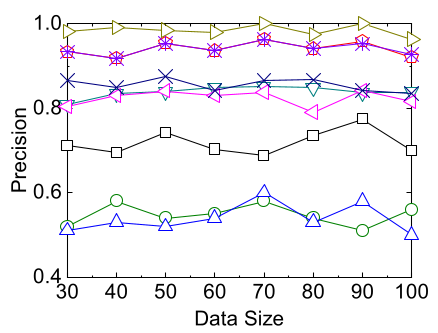
As the "Missing Rate" increases, traditional methods (KNN, SVM, Mode) collapse in performance. CrowdBNMVI maintains a significantly higher F-measure because even as the internal data disappears, the external "Human Knowledge" remains constant.
The Human Element: Real-World Latency
On platforms like Amazon Mechanical Turk, the authors achieved 80% task completion in under 3 hours. By using "Majority Voting" and qualification tests, they effectively filtered out "spammers," ensuring that the human input was the "ground truth" the Bayesian Network needed to refine its internal probabilities.
Critical Analysis & Takeaways
Why is this important? CrowdBNMVI proves that we don't need to choose between human accuracy and machine scale. By using humans to solve the "Active Learning" subset of the most influential data points, we get the best of both worlds.
Limitations:
- Static Pricing: The model assumes a flat cost per HIT. Future work could benefit from dynamic pricing based on task complexity.
- Knowledge Latency: While 3 hours is fast for batch cleaning, it is still a bottleneck for real-time streaming data.
Conclusion
The synergy of probabilistic graphical models and crowdsourcing provides a robust pathway for high-stakes data cleaning. This research is a blueprint for systems where data quality is paramount, such as clinical trial databases or historical archive restoration.