
Recursive Influence Maximization: Breaking the 500x Speed Barrier in Big Social Networks
KNOWLEDGE‐BASED SYSTEMS
This paper presents a novel probability-based recursive method for Influence Maximization (IM) in large-scale social networks. By estimating influence spread through node-to-node reachable probabilities rather than expensive Monte Carlo simulations, the proposed algorithm significantly reduces computational overhead while maintaining high accuracy.
TL;DR
Influence Maximization (IM)—the task of finding nodes to maximize information spread—has long been plagued by a "trilemma" of computation speed, accuracy, and memory usage. This paper introduces a recursive estimation framework that turns a simulation-heavy problem into a fast, probability-driven calculation. The result? A 500x speedup over the industry-standard CELF algorithm without sacrificing the quality of the seed nodes found.
Background: The Scalability-Accuracy Dilemma
In the world of social network analysis, the Independent Cascade (IC) model is the standard for simulating how a "viral" message spreads. However, calculating the expected spread is #P-hard.
Current solutions generally fall into two camps:
- Greedy Algorithms (e.g., CELF, CELF++): Accurate but painfully slow because they run thousands of Monte Carlo simulations for every candidate node.
- Heuristics (e.g., DegreeDiscount, PMIA): Fast but "brittle"—they often fail when network structures don't fit their specific assumptions.
The authors identify a critical bottleneck: The cost of simulating cascades. If we could estimate influence spread using simple probability math instead of rolling the dice thousands of times, we could scale to millions of nodes.
Methodology: The Power of Recursion and FKG Inequality
The core innovation lies in treating influence spread not as a simulation result, but as a node-to-node reachable probability.
1. From Nodes to Sets
The authors prove that the probability of a node being reached by a merged set of nodes can be expressed by the individual probabilities and , adjusted for the overlap (when and both influence ).
2. The Theoretical Anchor: FKG Inequality
To handle the complex conditional probabilities that arise when nodes are path-dependent, the authors apply the Fortuin–Kasteleyn–Ginibre (FKG) inequality. This allows them to mathematically bound the "overlap" of influence, ensuring that their estimates don't double-count influence spread in dense clusters.
 The recursive approximation formula (Eq. 15) uses a linear combination of bounds to estimate influence based on the "distance" between candidate seeds.
3. Three Pillars of Implementation
To balance memory and speed, the paper proposes three strategies for obtaining the initial node-to-node probabilities ():
- StatProb (Static Strategy): High accuracy, uses more memory.
- PropProb (Propagation Strategy): Minimal memory footprint (O(Nn)).
- CompProb (Compound Strategy): A balanced hybrid approach.
Experiments: Speed and Accuracy
The authors tested their approach on four datasets, ranging from the small ego-Facebook (4k nodes) to the larger email-Enron (36k nodes).
Performance Gains
The results are striking. While maintaining an influence spread nearly identical to the "exact" greedy algorithms, the proposed method achieved:
- 561x speedup on
ca-HepPh. - 855x speedup on
ego-Facebook.
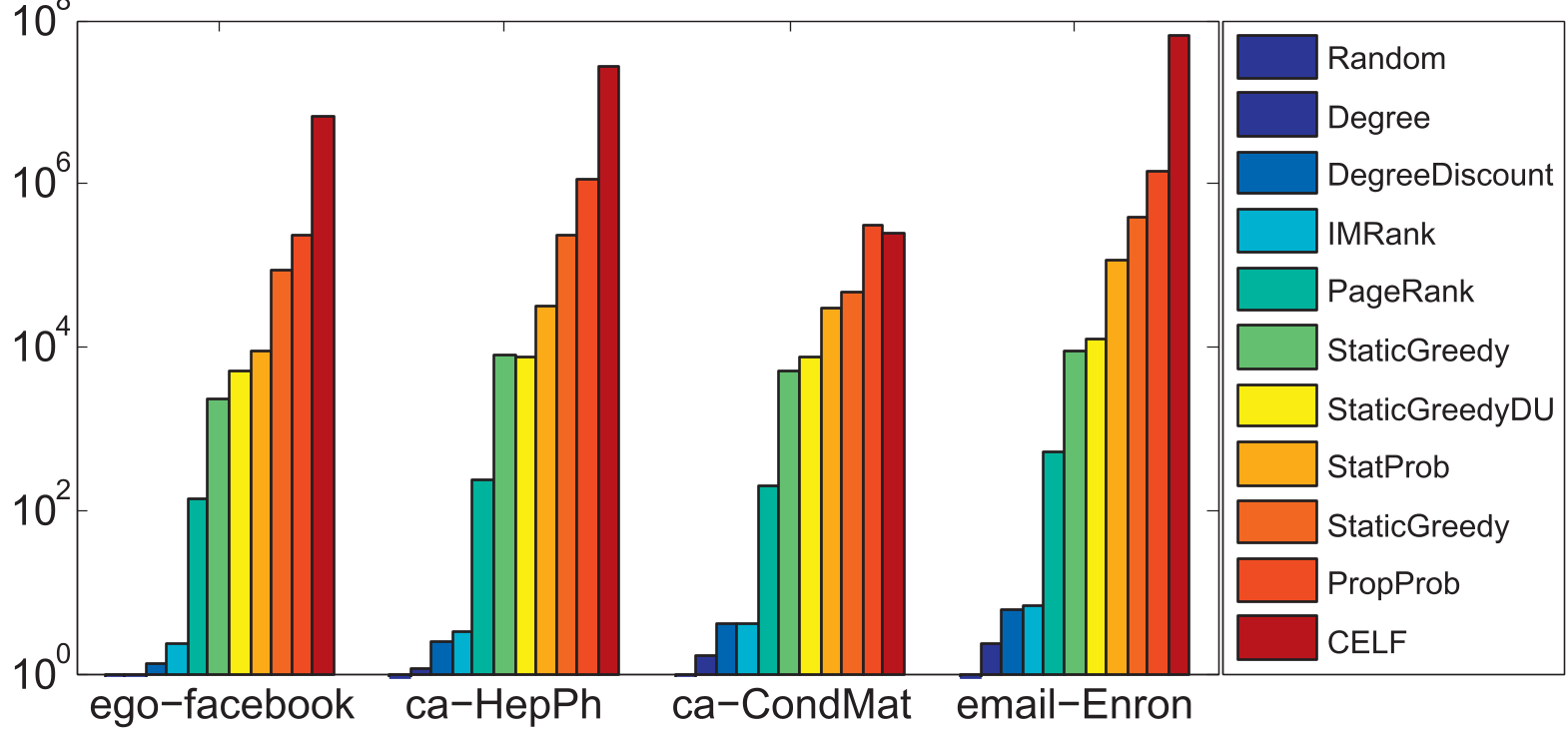 Fig 7: Running times show that while traditional CELF (purple) scales poorly, the recursive strategies (StatProb/PropProb) remain significantly faster.
Accuracy Consistency
Unlike simple heuristics like PageRank or Degree, which often drop in performance on specific network topologies, the recursive estimation (referred to as StatProb/PropProb in graphs) consistently stays at the top of the "Influence Spread" curves, matching the expensive CELF and StaticGreedy benchmarks.
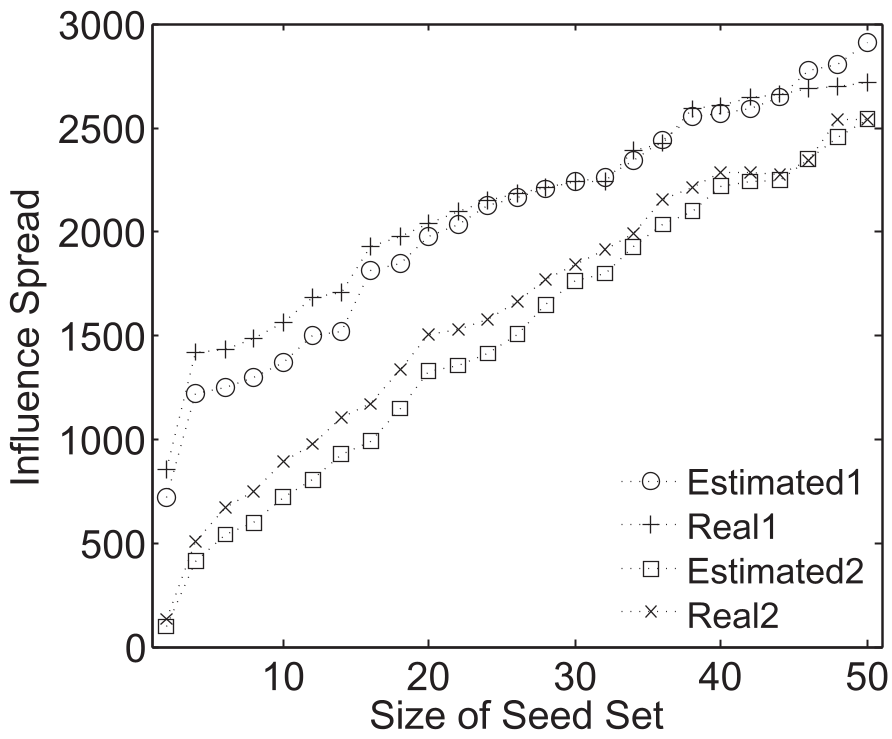 In every dataset, the authors' method (red and blue lines) overlaps with the optimal greedy results, outperforming PageRank and Degree heuristics.
Critical Analysis & Takeaways
The brilliance of this work is its physical intuition: it recognizes that in a sparse social network, the influence of two distant nodes is nearly additive, while for close nodes, the overlap is predictable.
Limitations: The preprocessing stage still requires a degree of simulation to estimate the initial "node-to-node" values. While this is a one-time cost, it remains the most expensive part of the pipeline ().
The Future: This paper paves the way for "Simulation-Free" IM. Future iterations might use Graph Neural Networks (GNNs) or embedding techniques to estimate these node-to-node probabilities even faster, potentially enabling real-time influence maximization on streaming social data.
Final Thought: If you are building a viral marketing engine or a public health alert system, the days of waiting hours for Monte Carlo results are over. Recursive estimation is the new standard for efficiency.