
GCR: Breaking the Speed Barrier in Social Trust and Distrust Inference
KNOWLEDGE‐BASED SYSTEMS
This paper introduces GCR (Gullibility-Competence-Reciprocity), a localized, non-propagative algorithm for predicting trust and distrust in weighted signed social networks. It leverages three social traits to estimate hidden relationship weights, achieving performance comparable to state-of-the-art methods like AGR while being up to 100x faster.
TL;DR
Trust is the currency of Social Networks, but quantifying it is historically slow and complex. This paper proposes GCR, a revolutionary algorithm that ignores traditional "path-based trust propagation" in favor of analyzing localized social traits: Gullibility, Competence, and Reciprocity. The result is a system that predicts both trust and distrust with high accuracy, remains robust against sparse data, and operates at speeds up to two orders of magnitude faster than current state-of-the-art methods.
The Problem: The Transitivity Trap
Most trust algorithms rely on the logic: "If Alice trusts Bob, and Bob trusts Charlie, then Alice might trust Charlie." While intuitive, this approach—known as transitivity—has three fatal flaws in modern OSNs:
- Distrust is NOT Transitive: If you distrust your enemy, and your enemy distrusts a third party, that doesn't mean you trust that third party.
- Trust Decay & Path Conflict: Information lost over long paths makes predictions unreliable, and overlapping paths lead to "echo chamber" biases.
- Computational Nightmare: Searching for paths in a billion-node graph (like Facebook or X) is too slow for real-time interaction.
Methodology: The Tug-of-War Analogy
Instead of walking the graph, the authors treat trust as a Tug-of-War between the social characteristics of the two people involved: the Trustor and the Trustee.
1. The Core Metrics
- Gullibility/Paranoia: Does the Trustor tend to trust everyone (Gullible) or suspect everyone (Paranoid)?
- Competence/Incompetence: Is the Trustee generally highly rated by others (Competent) or widely distrusted (Incompetent)?
- Reciprocity: Does this pair have a history of returning trust for trust?
2. The Weighting Mechanism
The final trust value is calculated by weighing these forces. If a trustor is highly gullible and the trustee is highly competent, both forces pull the trust value toward the maximum (). If they are strangers but value reciprocity, the existing back-link heavily influences the result.
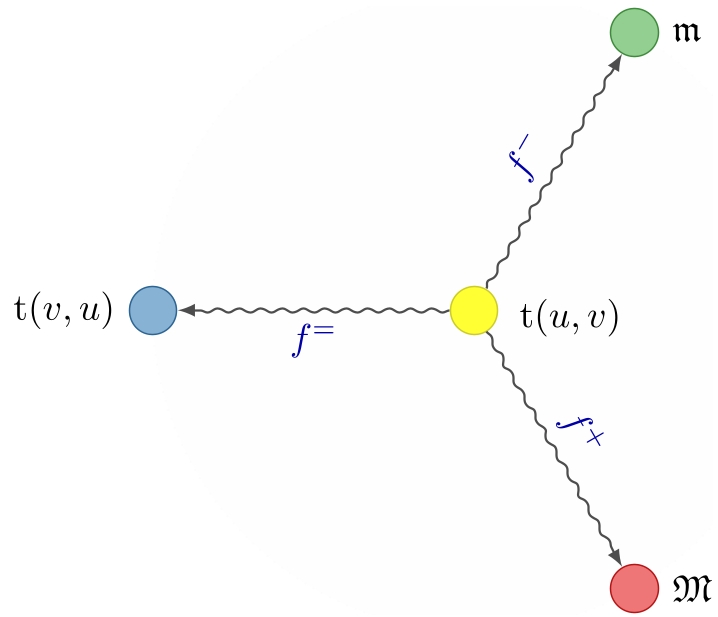 Fig 1: The trust value is influenced by competing forces: GCR pulls the value toward M (max trust), m (max distrust), or the reciprocal value.
Experiments: Accuracy Meets Speed
The authors tested GCR against five major baselines (REC, BaD, FxG, STAR, AGR) across four large datasets.
Performance & Robustness
GCR significantly outperformed global metrics (BaD, FxG) and complex propagative models (STAR) in Error (MAE/RMSE). Remarkably, even when 90% of the network data was deleted (sparsity), GCR's accuracy remained nearly flat, while other models' performance collapsed.
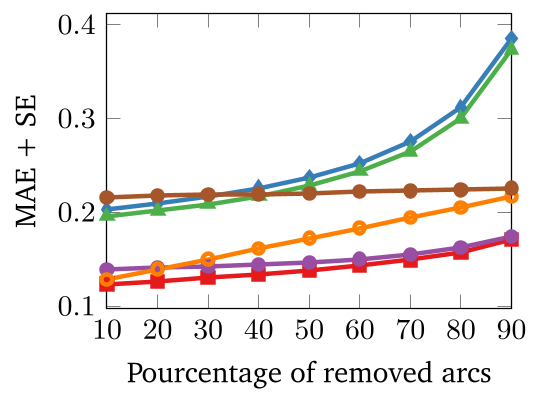 Fig 2: Performance remains stable (flat lines for GCR) even as more arcs are removed, demonstrating extreme robustness to network sparsity.
The Speed Advantage
The real "mic drop" moment is the efficiency. Because GCR only looks at a node's immediate neighbors (local metrics), it side-steps the or complexities of other models.
- Inference Speed: GCR is roughly 100x faster than the runner-up (AGR).
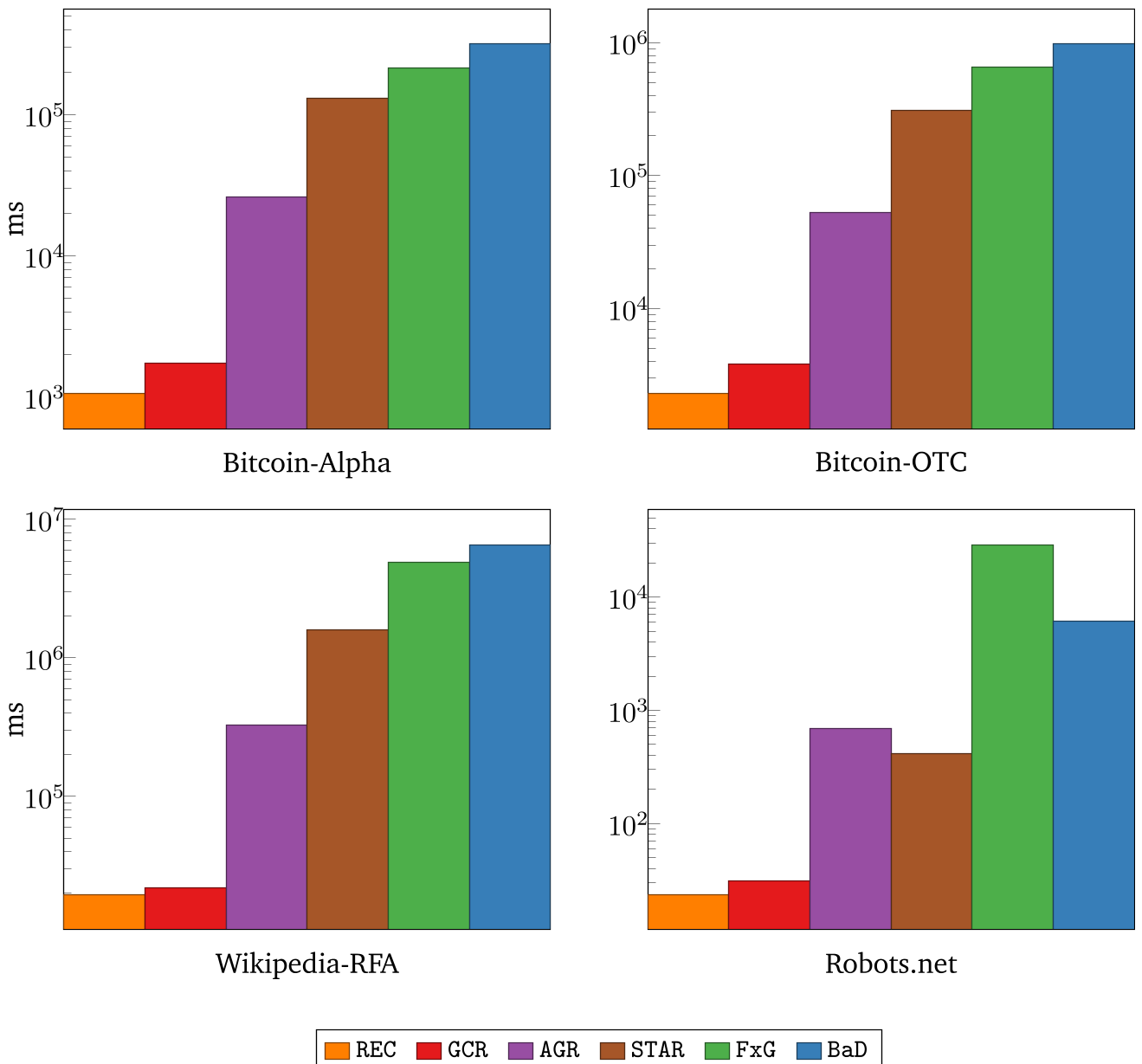 Fig 3: Logarithmic scale of execution time. GCR (yellow) is significantly lower—and thus faster—than competing accurate models like AGR.
Critical Insight: Why This Matters
This work shifts the paradigm of trust inference from "global connectivity" to "individual psychology." By quantifying social traits, we can predict relationships without needing to know the entire structure of the internet.
Limitations: The model currently assumes the three traits are independent. However, in reality, a "gullible" person might also be "more prone to reciprocate." Future iterations that model the correlation between these traits could push accuracy even higher.
Conclusion (Takeaway)
GCR proves that the best solution isn't always the most mathematically complex one. By using local traits instead of expensive graph traversals, we can build social platforms that identify malicious actors and "fake news" spreaders in milliseconds, rather than minutes.