
Beyond Single Graphs: Maximizing Influence in Fragmented D2D Social Networks
KNOWLEDGE‐BASED SYSTEMS
The paper proposes a novel framework for Multi-Community Influence Maximization (MCIM) in Device-to-Device (D2D) social networks, aiming to identify seed users across multiple communities to maximize content propagation. It decomposes the NP-hard MCIM problem into two subproblems: Single Community Influence Maximization (SCIM) using a custom Weighted LeaderRank with Neighbors (WLRN) algorithm, and Multi-Community Budget Allocation (MCBA) via an Optimal Budget Allocation (OBA) method based on reinforcement learning.
TL;DR
This research tackles the challenge of information spreading in Device-to-Device (D2D) networks, where geographical limits break the social graph into many small "islands" (communities). By combining a community-aware ranking algorithm (WLRN) with a Reinforcement Learning-based budget allocator (OBA), the authors achieved up to a 62% improvement in content reach over traditional methods like PageRank.
Context: This work shifts the focus from "finding the most popular person on the internet" to "effectively distributing a limited marketing budget across dozens of small, local groups."
The Problem: The "Island" Effect in D2D Networks
In standard online social networks (like Twitter), we usually treat the world as one giant, interconnected graph. However, D2D communication—sharing files via Bluetooth or WiFi Direct—only happens when people are physically close. This creates a fragmented landscape of many small communities.
Prior work often failed here by:
- Over-simplifying community selection: Simply giving every community the same number of seeds.
- Ignoring local dynamics: Using global metrics that don't account for how information flows within a small, physical cluster.
- Static Allocation: Allocating seeds based on community size alone, which ignores the fact that a small community might have a much more efficient "influencer" than a large one.
Methodology: The Two-Step Solution
The authors break the Multi-Community Influence Maximization (MCIM) problem into two distinct stages:
1. Ranking within the "Island" (WLRN)
Instead of using standard PageRank, the authors propose Weighted LeaderRank with Neighbors (WLRN).
- Why Weights? In D2D, how often you share matters more than just if you are connected.
- The Virtual Node: A virtual "Leader" node is connected to every user, allowing the algorithm to converge more robustly than standard PageRank.
- Neighbor Power: It doesn't just look at a user's direct links; it factors in the influence of 1-hop and 2-hop neighbors (parameterized by and ).
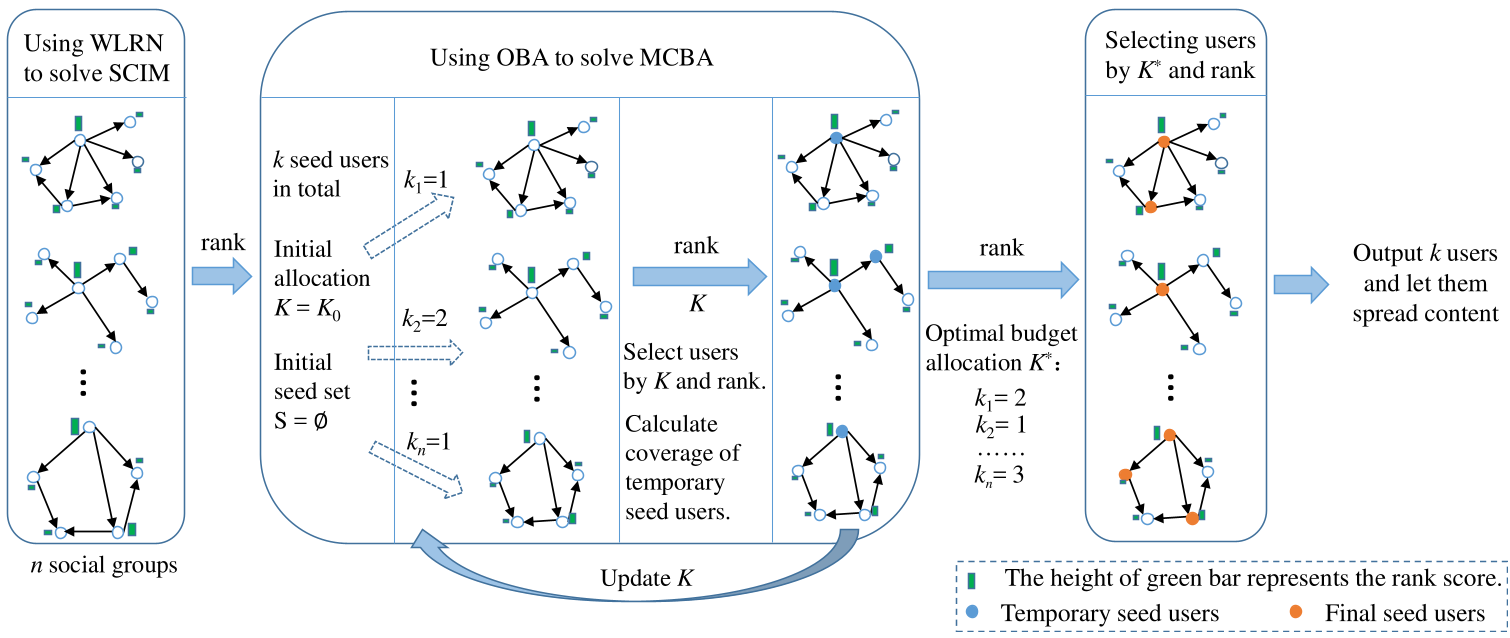 Figure: The framework workflow, transitioning from local community ranking to global budget allocation.
2. The Smart Allocator (OBA via Reinforcement Learning)
The real innovation is Optimal Budget Allocation (OBA). The authors treat the act of assigning seeds to communities as a Markov Decision Process (MDP).
- State: Which communities have we already dealt with, and how many seeds are left in our pocket?
- Action: How many seeds should we give to the current community?
- Reward: How many new users will be covered by those seeds?
By using Value Iteration, the model learns the "Long-term Value" of saving seeds for future communities versus spending them now.
Experimental Results: Proving the Advantage
The authors tested their method against real-world data from Xender (an offline file-sharing app) and Bitcoin-Alpha.
- Superiority of OBA: Even when using standard ranking algorithms like HITS or Closeness, using the OBA allocation outperformed random, average, or proportional allocation significantly.
- Efficiency: The proposed WLRN ranking consistently found better seed sets than the "Greedy" algorithm in much less time.
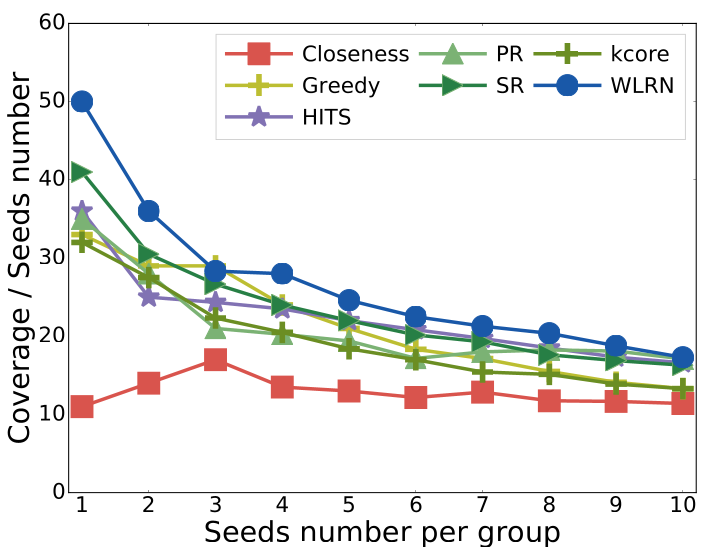 Figure: Cumulative coverage over time, showing the consistent lead of the proposed method (WLRN).
Critical Insight & Conclusion
The core takeaway is that Structural Property Propagation Potential. A community might be large, but if its internal links are weak or redundant, giving it more seeds (proportional allocation) is a waste. The OBA method fixes this by using "historical feedback" to understand the true "ROI" of a seed user in a specific community.
Limitations & Future Work
- Computational Cost: Value Iteration requires scanning all states/actions, which is slow for massive networks. Future versions could use Deep Q-Learning (DQN) to scale.
- Dynamic Graphs: D2D communities change as people move. Adapting this budget allocation in real-time to shifting community boundaries remains an open challenge.
In summary, this paper provides a robust blueprint for how mobile networks can offload cellular traffic by intelligently "seeding" content in offline D2D clusters.