
The Social Mechanics of Innovation: Bridging the Cognitive Gap
Knowledge behaviour and social adoption of innovation
This paper introduces the "Social Adoption of Innovation" model, which integrates social networks and information systems as simultaneous sources for bridging the knowledge gap in disruptive innovation. It extends Brookes' fundamental equation of information science by proposing two symbolic equations to quantify general knowledge behavior and information-seeking skills.
TL;DR
Innovation is often equated with technology, but its success hinges on a human factor: the Knowledge Gap. This paper argues that merely building better information systems isn't enough to drive the adoption of disruptive tech. Instead, it proposes a Social Adoption of Innovation model where social networks function as dynamic information sources, helping users navigate the "dark matter" of complex cognitive shifts through two new symbolic equations for knowledge behavior.
Background: Beyond the Statistical Curve
While frameworks like Rogers’ Diffusion of Innovations help us understand the S-curve of adoption, they often fail to explain why individuals stop using a product despite its clear benefits. The bottleneck is rarely the lack of data; it is the Cognitive Gap—the distance between what a user knows and what they need to know to master a disruptive tool.
Problem: The Limits of System-Centric Design
Historically, Cognitive Information Retrieval (CIR) has focused on improving the interface between the human and the database. However, this paper identifies a critical flaw:
- The "Dark Matter" of Behavior: Human emotions, situational pressure, and professional intuition are too complex for traditional system design to "solve."
- Information vs. Knowledge: Information systems provide data, but knowledge requires skills (cognitive and emotional) to act on that data.
- The Isolation of CIR: Current models treat the social environment as a background "influencer" rather than a primary engine of the search process.
Methodology: The Innovation Space
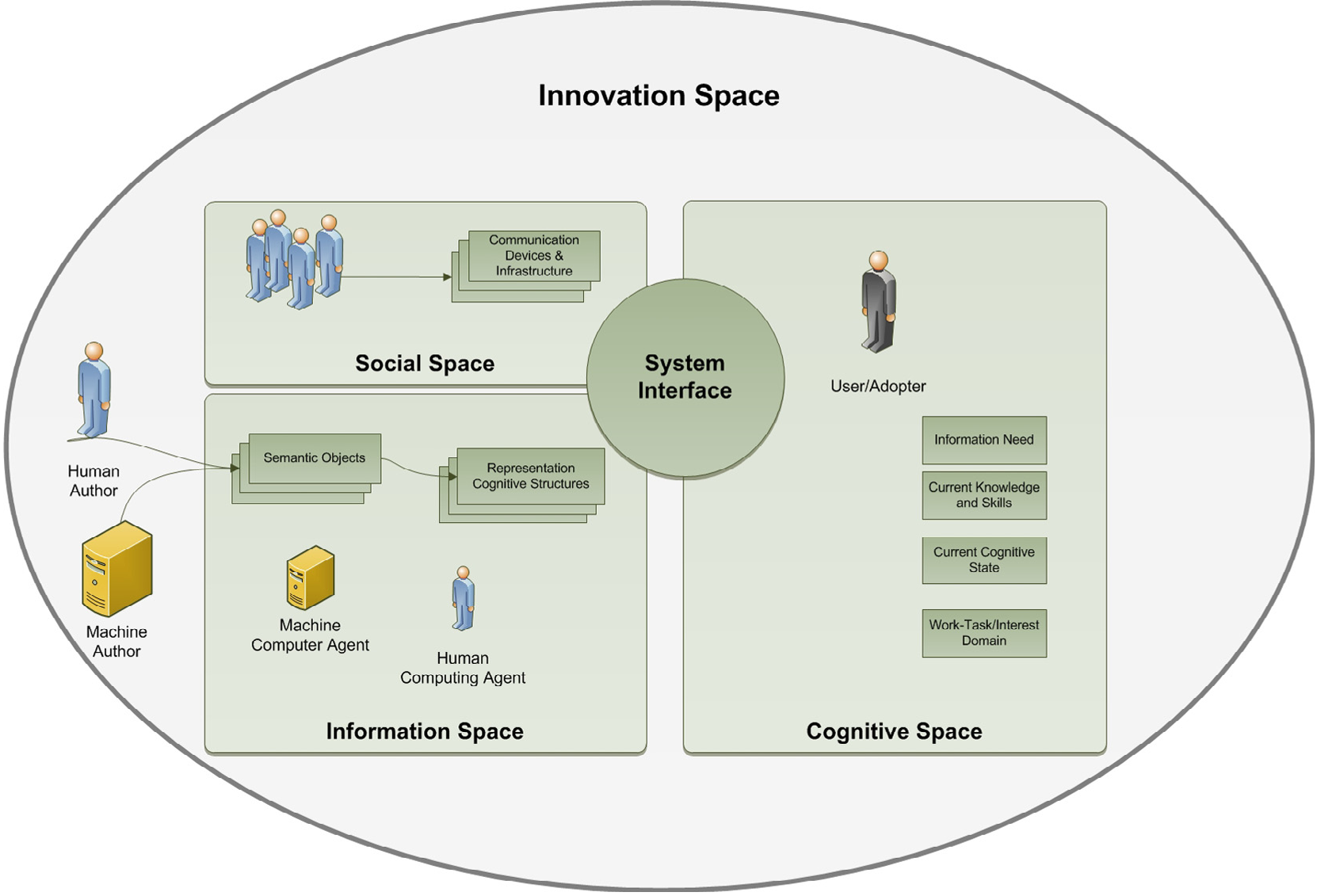
The author introduces the Innovation Space, a holistic environment where factual data is processed through two distinct mirrors: the Information Space (digital systems) and the Social Space (human networks).
The New Mathematical Intuition
Building on Brookes' (1980) work, the study offers a symbolic formula for the General Knowledge Behavior:
- : The change in your knowledge structure.
- : Your current and newly learned skills (the tools).
- : Information from both the System () and the Social () spaces.
- The Operator: This represents the transformational application of skills/knowledge onto information.
This suggests that if two users receive the same information but have different Social Skills (), their resulting knowledge and ability to adopt the innovation will differ wildly.
Experiments & Core Insights: The "Social" Advantage
The paper highlights why the Social Space is faster and more adaptive than the Information Space:
- Reduced Authoring Latency: In a database, a "semantic object" (like a manual) takes months to write, edit, and index. In a "Google+ Hangout" or a "Quora" thread, expert knowledge is transformed into a semantic object in seconds.
- Serendipity: Social networks allow for "information encountering"—finding vital solutions by accident through loose ties (weak links), which structured queries rarely facilitate.
- Skill Triangulation: Adoption requires three types of skills, as shown in the second equation: (Systems skills + Social skills + Professional skills).

Critical Analysis & Conclusion
Takeaway
Success in disruptive innovation—whether it's the iPad in 2011 or Generative AI today—is not just about the "U" (User) and the "I" (Interface). It's about the "S" (Social). Adopters don't just need tutorials; they need "communities of practice" where they can exchange real-time feedback and bridge their cognitive gaps.
Limitations
The model is currently symbolic and qualitative. While it provides a brilliant conceptual map for "why" adoption fails, the next step (as the author notes) is to quantify these variables through empirical tracking of software adoption in schools.
Future Outlook
This work anticipates a future where search engines no longer just crawl websites, but crawl "social expertise," effectively merging the Information Space and Social Space into a single, unified cognitive assistant.