
Beyond the Innovation Lab: How Everyday Teams Turn Knowledge into Performance
Role of knowledge conversion and social networks in team performance
This study investigates the impact of knowledge conversion processes (SECI model) and social network patterns on the performance of 76 permanent work teams across private and public sectors. The research demonstrates that both knowledge management and networking significantly predict performance, but findings vary depending on whether team members or top management provide the evaluation.
TL;DR
In the modern workplace, teams are often hailed as the "engine room" of the organization. However, a significant study by Janhonen and Johanson reveals that the secret to their success isn't just what they know, but how they talk to each other and where their leaders look for help. By studying 76 permanent teams, the researchers found that while lively internal interaction is vital, "over-networking" outside the organization can actually hurt team performance.
Background Positioning: This work bridges a critical gap between static "Knowledge-Based Views" and dynamic "Social Network Theory," shifting the focus from elite R&D labs to permanent, everyday work teams in both public and private sectors.
The "Everyday Team" Dilemma
Most research on team performance focuses on "special" cases: high-stakes project teams or cutting-edge innovators. But what about the permanent teams in retail, healthcare, and administration?
The authors argue that these teams face a unique challenge. They aren't just one-off projects; they are the organizational structure itself. The friction arises because what management sees as a high-performing team (usually one that is cohesive and fits the hierarchy) differs from what team members experience as success (fluidity and effective knowledge use).
Methodology: The SECI Model Meets Social Networks
The researchers combined two major frameworks:
- The SECI Model: Nonaka’s classic cycle of knowledge conversion:
- Socialization (Sharing experiences)
- Externalization (Writing down insights)
- Combination (Using IT systems to merge data)
- Internalization (Learning by doing)
- Social Network Analysis (SNA): Measuring the "Density" of communication (how much members talk to one another) and "Ego-networks" (who the leader and members talk to outside the team).

Key Insights: "Teamarchy" Over "Boundaryless"
The study’s most provocative finding is the birth of what could be called "Teamarchy."
Contrary to the "boundaryless organization" hype of the late 2000s, this study suggests that teams thrive when they are somewhat "selfish."
- Internal Strength: Teams with high "Network Density" (everyone talking to everyone) were rated higher by both members and top management.
- Leader as Gatekeeper: Performance is boosted when the team leader has strong ties within the broad organization (intra-organizational), but performance drops when leaders spend too much time on inter-organizational ties.
- The Cost of Networking: Externalizing knowledge to other organizations doesn't pay off for the team; it drains time and energy without immediate local reward.
Experimental Performance Breakdown
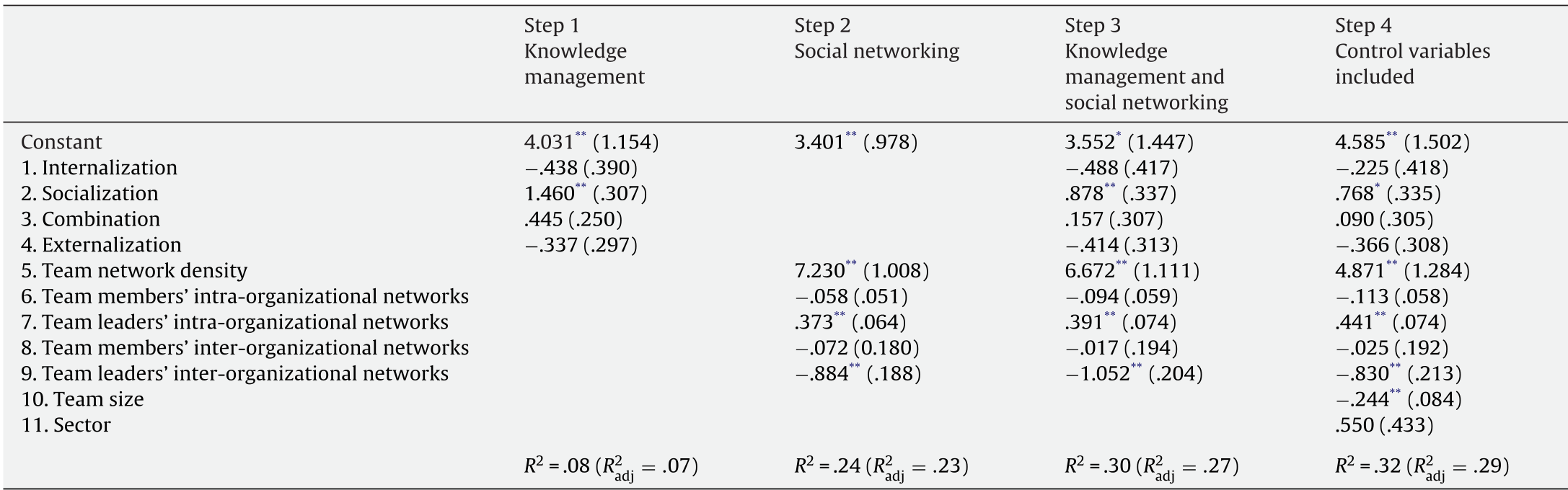
The researchers used a regression analysis to see which factors actually moved the needle on performance.
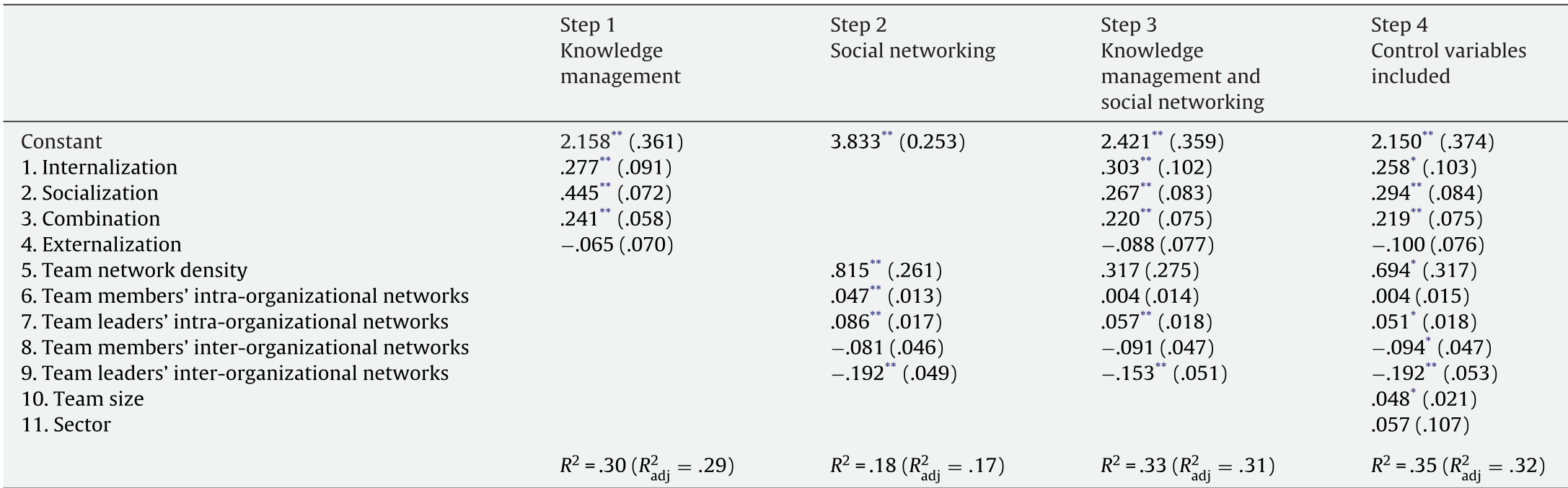
- For Team Members, nearly all knowledge processes (Internalization, Socialization, Combination) are critical. They value the tools and the learning.
- For Top Management (see Table 3), the view is simpler: they value Socialization and internal network density. They correlate "unity" with "performance."
Critical Analysis & Takeaways
The Rise of the "Selfish Team"
The study highlights a danger: teams that are highly effective internally often become isolated from the host organization. Because only 6% of participants felt they were rewarded for sharing knowledge outside their group, teams naturally prioritize their own "teamarchy" over organizational "common good."
Practical Guidance for HR and Managers:
- Small is Beautiful: Both models showed that smaller team sizes significantly improve performance scores.
- Protect the Leader’s Internal Ties: Ensure team leaders are connected to other departments and experts within the company, but don't force them into external stakeholder management unless absolutely necessary for the task.
- Incentivize Knowledge Flow: To stop "lessons learned" from staying trapped inside a team, management must create rewards for inter-team externalization.
Conclusion
This study proves that performance in everyday teams is a delicate balance of internal cohesion and selective external navigation. While "Socialization" is the universal driver of success, the negative impact of external inter-organizational ties serves as a warning: sometimes, keeping your head down and talking to your teammates is the most productive thing you can do.
Limitations: The study relies on subjective evaluations rather than objective financial metrics (like sales growth), though the authors argue that subjective measures correlate strongly with objective outcomes in these contexts.