
Knowledge Discovery in the Age of Big Social Media: A Key-Value Approach
Knowledge Discovery from Big Social Key-Value Data
This paper presents a big data science solution for social network analytics specifically designed for social entities stored in key-value databases. The authors leverage the MapReduce framework and cloud computing to discover interesting patterns, such as influential users and connection depths, within massive social networks like Twitter and Facebook.
TL;DR
In the era of the "5V's," traditional databases fail to keep up with the explosive growth of social network linkages. This paper introduces a specialized big data science solution that reimagines social relationships (likes, follows, and friendships) as Key-Value pairs. By deploying this model on cloud clusters using Hadoop and Spark, the authors achieved up to an 8x speedup in mining complex social patterns from real-world datasets like Twitter and Facebook.
Problem & Motivation: The 5V Challenge
The sheer volume and velocity of social media data—think of Facebook's 1.79 billion users or Twitter’s intricate follower webs—make standard analytical tools obsolete. The authors identify two primary types of interdependencies that modern systems must handle:
- Directional (Follow/Subscribe): User A follows User B, but the reverse isn't necessarily true (e.g., Twitter).
- Bi-directional (Mutual Friendship): User A and User B are linked symmetrically (e.g., LinkedIn, Facebook friends).
Existing methods often focused on Community Detection via clustering, but the industry needs more granular insights: Who is the most popular? Who is the most "isolated"? How many "friends-of-friends" does a specific marketing target have? Handling these queries requires a representation that is both space-efficient and natively parallelizable.
Methodology: Social Logic in Key-Value Stores
The core innovation lies in mapping social graph theory onto Key-Value (KV) databases. This transformation allows the system to leverage the MapReduce model for massive parallelism.
1. Representing Directional Relationships
A follow relationship is stored where the follower is the Key and the followee is the Value. To find the most "popular" followee (the person with the most followers), the system performs a simple but powerful "Swap" operation:
- Map Phase: Swaps
(Follower, Followee)to(Followee, Follower). - Reduce Phase: Groups by the new Key (Followee) and counts the occurrences.
2. Optimizing Mutual Friendships
For symmetric friendships (), a naive approach stores both and . The authors propose an Improved Approach that eliminates duplicates, effectively halving the storage requirement from to .
3. Solving the k-th Degree Connection Problem
One of the paper's more sophisticated contributions is generalizing social distance. By implementing shortest-path logic (based on Dijkstra’s intuition) within a distributed KV framework, they can identify:
- 1st Degree: Direct friends.
- 2nd Degree: Friends-of-friends.
- k-th Degree: Long-range influencers or "isolated" nodes at the network periphery.
Experiments & Results: Cloud-Powered Velocity
The authors tested their solution using the Stanford Network Analysis Project (SNAP) datasets on an Amazon EC2 cluster (11 m2.xlarge nodes).
- SNAP ego-Twitter: ~1.7 million relationships.
- SNAP ego-Facebook: ~88k friendships.
Key Performance Insights:
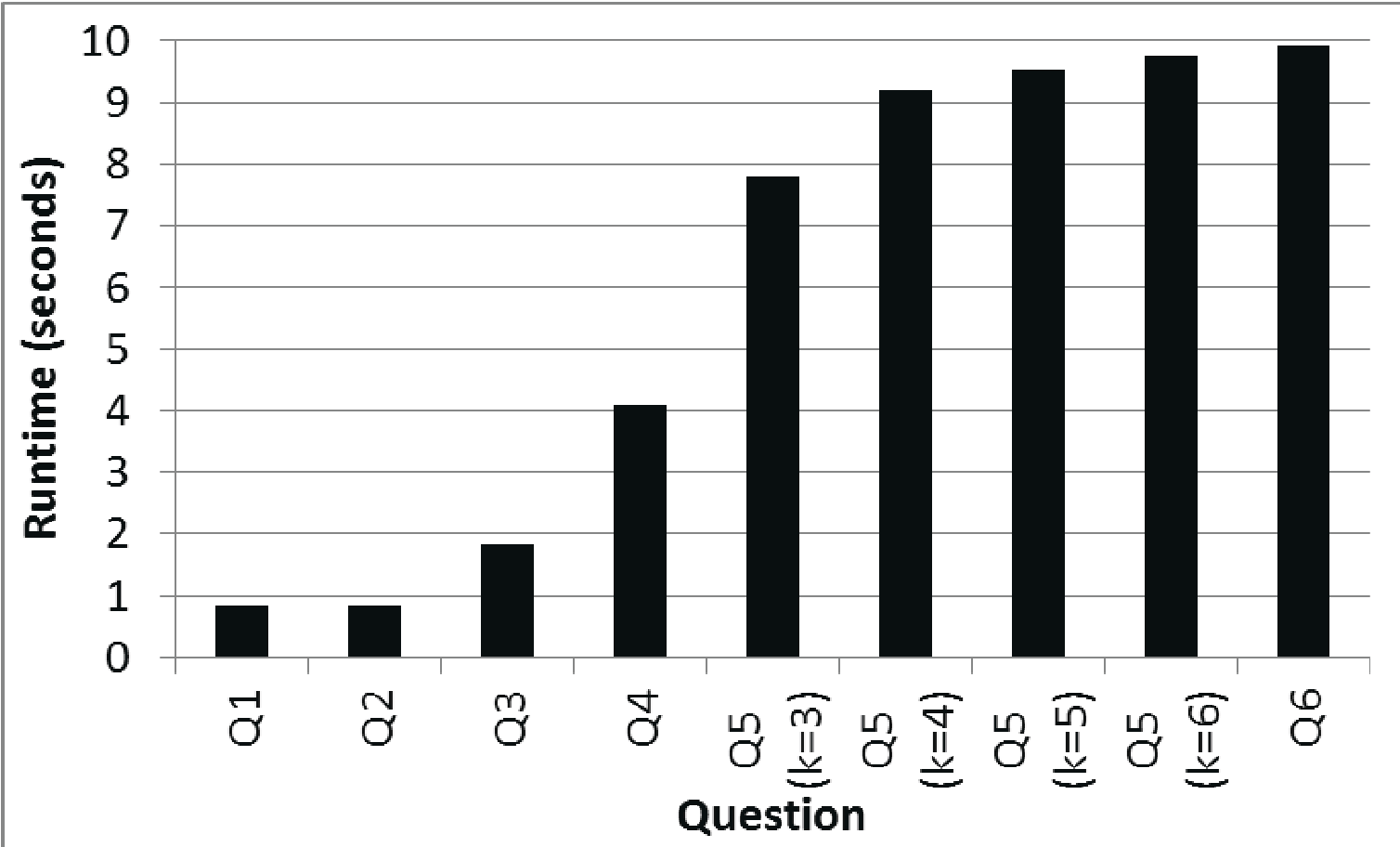
- Massive Speedup: The cloud-based solution was 6x faster for Twitter analytics and 7-8x faster for Facebook queries than a high-end single-machine setup.
- Scalability: The runtime remained stable and scaled linearly as more social entities were added, proving that the KV representation correctly exploits the Inductive Bias of distributed computing.
- Versatility: The system successfully identified "most isolated" users (6th-degree connections) which is historically a computationally expensive task on large graphs.
Deep Insight & Conclusion
The genius of this work isn't just in "using the cloud," but in the mathematical reduction of graph problems into KV problems. By treating a social network as a set of key-value associations rather than a giant adjacency matrix, the authors unlock the ability to use standard big data engines (Hadoop/Spark) to solve complex graph theory problems.
Takeaway for Industry: For businesses looking to identify "Targeted Customers" or "Influencers," this methodology offers a blueprint for building scalable recommendation engines without the overhead of specialized graph database hardware.
Limitations: While efficient, the current model relies on shortest-path algorithms that may still face "shuffle" bottlenecks in MapReduce as (the degree of connection) becomes very large. Future research into Graph Neural Networks (GNNs) might further refine how these KV pairs are embedded for even faster inference.