
Empowering Educators: A Knowledge-Driven Approach to Student Success in Credit-Based Systems
A Knowledge-Driven Educational Decision Support System
The paper introduces a Knowledge-Driven Educational Decision Support System (EDSS) specifically designed for universities utilizing a semester credit system. It leverages Educational Data Mining (EDM) techniques, such as J48 classification and k-means clustering, to provide actionable insights for managing students with poor academic performance.
TL;DR
In the landscape of modern higher education, the flexibility of the semester credit system is a double-edged sword. While it allows for personalized learning, it creates massive data complexity for administrators. This paper presents a Knowledge-Driven Educational Decision Support System (EDSS) that uses data mining to predict student outcomes with over 97% precision, helping managers decide when to offer a second chance and when to advise a change in path.
The Challenge: Flexibility Breeds Complexity
Most decision support systems are "data-driven"—they show you what happened (e.g., a student failed 3 classes). However, they lack the "knowledge" to explain what will happen next.
In a credit-based system, students take different paths. A student might fail a course because it was part of a difficult combination or because they are nearing a "drop-out" threshold. Prior works often ignored two critical factors:
- Curriculum Evolution: Programs change every few years, making old data models obsolete.
- The "Missing Part": It is hard to distinguish if a student hasn't taken a class because they are failing or because they are strategically delaying it.
Methodology: Mining for Actionable Knowledge
The authors propose a three-tier architecture (Presentation, Business Logic, and Storage) that moves beyond simple charts.
1. Handling Heterogeneity
To solve the problem of changing curriculum versions, the system maps equivalent courses across different academic years. This creates a unified data manifold that allows the model to compare a student from 2005 with one from 2024.
2. The Intelligence Phase
The system focuses on two "What-If" scenarios for students on the brink of dismissal:
- Classification & Trend Analysis: Using J48 decision trees and k-means clustering, the system predicts if a student can actually finish the program.
- Association Rule Mining: Using the Apriori algorithm, the system identifies "poisonous" course combinations. If a data set shows that 90% of struggling students fail when taking "Advanced Calculus" and "Physics II" together, the EDSS will warn managers to prevent that specific registration.
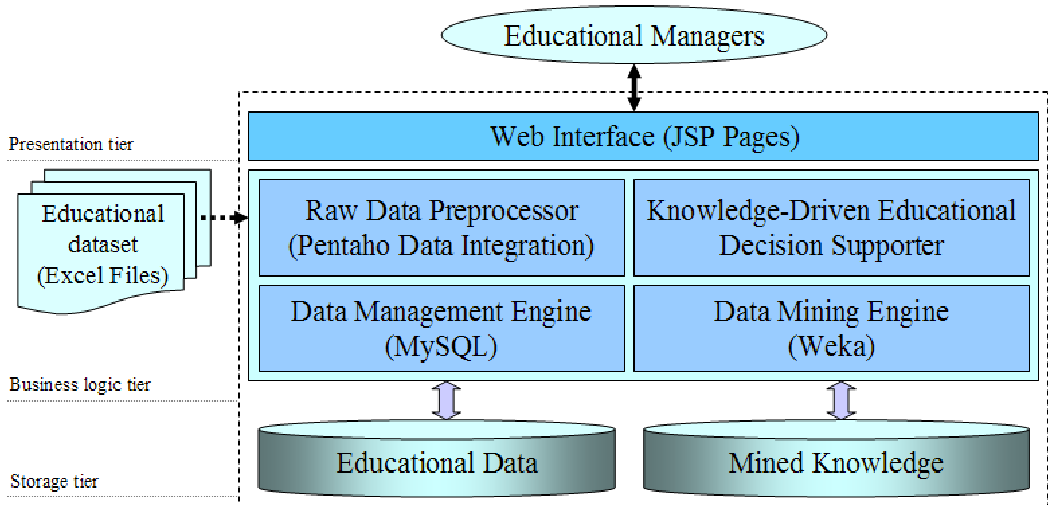 Figure 1: The component-based architecture of the proposed EDSS, highlighting the integration of the Weka mining engine.
Experimental Results
The system was tested on a dataset of 1,348 students and over 64,000 academic records.
- Classification Accuracy: The J48 model achieved a 97.06% precision in categorizing student statuses (Complete, Drop-out, Warning, etc.).
- Trend Prediction: The clustering approach achieved 93.07% precision in predicting whether a student’s performance would trend upward or downward in the following semester.
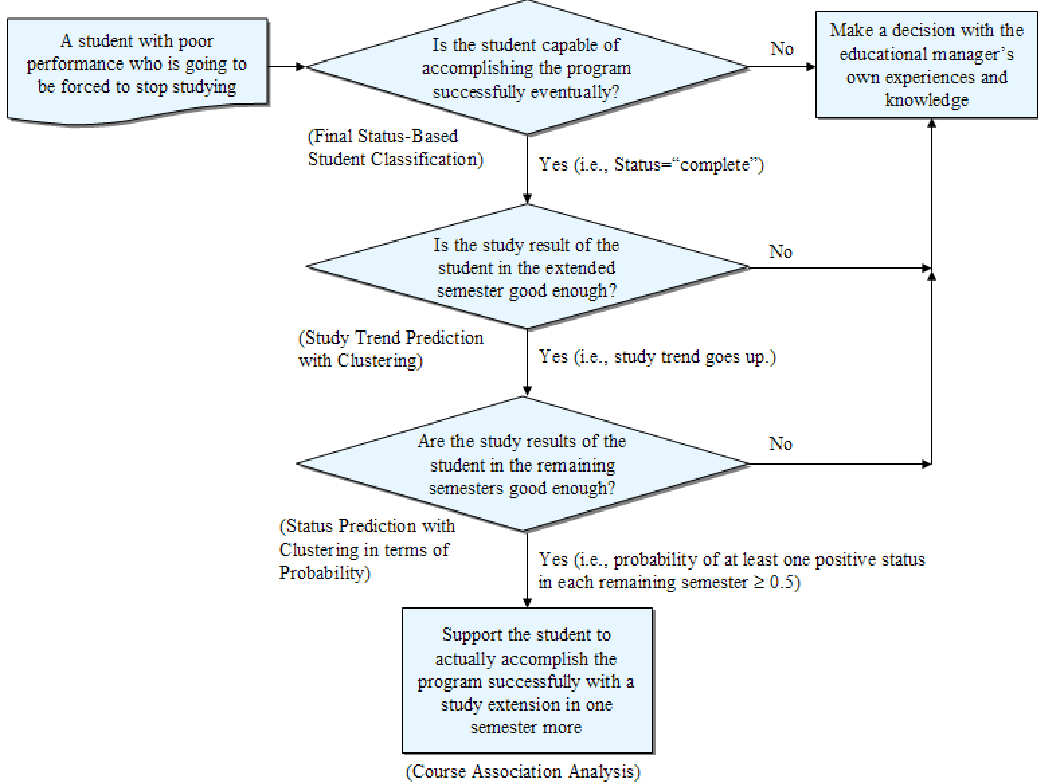 Figure 2: The logic flow for determining student study extensions based on predicted capability and course registration optimization.
Critical Insights & Future Outlook
The true value of this work lies in its Actionable Knowledge. Instead of just flagging a student as "at risk," the system provides a roadmap: "This student is likely to succeed if they do not take these three specific courses together next semester."
Limitations:
- The system currently relies on manual data uploads (Excel files), which lacks real-time capability.
- The models used (J48, Apriori) are robust but may struggle with the very high-dimensional, non-linear patterns that more modern Deep Learning (like RNNs or Transformers) could capture.
Conclusion: By treating educational data not just as numbers but as a "knowledge-intensive endeavor," the authors provide a blueprint for reducing the waste of time and money for both students and universities. The next step for this field will be moving from predefined problems to unstructured problem solving through autonomous machine learning.