
Knowledge Dynamics: Decoding the "Black Box" of Regional Innovation Clusters
Knowledge Dynamics in Regional Economies: A Research Framework
This paper introduces a hybrid research framework combining Social Network Analysis (SNA) and System Dynamics (SD) to map and simulate knowledge dynamics within regional clusters. It focuses on how firm-level "absorptive capacity" and specific network roles like "technological gatekeepers" drive innovation and sustainable learning patterns in regional economies.
TL;DR
The success of innovation hubs like Silicon Valley isn't just about being in the same neighborhood; it's about the invisible plumbing of knowledge flows. This paper provides a rigorous framework using Social Network Analysis (SNA) to map who talks to whom and System Dynamics (SD) to simulate how knowledge "stocks" grow over time. The core takeaway? A cluster’s health depends on "Technological Gatekeepers" and the "Absorptive Capacity" of its individual firms.
Problem & Motivation: Beyond the "Knowledge in the Air" Myth
For decades, economists relied on Alfred Marshall’s idea that knowledge is "in the air" in industrial districts. However, this fails to explain why some firms in the same city thrive while others stagnate.
The authors argue that knowledge diffusion is not a passive spillover. Instead, it is a complex, active process hindered or helped by:
- Absorptive Capacity: If a firm doesn't have a baseline of prior knowledge, it literally cannot "see" or use the innovation happening next door.
- Network Topology: Knowledge doesn't flow evenly; it follows specific social and professional paths.
- The Tacit vs. Codified Gap: Tacit knowledge (know-how) still struggles to travel across digital wires without high-trust "Communities of Practice."
Methodology: The SNA + System Dynamics Toolkit
1. Mapping the Players (SNA)
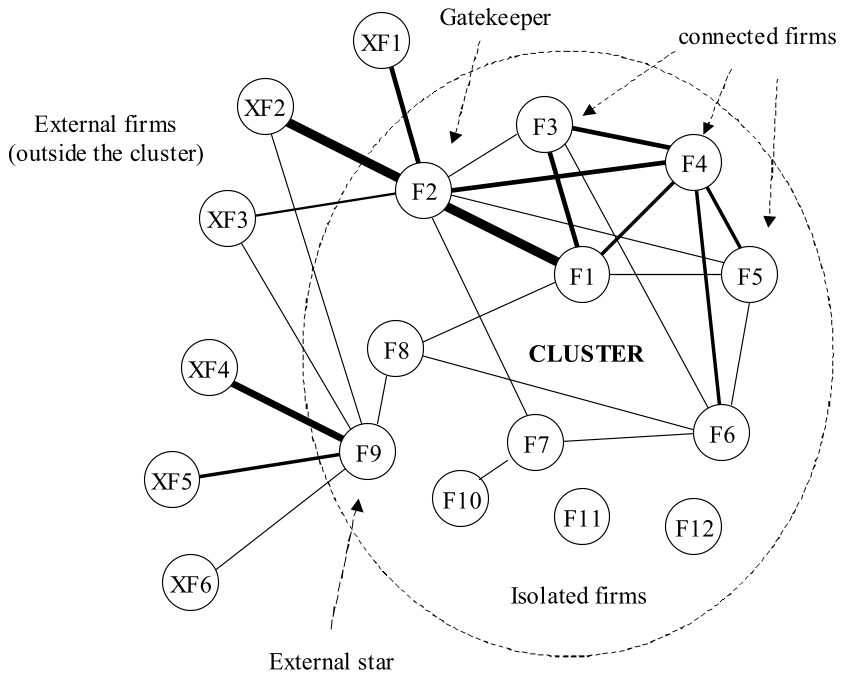
The methodology first uses SNA to categorize firms. By measuring Centrality (Degree, Betweenness, and Closeness), the framework identifies key personas:
- Technological Gatekeepers: The "heroes" of the cluster who connect local firms to global external knowledge.
- External Stars: Knowledgeable but isolated—they talk to the world but not their neighbors.
- Isolated Firms: Risk becoming obsolete as they lack both local and global connections.
2. Simulating the Flow (System Dynamics)
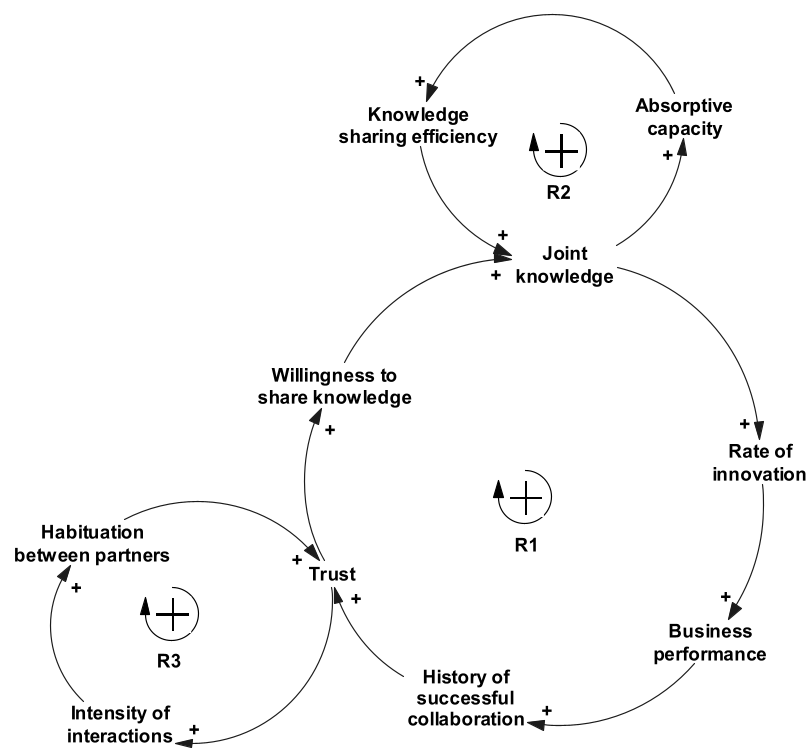
Once the map is drawn, System Dynamics takes over. Unlike physical goods, knowledge isn't "depleted" when shared. The authors model this using Causal Loops.
For instance, Loop R2 (Double-Loop Learning) shows a "success breeds success" cycle: as a firm acquires knowledge, its absorptive capacity increases, making it even more efficient at acquiring the next wave of knowledge.
The Role of ICT: Shifting the Knowledge Frontier
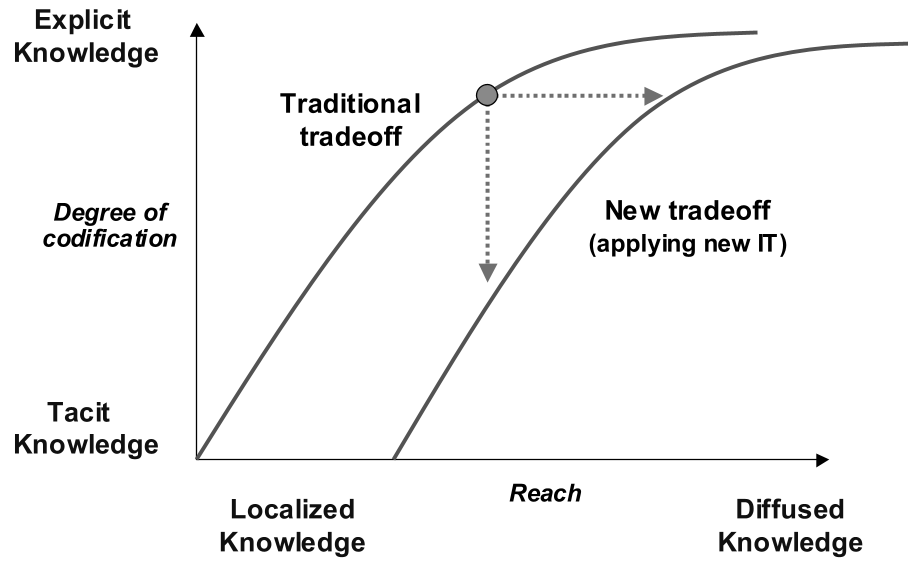
One of the paper's most insightful sections explores how Information Technology changes the "Codification vs. Reach" trade-off.
- Traditional View: To reach more people (Reach), you must simplify and codify knowledge (losing context).
- The ICT Shift: Modern tools allow high-context, tacit-like communication to reach larger groups simultaneously, potentially weakening the "geographical lock" of traditional clusters.
Critical Insight & Conclusion
Takeaway for Policy Makers
Don't just build a "Science Park" and hope for the best. Policy should focus on:
- Increasing the Absorptive Capacity of SMEs through education and R&D incentives.
- Empowering Institutional Gatekeepers (trade associations, tech-transfer centers) to bridge the gap between "External Stars" and the local network.
Limitations
The framework assumes a relatively stable network structure. In highly "turbulent" or "chaotic" markets (Emergent Order), the authors suggest that Agent-Based Modeling (like SWARM) might be more appropriate than System Dynamics, as it allows for the spontaneous creation and destruction of links.
Future Outlook
As we move into the era of AI-driven knowledge management, this framework provides the foundational logic for how digital "expertise locators" and automated "gatekeepers" might finally dissolve the remaining barriers to regional innovation.